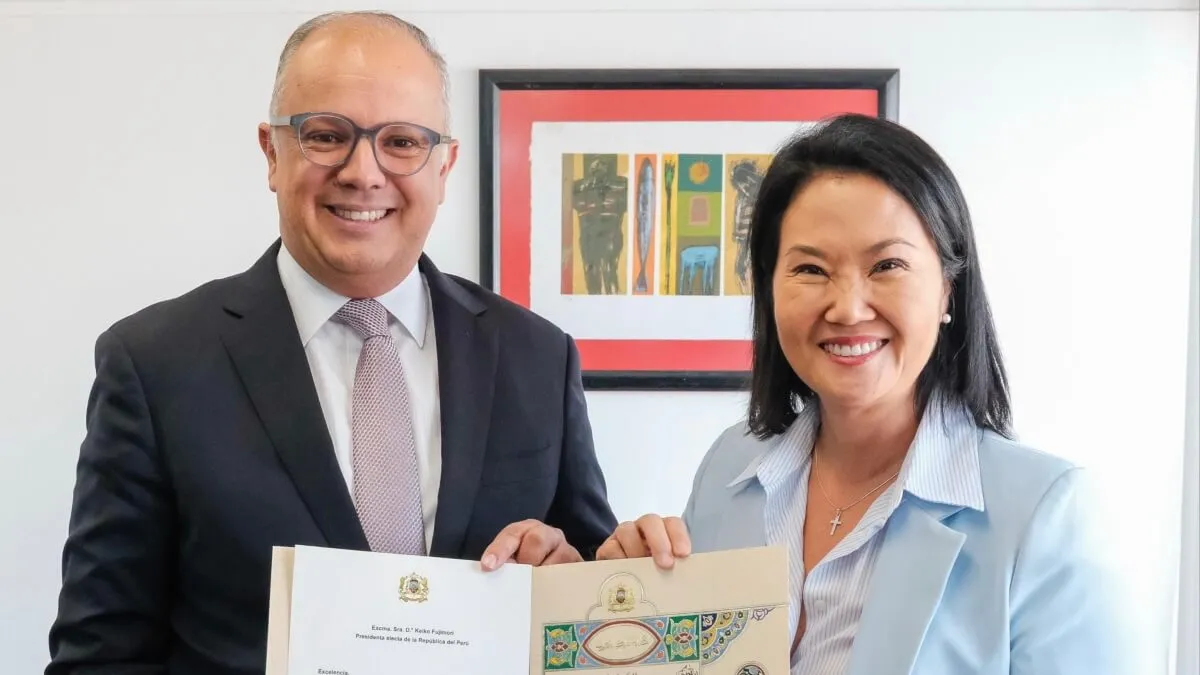

In a significant move that underscores her foreign policy priorities, Peru's newly elected president, Keiko Fujimori, has articulated her administration's clear support for Morocco's territorial integrity and its proposed autonomy plan for the Sahara region. This decision was publicly announced during a cordial meeting with the Moroccan ambassador to Peru, Amine Chaoudri, who delivered a congratulatory letter from King Mohammed VI, marking the beginning of a promising diplomatic relationship between the two nations.
During this pivotal meeting, President Fujimori conveyed her government's intent to endorse Morocco's autonomy initiative, which is recognized under UN Security Council Resolution 2797 as a viable framework for resolving the longstanding territorial dispute in the Sahara. The Moroccan monarch's letter praised Fujimori's election, emphasizing the strong ties between Morocco and Peru, built on mutual respect and shared values, and expressed a commitment to enhancing bilateral relations toward a multifaceted partnership that benefits both countries.
The new president's stance represents a clear departure from the ambiguity that characterized her predecessors' policies regarding the Sahara issue. Historically, Peru has wavered between supporting and distancing itself from the Polisario Front, which claims independence for Western Sahara. This shift can be traced back to the administration of President Fernando Beláunde Terry, who recognized the Sahrawi Arab Democratic Republic in 1984, followed by Alan García, who established formal diplomatic relations in 1987. These relations remained until 1996 when Alberto Fujimori, Keiko's father, severed ties, leaving a legacy of uncertainty that persisted through successive administrations.
In contrast, the recent presidency of Pedro Castillo had attempted to revive diplomatic relations with the Polisario Front, but this was met with conflicting actions from his ministers and ultimately led to a complicated diplomatic scenario. His brief tenure ended amidst a political crisis that saw him ousted from power. Following him, Dina Boluarte's administration maintained a status quo of ambiguity until suspending ties with the Polisario Front in September 2023, yet refraining from endorsing Morocco’s autonomy plan.
With Fujimori's ascent to the presidency, there is a palpable sense of a return to her father's policy of supporting Morocco's claims over the Sahara. Her administration is expected to not only reaffirm this support but also actively promote Morocco's sovereignty and the autonomy initiative as the foundation for a lasting resolution to the conflict.
This evolution in Peru's foreign policy aligns with Morocco's proactive diplomatic efforts across Latin America, where the Polisario Front has historically received considerable backing. Morocco's initiatives, focusing on economic, cultural, and academic collaboration, have fostered closer ties with various nations in the region, thus reinforcing its strategic influence as a gateway between Africa, Europe, and the Arab world. This has resulted in several countries retracting their recognition of the Sahrawi Arab Democratic Republic, indicating a shift in regional dynamics that could favor Morocco's position.
As reported by atalayar.com.