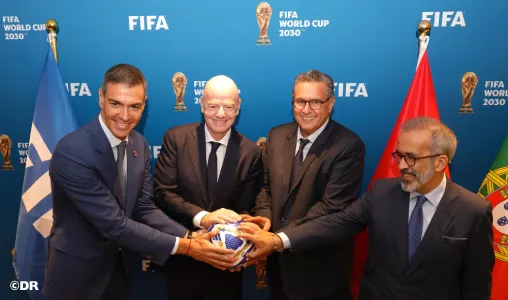

In a significant political development, Portugal’s left-wing party, Livre, has formally requested the exclusion of Morocco from the joint hosting of the 2030 FIFA World Cup. This call arises in the wake of the recent migration crisis in Ceuta, which has severely impacted the region. The tournament is slated to be co-hosted by Morocco, Portugal, and Spain; however, Livre advocates that the event should be held solely in Portugal and Spain, excluding Morocco altogether.
In an open letter directed to Portuguese Prime Minister Luís Montenegro and the President of the Portuguese Football Federation, Pedro Proença, the party has accused Morocco of exploiting vulnerable migrants amid the recent surge of migration to Ceuta, a city under Spanish occupation. The five lawmakers representing Livre articulated that Morocco's involvement in the hosting of the tournament has become “unsustainable.” They accuse the Moroccan government of violating international law and human rights, highlighting that the nation has played a significant role in facilitating the mass movement of migrants towards Ceuta.
The crisis has reportedly led to numerous fatalities, with earlier reports indicating that at least 75 individuals lost their lives, while more recent data from Ceuta authorities suggest the death toll has risen to 88. The mass migration attempt witnessed tens of thousands of people striving to reach Ceuta, prompting Moroccan officials to claim that misinformation and the misinterpretation of a Spanish court ruling had inadvertently fueled the situation. They argued that these factors created false expectations among migrants regarding their potential status once reaching Ceuta by sea, suggesting that they would not be sent back. Moroccan authorities asserted that they have taken measures to deploy security forces aimed at curbing irregular migration.
Despite these assertions, Livre maintains that Portugal should not endorse what it describes as the normalization of border violence, human rights abuses, and the political exploitation of marginalized populations. The party has urged not only the governments of Portugal and Spain but also the European Union and UEFA to affirm that only Portugal and Spain should host the upcoming World Cup. Furthermore, they have called for a collaborative approach between the Portuguese government and football federation and their Spanish counterparts to establish a unified position regarding the tournament.
This is not the first time that Livre has expressed concerns regarding Morocco's role in the World Cup hosting arrangement. During the bidding process, the party raised alarms about Morocco’s policies in relation to Western Sahara and highlighted long-standing human rights violations attributed to the Moroccan government. In a statement to the Portuguese public broadcaster RTP, a spokesperson for Livre, Jorge Pinto, emphasized that the recent events in Ceuta represented “the last straw.” He characterized the migration crisis as part of a larger trend where migrants are used as pawns for political leverage.
Pinto drew parallels between the current situation and previous instances involving the governments of Turkish President Recep Tayyip Erdoğan, Russian President Vladimir Putin, and Belarusian President Alexander Lukashenko, alluding to their tactics of utilizing migration for political gain. He also critiqued FIFA’s governance under President Gianni Infantino, questioning the transparency of the selection process for World Cup host nations.
Initially, Portugal and Spain had considered including Ukraine in their joint bid for the 2030 World Cup; however, following the onset of war, Morocco joined the bid as a substitute host. Meanwhile, Morocco is progressing with the construction of the Grand Stade Hassan II in Casablanca, a colossal stadium expected to accommodate 115,000 spectators, potentially positioning Morocco to host the final match of the 2030 World Cup.
As reported by moroccoworldnews.com.