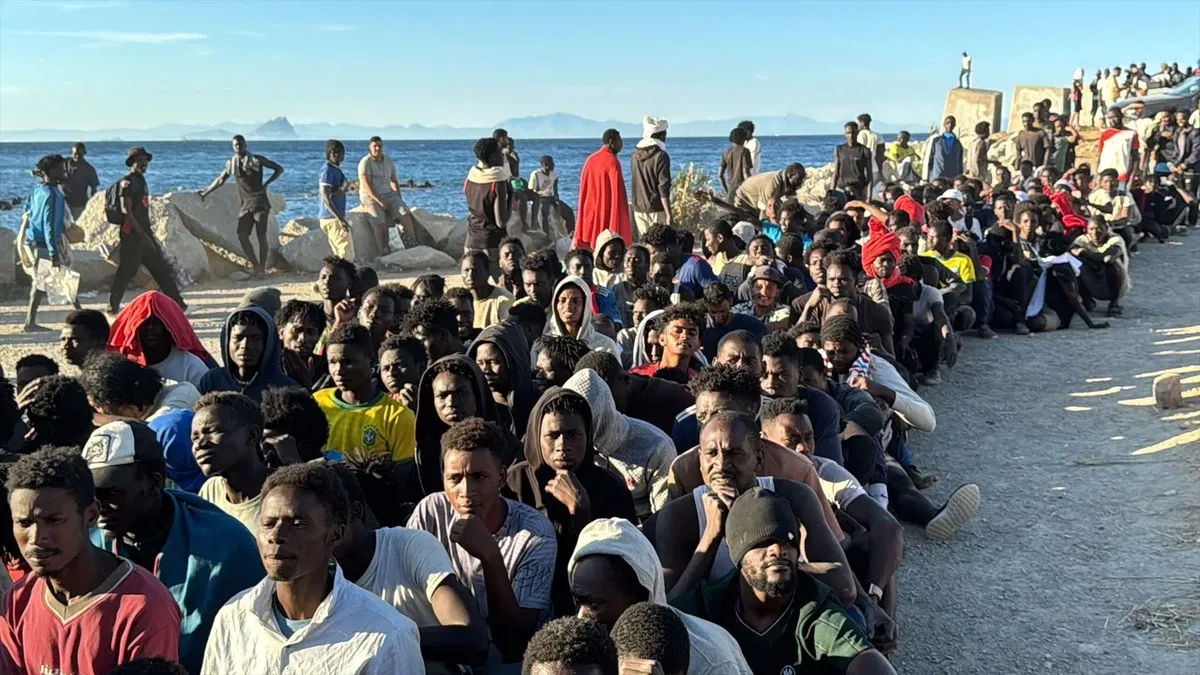

The prospect of new irregular migration attempts to Ceuta has resurfaced, particularly with the emergence of calls indicating September 23rd as a potential date for mobilization from Morocco. This date coincides with Morocco's legislative elections, a context that appears to be linked to messages circulating through various communication channels and groups.
Currently, there is no confirmation that a new mass entry will occur, nor is it certain that the mobilization will materialize. Reports suggest that any potential mobilization is likely to be less intense than the one observed at the end of July. However, the reliability of these messages cannot be entirely dismissed, and they may also be part of a strategy aimed at wearing down local authorities.
September 23rd emerges as a new date following a previous call for mobilization on August 15th, which did not result in a mass entry. Prior to that date, various messages circulated on social media and messaging apps, pinpointing August 15, 2026, as the chosen day for attempting to cross from Morocco to Ceuta. These posts, primarily written in Darija, referenced Castillejos (Fnideq) and Ceuta, encouraging interested individuals to join different messaging groups.
Previous Predictions Did Not Materialize
Some of the posts employed phrases like 'Our last opportunity,' while others referred to an appointment for that day. One shared screenshot claimed that around 1,000 people had joined one of these groups, even announcing the creation of a second group. Ultimately, August 15th passed without a repetition of the mass entry observed on July 30th. On that day, the police pressure exerted by Morocco on groups attempting to approach the border, coupled with the Spanish forces deployed around the Tarajal perimeter, helped maintain control over the situation.
Nevertheless, following that call, new messages have emerged indicating a new date, with September 23rd mentioned as a possible day for another entry attempt into Ceuta. Other dates have also circulated, with some content including false information or disinformation.
The selected date aligns with Morocco's legislative elections, officially scheduled for September 23rd, where 395 members of the House of Representatives, the lower house of the Moroccan Parliament, will be elected. The electoral campaign is set to commence on September 10th and conclude on the 22nd, the day before the elections.
This will mark the sixth legislative election during the reign of King Mohammed VI. The current House of Representatives is controlled by a coalition led by Moroccan Prime Minister Aziz Akhannouch. The political and social context of the country is also linked to some of the discussions surrounding migration issues. Among the primary challenges facing Morocco are immigration, youth unemployment, and economic prospects. The Justice and Development Party (PJD), one of the main opposition parties, has called for an investigation into the exodus towards Ceuta.
Social Media's Role in Previous Entries
The new calls for mobilization come after social media and messaging applications played a significant role in the movements observed prior to the migration crisis at the end of July. On July 27th, just days before the mass entry, public Facebook groups were detected being used to share information related to potential irregular entries to Ceuta. One of these groups, titled 'Hraga Ceuta,' had over 20,000 members at the time.
Within their posts, one could find Google Maps screenshots measuring distances in the area of the breakwater and coastline, information regarding sea conditions, photographs of the shoreline, and materials related to crossings. There were also advertisements for the sale of diving fins and inquiries from users about the situation at the border and in Castillejos before embarking on a possible crossing.
In the days leading up to July 30th, messages, videos, and audio recordings circulated, urging individuals to gather in the Castillejos area to attempt access to Ceuta. This mobilization culminated in a mass entry at various points along the coast, particularly in the area of the Tarajal breakwater, creating significant pressure on the city and prompting a deployment of the National Police, Civil Guard, Army, and emergency services.
Following those events, new calls for mobilization began circulating, first for August 15th and now with September 23rd as a potential new date. It remains uncertain whether this new call will lead to another entry attempt and what its scope might be. All indications suggest a mobilization that could be less intense than that observed at the end of July, although various possibilities regarding the evolution of messages disseminated on social media and messaging apps remain open.
The upcoming date also coincides with a period of heightened activity in Morocco due to the upcoming legislative elections. For now, September 23rd is appearing on certain channels as a potential day of mobilization towards Ceuta, with no confirmation of a new mass entry taking place.
As reported by antena3.com.