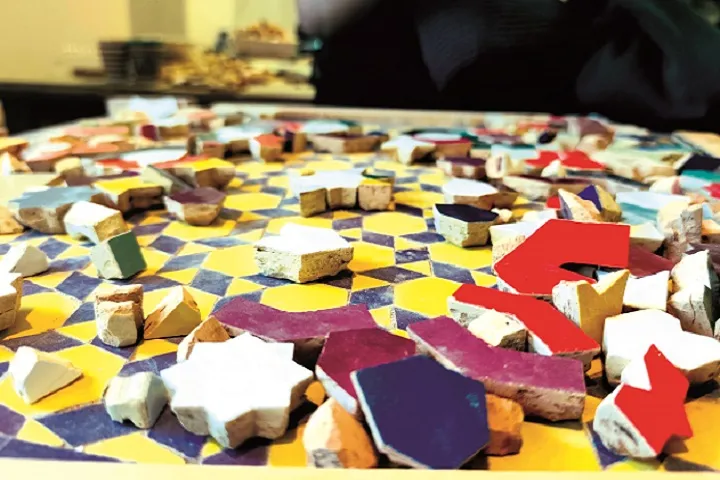

Understanding the Art of Zellige in Moroccan Architecture
The intricate art of zellige, a mosaic tilework technique synonymous with Moroccan architecture, embodies a profound narrative of cultural heritage and craftsmanship. Within the historic city of Fes, zellige transcends mere decoration, transforming clay into a canvas of geometric poetry. This artistic journey begins from the earth itself, as craftsmen, known as "maâlem", channel their expertise to mold and shape raw materials into stunning visual displays. A visit to a zellige workshop reveals the meticulous processes involved, as reflected in the insights of Master Rashid, who emphasizes that the essence of this craft lies not just in the final product but in the arduous journey that starts with mixing the clay, known as "zuba", with water and flour, showcasing the labor and sweat that breathe life into the craft.
Moreover, the narrative of zellige extends beyond colors and patterns to include intricate geometrical shapes, each carrying a historical significance passed down through generations. As artisans wield their chisels, they transform plain squares into a vibrant world of forms, giving birth to pieces like "muthamman", "mawtah", "qafa", "dirham", and "muhadad" while showcasing shapes such as stars and almonds. Each piece, irrespective of its size, is meticulously placed within the mosaic, where precision is paramount, leaving no room for error. This transformation illustrates how the artisan evolves from a mere clay mixer to a mathematical engineer, crafting a cohesive visual story that highlights the meticulous beauty inherent in Moroccan architecture.
Dar Aamel: The Laboratory of Moroccan Craftsmanship
To truly appreciate the value of Moroccan zellige, one must step into the realm of Dar Aamel. This space is far more than a conventional workshop; it serves as a dedicated laboratory for the creation of zellige, covering an expansive area of approximately 600 square meters. Here, the sounds of clay colliding and water flowing resonate, as this space specializes in preparing the foundational elements of zellige before they proceed to the embellishment and cutting stages. Master Rashid elaborates that the location of Dar Aamel is intentionally selected to be in proximity to the original gray clay sources of Fes, designed to optimize air circulation and water flow, crucial for the clay's initial stages before it is subjected to fire.
The process commences with the extraction of clay in its raw form, resembling hard rock masses that conceal the earth's secrets. According to Master Rashid, the first step involves manually breaking down this clay using iron hammers, reducing it into manageable pieces. The clay is then transferred to the "zuba", a spacious water basin where it is fully submerged to soften the mineral fibers and eliminate salts and impurities. When the clay settles at the bottom of the basin, a phase of rigorous labor ensues, where artisans immerse themselves in the task of kneading the clay with their feet, merging human effort with the earth itself. This physically demanding process not only tests the artisan's strength and patience but also ensures that every particle of clay is evenly compressed, preventing cracks during the firing stage.
Once the kneading is complete, the clay is allowed to rest and ferment, a critical stage that grants Fassi zellige its durability, capable of lasting for centuries. As the clay achieves optimal pliability, artisans utilize a "qala", a mold used for shaping traditional bricks. They carefully press the fermented clay into the mold, ensuring a consistent form. Utilizing a "muhaka", they flip the slightly dried clay to balance moisture evaporation from all sides before removing the pieces from the mold to dry naturally under the sun—a process that no modern machinery can replicate.
As reported by alalam.ma.