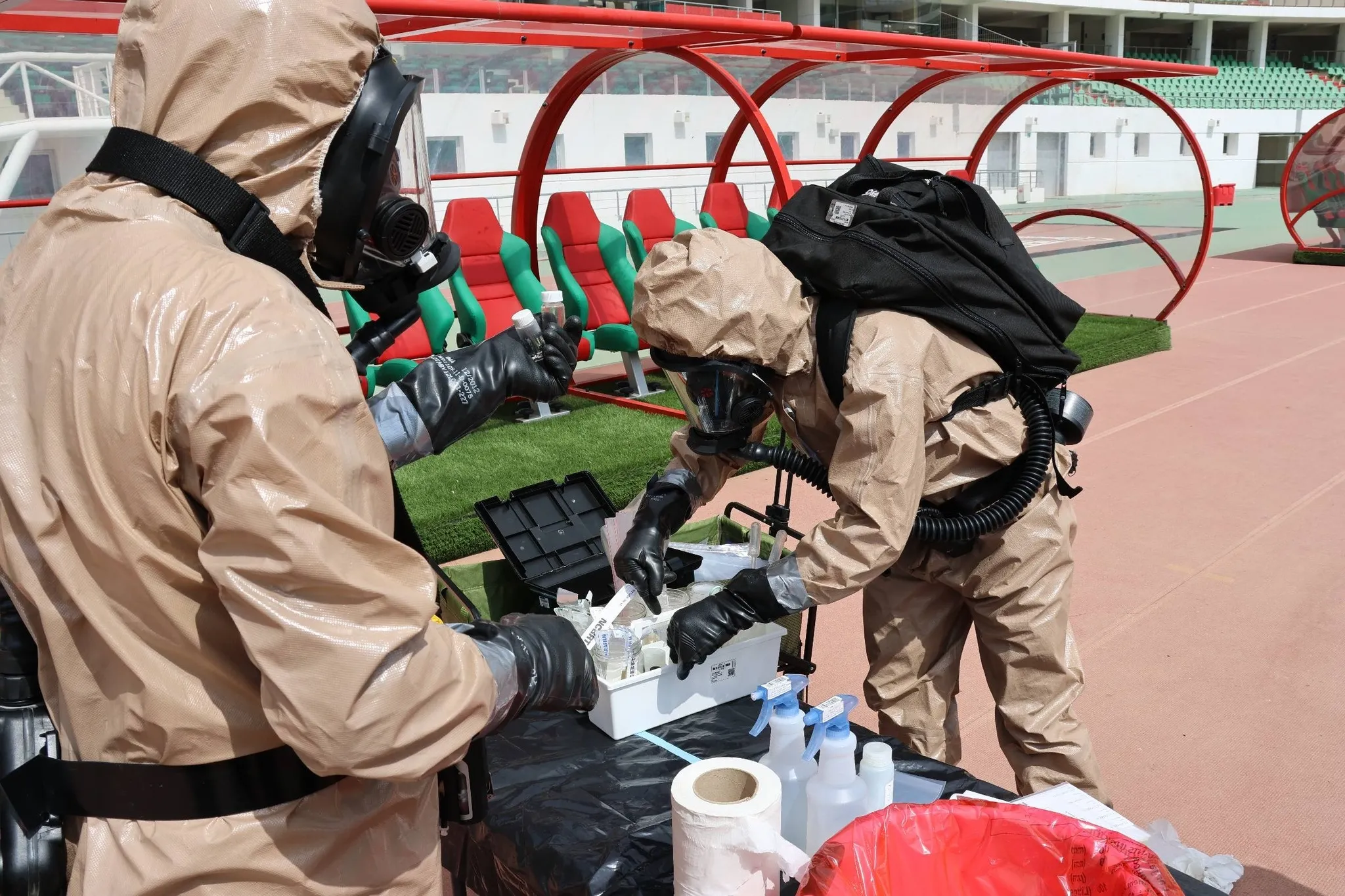

In a significant display of Moroccan-American military cooperation in disaster management, a counter-weapons of mass destruction (C-WMD) exercise took place on Tuesday at the Grand Stadium in Agadir. This training is part of the combined Moroccan-American exercise "African Lion 2026," which is conducted under the High Instructions of His Majesty the King, Supreme Leader and Chief of General Staff of the Royal Armed Forces.
The exercise simulated a scenario unfolding during a football match at a major continental event, with over 40,000 spectators in attendance at an urban stadium. A fire broke out in a store located southwest of the field, leading to panic among the crowd. At the same time, several spectators began exhibiting severe respiratory and skin symptoms, while Nuclear, Radiological, Biological, Chemical, and Explosive (NRBCE) detectors indicated the presence of a chemical agent near the stadium's technical infrastructures.
Amidst the chaos, a suspicious vehicle was discovered on-site. Shortly after, smoke was released to mimic the dispersal of a chemical agent, resulting in an explosion in a storage area of the stadium containing lubricants. This secondary explosion severely exacerbated the situation, increasing confusion and panic among the spectators and adding a layer of complexity to the ongoing incident management.
In response to the rapidly deteriorating situation, special forces were promptly deployed to identify, locate, and apprehend several hostile individuals involved in the unfolding events. Security services also reported the presence of a drone flying over the operational area, posing a potential threat to the intervention and the safety of responders. Consequently, the immediate need to neutralize this drone was initiated using an advanced anti-drone system.
During the intervention, a booby-trapped vehicle was discovered in the stadium's underground parking lot, designed to hinder rescue operations and cause casualties among responders. To address this threat, NEDEX (Neutralization, Removal, Destruction of Explosives) teams from both Moroccan and American units were engaged to safely handle the device using a teleoperated robot, prior to carrying out decontamination operations and aerial evacuation procedures.
Training scenarios of this nature are essential for testing the interoperability levels among various national and international responders in the field of NRBCE response, as well as for developing the capabilities to utilize drones and modeling tools in emergency management. Additionally, these exercises aim to evaluate inter-agency capabilities to detect, contain, and neutralize chemical threats in complex NRBC scenarios, validate the effectiveness of Standard Operating Procedures (SOPs) during NRBCE emergencies, and identify logistical, technical, medical, and communication challenges.
Initiated on April 27, the "African Lion 2026" exercise will continue until the 8th of this month across various locations, including Benguérir, Agadir, Tan-Tan, Taroudant, Dakhla, and Tifnit. By enhancing operational, technical, and procedural interoperability among participating armies, this largest exercise conducted in Africa remains a pivotal event for military personnel to exchange procedures and experiences, particularly in joint combined training and exercises.
This twenty-second edition exemplifies the enduring nature of cooperation between the Royal Armed Forces and the United States Armed Forces, reflecting the historical and robust ties that bind the two nations.
As reported by lareleve.ma.