
Rabat Hosts the 2026 Science Festival Focused on Health Efficiency
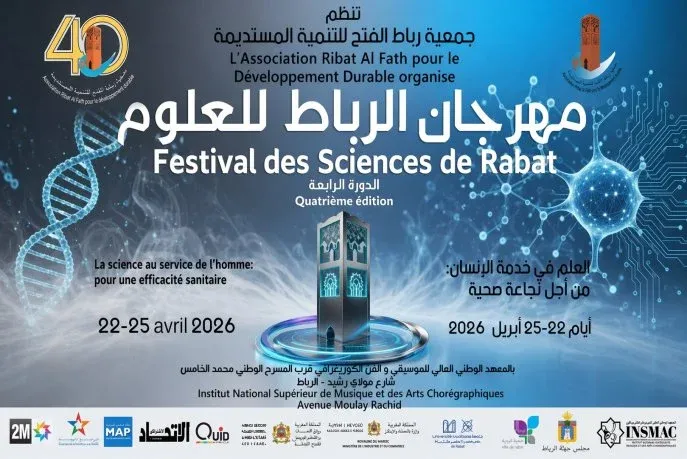
From April 22 to 25, 2026, Rabat will be the vibrant host of the fourth edition of the Science Festival, organized by the Ribat Al Fath Association for Sustainable Development at the National Institute of Higher Music and Choreographic Arts. This year's festival is centered around the theme of health efficiency, bringing together researchers, students, institutions, and experts to discuss crucial issues relating to health sovereignty, technological innovation, and the democratization of knowledge. A significant emphasis will be placed on involving youth and developing solutions that are tailored to local realities.
A National Priority in the Spotlight
The Moroccan capital is set to transform into a convergence space for science, innovation, and society over the four-day event. The festival aligns with a national momentum focused on modernizing the healthcare system and advancing scientific research as a strategic lever. By adopting the theme "Science Serving Humanity for Health Efficiency," organizers aim to highlight the pivotal role of scientific knowledge in enhancing public health policies. The event serves as both a space for reflection and a platform for experimentation, encouraging collaboration across disciplines. The concept of health efficiency is thus expanded beyond mere medical system performance, encompassing social, territorial, and technological dimensions.
The opening day on April 22 will set the tone for the festival, featuring notable institutional figures such as Abdelkrim Bennani, president of the Ribat Al Fath Association, Azzedine El Midaoui, minister of higher education, scientific research, and innovation, and Ryad Mezzour, minister of industry and commerce, who will inaugurate the Science Village. This kickoff event will showcase projects from about thirty clubs and associations from engineering schools, faculties, and high schools, presenting innovative technological solutions that are often developed in educational contexts but have practical applications in the health sector.
During the opening ceremony, speakers will discuss the challenges of health sovereignty and the necessity of strengthening synergies between academic research and industry. A plenary session will address the relationship between digitalization, scientific research, and social justice, establishing a foundation for the discussions to follow.
At the heart of the festival, the Science Village will be a primary interaction space for the public, open daily from 11 AM to 7 PM, featuring a permanent exhibition of approximately thirty projects focusing on robotics and digital health. Demonstrations will make complex technologies accessible, showcasing their potential in various contexts through prototypes, applications, and concrete solutions aimed at local health access challenges.
The festival program includes significant panels and thematic conferences featuring national and international experts discussing topics ranging from genetics to medical artificial intelligence, surgical robotics, and biomaterials. The first panel will explore the role of scientific culture in reducing health inequalities, emphasizing the crucial role of scientific education as a development driver and as a tool for empowerment. Subsequent discussions will delve into genetic advancements and their ethical implications, addressing the balance between scientific progress and ethical demands.
As the festival progresses, the third day will focus on industrial innovation, artificial intelligence, and robotics applied to health, highlighting advanced technologies' role in transforming medical practices. Presentations will cover robot-assisted surgery, AI applications in diagnostics and patient monitoring, and the development of digital solutions tailored to African health systems. Startups from the digital health ecosystem will enrich these discussions by sharing real-world challenges they face.
Among the highlights of this edition is the "AI for Rural Health" hackathon, which invites teams to develop innovative solutions using artificial intelligence to address specific needs in rural healthcare. Finalist projects, emphasizing "Edge AI" technologies that operate without a constant Internet connection and accommodate local languages, will be showcased on the festival's final day. This initiative exemplifies the organizers' commitment to promoting inclusive innovation and reducing territorial disparities in healthcare access.
The last day of the festival will also feature a panel on the new frontiers of medicine, discussing topics such as medical physics, data science, and biomaterials. Speakers will illuminate the connections between fundamental research and medical applications, highlighting the technological advancements that promise to redefine medical practices and enhance care quality. The discourse will also touch upon the role of natural resources as a lever for health, advocating for sustainable approaches in developing medical innovations.
Beyond conferences and demonstrations, the Rabat Science Festival embodies a strong educational ambition, with the Ribat Al Fath Association aiming to inspire scientific careers and recognize young people's commitment. The awards ceremony at the festival's conclusion will honor participating clubs and their initiatives, acknowledging young researchers' efforts and encouraging them to continue their projects. By placing youth at the center of its agenda, the festival fosters a dynamic scientific ecosystem capable of addressing future challenges.
This gathering serves as an essential platform for dialogue and reflection on contemporary health issues, uniting institutional actors, researchers, entrepreneurs, and students. Through its various components, the event underscores the need for a holistic approach that integrates technological innovation, social equity, and territorial anchoring, reaffirming science's central role in building more resilient societies. In a rapidly transforming context, this rendezvous offers an opportunity to rethink development models and strengthen the ties between knowledge and action, ultimately solidifying Rabat's status as a center of excellence in research and innovation.
As reported by quid.ma.