
Celebrating the Legacy of Abdeslam Saladi
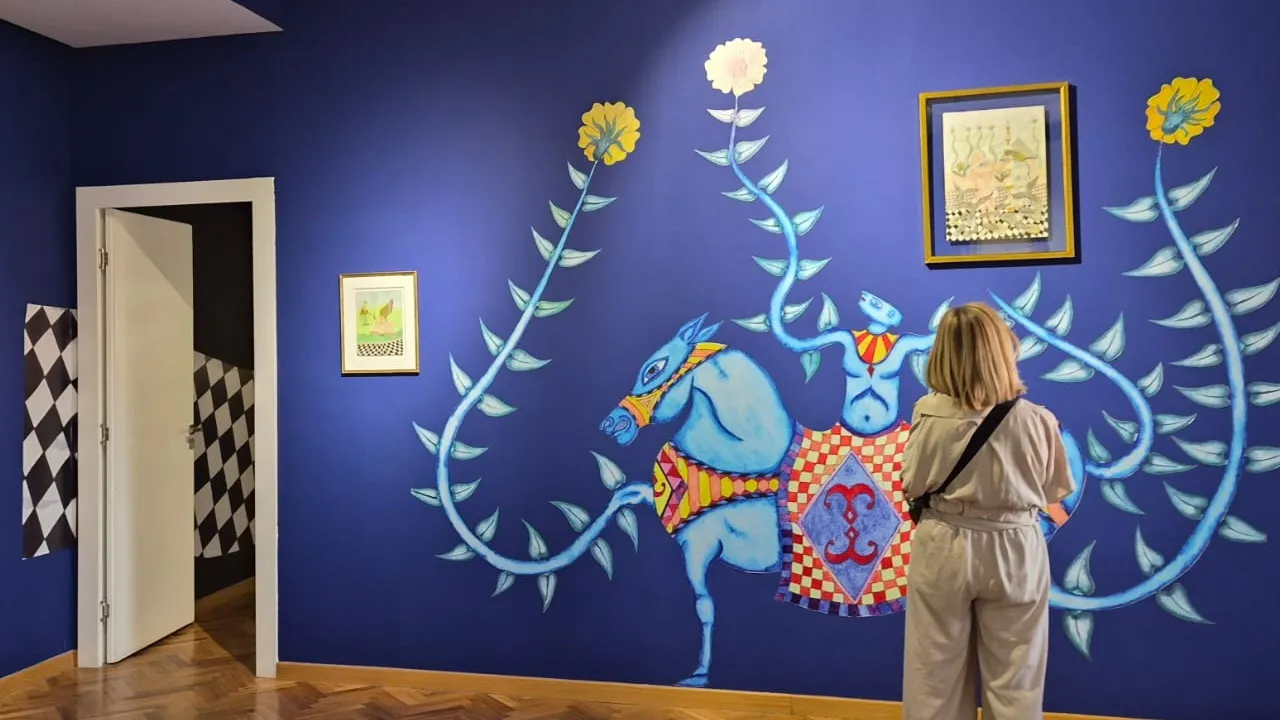
The "Comptoir des Mines" gallery in Marrakech is hosting a remarkable exhibition featuring the works of the renowned Moroccan artist Abdeslam Saladi (1940 - 1992) until July 15. Saladi is celebrated as a distinctive figure in Moroccan art history, capturing and embodying the spiritual essence of the red city with unparalleled precision. The exhibition, titled "Abdeslam Saladi: The Sufi Odyssey," was deemed a challenge to organize due to the lengthy and complex discussions that the gallery management engaged in with various collectors of the artist's works. Their efforts culminated in a significant collection that allows for a rediscovery of Saladi's artistic contributions.
A Unique Artistic Vision
In the foreword of the exhibition catalog, Hicham Daoudi articulates that there are certain artworks that defy explanation; they assert their existence and penetrate the soul, often leaving an indelible mark that is difficult to articulate. Saladi's work is categorized among these rare pieces, emerging from an internal necessity that resists conventional classification. Daoudi describes Saladi as an artist possessing a heightened sensitivity, who experienced marginalization and moments of fragility that kept his work on the periphery of mainstream narratives for an extended period. His paintings are born not from traditional aesthetic projects but from an acute state of emergency, emerging first as a vital, almost therapeutic gesture—serving to contain, organize, and render visible internal tensions that language alone could not express. Upon his return to Marrakech, a city that provided him with essential rhythms, imaginative realms, and visible and invisible layers, Saladi captured something fundamental: a dual essence of the world that is both mystical and popular, gradually shaping his artistic vocabulary.
Daoudi emphasizes that Saladi's works, teeming with hybrid forms and organic repetitions, do not merely depict a world; rather, they present an experiential journey. Both the ear and eye are provoked and tested, as one might think they recognize a form only for it to vanish, leaving them in a struggle for understanding where meaning remains ever elusive. According to Daoudi, Saladi disrupts established norms and transcends existing imagery, transforming his canvases into active surfaces and unstable fields where viewers project their own stories and interpretations. The artwork ceases to be merely an object; instead, it becomes an operational mechanism that engages the observer, compelling them to become active participants in their perception.
Saladi's intimate relationship with his own experiences, as Daoudi points out, escapes the realms of mere acknowledgment or confession. His painting is not a means of catharsis; instead, it is a transformative process that organizes density, structures chaos, and builds, piece by piece, a unique cosmology where the invisible finds form and representation without ever allowing itself to be reduced or simplified.
The exhibition of Saladi’s works at the "Comptoir des Mines" carries significant symbolism, representing a homecoming of the artist’s creations to the city that shaped his vision and where he captured a crucial part of its spirit. This return is not merely geographical but also symbolic, reestablishing Saladi within his rightful space in a history and memory that belong to him entirely. The proposed Sufi odyssey is not a linear journey but rather an immersion into a universe where landmarks fluctuate, forms intertwine, and the eye is continually stimulated. Ultimately, it invites viewers to experience a canvas that does not simply represent the world but also influences those who encounter it.
In the exhibition catalog, the writer and poet Abdullah Zarqa reflects on Saladi's artistry, asserting that he is not the naive painter some might perceive him to be. Instead, he describes Saladi as 'enlightened' in a mystical sense, having studied philosophy and approached painting through the lens of the human form without ever intending to display it. He lived in the shadow of his works, often silent, yet filled with the cacophony of ideas and emotions that surged within him. In that very moment, Saladi reached a state of 'blindness' that allowed him to envision what he would create in the days to come.
Saladi's artistic journey is marked by a profound love for life, which at times bordered on fear. He narrated the visible existence around him through a personal language, embellishing the world with patience and dedication. He was a 'cosmic creator,' giving rise to new forms and lives that had never before graced existence. His creativity was inseparable from existence itself, as he navigated between two worlds: one of worship and annihilation, and another filled with the pains of the second realm, all while acknowledging the reality of the first. He balanced the absolute beauty of the second world with the relative and often overly realistic nature of the first. Zarqa concludes that Saladi lived many lives, dying with his mortal body yet leaving behind an eternal essence in his works that continue to narrate countless lives.
The exhibition proposes to showcase works from prestigious art collections, aiming to redraw the key milestones of Saladi's artistic journey, including one of his earliest works from around 1977. The gallery invites the public to engage in a renewed and profound reading of Saladi’s legacy, characterized as a visionary heritage that not only describes the world but also invents its existential necessity. Saladi's art emerges from a deep fragility and reflects the internal struggles and isolation he experienced, establishing itself first as a space of survival before evolving into a language of expression. In a world saturated with artificial and reconstructed images, Saladi's legacy retains a unique power where fragility transforms into a language, and imagery regains its spiritual depth.
This exhibition serves as a tribute to the collectors, gallery owners, and institutions that have early on contributed to preserving and conveying the works of this remarkable artist to future generations.
As reported by elaph.com.