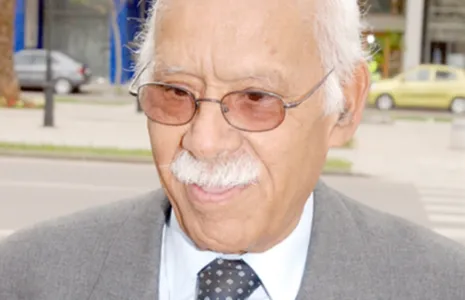

Mohamed Serghini: A Pillar of Moroccan and Arab Literature
The late Mohamed Serghini, born in Fez in 1930, is recognized as one of the most significant intellectual and literary figures in Morocco and the Arab world. Over several decades, he made substantial contributions to the establishment of modern poetic and critical pathways, leaving behind a rich legacy of creativity and thought that spans poetry, criticism, translation, semiotic studies, philosophy, novels, and theater. His literary contributions are notable, with major poetry collections such as “And the Burning of His Names Comes” (1987), “Seas of Mount Qaf” (1991), “The Sabaean Being” (1992), and “Who Did This to Your Skulls?” (1994). His collection “Under the Ruins Above the Ruins” earned him the Morocco Book Award in the poetry category, further solidifying his influential status.
In addition to his poetic works, Serghini enriched Moroccan and Arab libraries with significant contributions to criticism and thought, including “Lectures on Semiotics” (1987), a study and translation of the poetics of Salah Stetie, as well as his novel “I Found You in This Archipelago” (1992) and the play “The Ghost Train Song” (1986). The uniqueness and distinctiveness of his poetic experience are characterized by a tendency to transcend the ordinary and rebel against conventional forms, engaging in a profound interaction between mystical sensibility and the horizons of modernity. This continuous quest to innovate new forms and visions of poetic expression has earned his work a prominent place in the Moroccan and Arab poetic landscape, drawing the attention of critics and researchers both inside and outside Morocco.
A Legacy of Educational Impact and Recognition
Serghini's creative journey culminated in his receipt of the International Arkhana Poetry Award in 2004, making him one of the first recipients of this prestigious prize awarded by the House of Poetry in Morocco. He also won the Morocco Book Award in the poetry category for his collection “Under the Ruins Above the Ruins” in 2013. Yet, Serghini was not just a poet; he represented a unique cultural and intellectual phenomenon that combined strict academic training, critical and philosophical engagement, deep mysticism, and the brilliance of modern poetic imagination. This multifaceted profile positioned him as a leading figure in the trajectory of contemporary Moroccan poetry and the formation of generations of researchers and scholars.
Hailing from the culturally and scientifically rich city of Fez, Serghini received his early education there, profoundly influenced by the city's intellectual atmosphere. He continued his academic journey at Al Quaraouiyine University before moving to the East, where he earned a bachelor's degree in literature from Baghdad University in 1959. Upon returning to Morocco, he furthered his academic qualifications, obtaining a degree in comparative literature from Mohammed V University in Rabat in 1963, and later being awarded a doctorate in the third cycle in 1970 and a state doctorate from the Sorbonne University in Paris in 1985.
In addition to his creative and intellectual contributions, Serghini played a prominent role in higher education and the formation of generations of students. He joined the Faculty of Arts and Humanities in Fez as a professor in the early 1960s, remaining engaged in teaching, research, and academic supervision, eventually serving as deputy dean of the faculty from 1986 to 1991. Thus, Serghini's impact extended far beyond his published poetry, studies, and creative works; it reached generations of students and researchers who learned critical knowledge and academic research skills from him, contributing in turn to the ongoing legacy of the Moroccan school of poetry and criticism.
With his passing, Morocco loses one of the most prominent symbols of contemporary poetic and intellectual movements, while the Arab cultural scene mourns a poet, critic, and thinker who remained dedicated to renewal and the pursuit of alternative horizons for poetry and thought over the decades. His works stand as a testament to a rich creative and intellectual journey, leaving a lasting imprint on the literary memory of Morocco and the Arab world.
As reported by achpress.com.