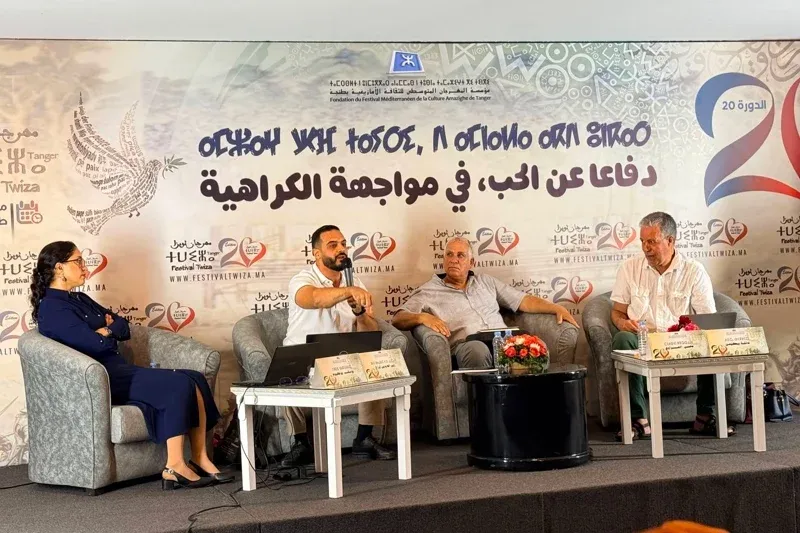
Debunking Historical Myths of Origins
In a significant development within the field of genetic research, computer engineer and geneticist Aurag Zain al-Abidin emphasized the necessity of scientifically dismantling the forced correlation between the Amazigh people of Morocco and Yemen. During his presentation at the "Morocco in the Mirror of New Archaeological Discoveries" seminar, which took place as part of the 20th edition of the cultural festival "Thwiza" in Tangier, Zain al-Abidin revealed that a 2024 discovery of remains in Socotra has led to new insights that challenge long-held beliefs. Historically, it was claimed that the Sanhaja and Kutama tribes descended from Yemen, and that all Amazighs had their origins there. However, he stated that recent findings indicate that there is no connection to Yemen at all; instead, genetic components from other regions, such as the Natufians and Zagros in Iran, and Anatolian Farmers, were identified.
Genetic Continuity and Local Roots
Zain al-Abidin further elaborated on the continuity of populations, noting that they remained isolated in their regions without dispersing, thus negating links to the Marib Dam or other Yemeni associations. He referenced finds from Setif, which are Numidian remains, and from the Canary Islands, which carry the Amazigh E-M81 lineage, illustrating the local roots of these populations. He argued against the misconception that the Mauritanians were of sub-Saharan descent, asserting that the local ancestry and genetic continuity prevail in North Africa. He posited that while there have been migrations and influences from other regions, the predominant genetic component remains local, as exemplified by the genetic profile of King Bogud, who lived around 49 BC and showcased local characteristics.
Moreover, Zain al-Abidin pointed out that while globally recognized lineages exist, they do not imply purity, as migrations have always occurred. Anthropologists and geneticists focus on the most prevalent lineage in each region, such as E-M81 among the Amazigh in North Africa, E-M78 among Egyptians, and E-M2 in sub-Saharan Africa. He also identified the R1b lineage in Europe and the J1 lineage prevalent among Arabs in the Middle East, underscoring that although these lineages are dominant, they coexist with a mixture of other genetic ancestries.
In a compelling conclusion, Zain al-Abidin highlighted that a study conducted in 2013 found that approximately 84% of Moroccans belong to Amazigh lineage, suggesting that most of the population is still rooted in local ancestry, contrary to claims of a mixed heritage akin to that of the United States or Brazil. He noted the sub-lineage E-Z5009, derived from E-M81, which unites the Amazigh of the Rif, Atlas, and Sous regions, asserting that they share a significant ancestor who lived around 300 BC.
Fellow researcher Youssef Boukboot also contributed to the discussion, pointing out the ongoing identity crisis in North Africa, where many individuals remain unaware of their true origins. He stressed the historical difficulty in proving claims of descent that stretch back more than 400 years, as there are no documented genealogies in Morocco that extend continuously for such long periods. Boukboot advocated for genetic science as a means to resolve these identity dilemmas scientifically, distancing the discourse from populist narratives. He informed the audience of a new laboratory being constructed near Tangier, which is expected to attract significant interest from those eager to uncover their true ancestries through genetic analysis.
As reported by hespress.com.