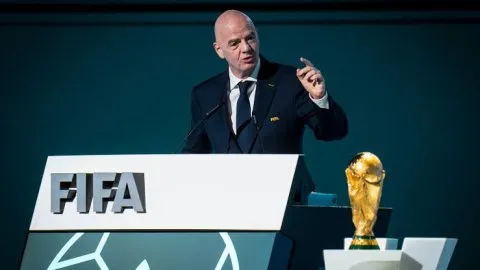

The recent World Cup has highlighted the increasing commercialization of football, transforming it into a product that mirrors American sporting culture. With matches featuring strategically timed breaks, misleadingly termed hydration pauses, even in air-conditioned stadiums, it is clear that FIFA's priorities have shifted dramatically under Gianni Infantino's leadership. The FIFA president seems more focused on the financial rewards of the tournament rather than the essence of the sport itself. While this perspective may resonate with some, it raises an important question: is this shared by the wider football community?
Infantino’s approach to leadership draws parallels with certain African leaders who cling to power, seeking third and fourth terms without regard for democratic principles. His re-election appears predetermined, with 200 out of 211 federations reportedly supporting him prior to the scheduled vote in March 2027. Despite a lack of challengers, there is a growing conversation about whether Infantino should continue to lead FIFA, especially considering the organization's governance structure. Why has the African Football Confederation (CAF) remained silent during discussions that have challenged Infantino’s commercial ambitions? Shouldn't CAF and African federations take the initiative in advocating for reforms that honor FIFA's status as a non-profit organization?
Life is often unpredictable. Who could have foreseen that after FIFA's financial windfall from hosting the 2026 World Cup—projected to generate $15 billion, approximately 7,500 billion CFA francs—Infantino would encounter difficulties? To put this into perspective, Burkina Faso's entire budget does not even reach half of this amount, totaling only 3,700 billion CFA francs. The flagship event for FIFA, the 2026 World Cup, will feature 48 teams and 104 matches, which the organization anticipated would yield $11 billion but ultimately surpassed expectations.
FIFA's substantial revenues can be attributed to its flagship events, particularly the men’s World Cup, which continues to dominate the organization's financial portfolio. The women’s World Cup has generated $500 million, while the newly established Club World Cup brought in $2 billion, underscoring the male World Cup's prominent status. FIFA's revenues have doubled compared to the previous cycle from 2019 to 2022, which netted only $7.5 billion. This surge in income is rooted in the expansion of the tournament, increasing the number of nations, matches, and consequently, broadcasting rights and advertisements.
Why limit the World Cup to every four years when the cash cow could potentially produce every two years? The prospect of increased earnings naturally delights leaders like Infantino, whose bonuses are tied to FIFA's financial success. In an effort to capitalize further, Infantino proposed the establishment of FIFA Forward Enterprise (FFE), a company aimed at commercializing tournament rights. This venture, valued at $20 billion, would invite private investors to acquire minority stakes, a move that raises significant ethical concerns. Notably, British media revealed that investment interest includes JP Morgan and Thrive Capital, owned by Joshua Kushner, raising alarms about potential conflicts of interest.
The UEFA, the most powerful confederation, quickly voiced its disapproval, threatening to withdraw from the World Cup if this privatization plan proceeded. Following suit, CONCACAF and AFC also expressed their discontent. In contrast, only CAF and the Oceania Football Confederation have remained publicly silent on the matter. This lack of response is troubling. Why wait for a crisis to unfold when the CAF could leverage modern communication tools to consult its members? Some speculate that the CAF's silence indicates support for Infantino. If South American federations joined in opposition, Infantino would face considerable resistance, prompting him to retract his divisive proposal.
The fallout from this plan led to the resignation of FIFA’s second-in-command, Carlos Condeiro, who opposed it, affirming that FIFA does not require private investment due to its ample reserves. Other high-ranking officials, including Mattias Grafstrom, the Secretary-General, publicly voiced their disapproval. Arsène Wenger also expressed his lack of awareness about the proposal and his disagreement with it. In an effort to quell the unrest, Infantino convened an emergency meeting in Morocco.
At this juncture, CAF must reclaim its honor by defending African football and the interests of its continent. The resolution of this crisis necessitates a thorough reassessment of FIFA's governance. It is disheartening that CAF, representing the second-highest number of nations, has not asserted its influence during this critical time. It has failed to protect African football interests while Infantino has compromised integrity for personal connections with powerful figures, including Donald Trump.
CAF must also confront the economic realities that have led to the continent receiving fewer World Cup spots compared to Europe. The disparity in revenue generation between African nations and their European counterparts remains stark, resulting in a disproportionate share of FIFA funds. For instance, UEFA, with 16 qualified countries, is set to receive $200 million, while CAF, with only nine representatives, will receive just $111 million. This inequity highlights the need for reform and equitable representation.
In conclusion, the ongoing challenges within FIFA and the lack of decisive action from CAF highlight an urgent need for governance reform. The aim should be to ensure that football remains a sport accessible to all, rather than a privilege reserved for an elite few. The establishment of a new leadership team that prioritizes good governance in football is essential to uphold the integrity and values of the sport.
As reported by lefaso.net.