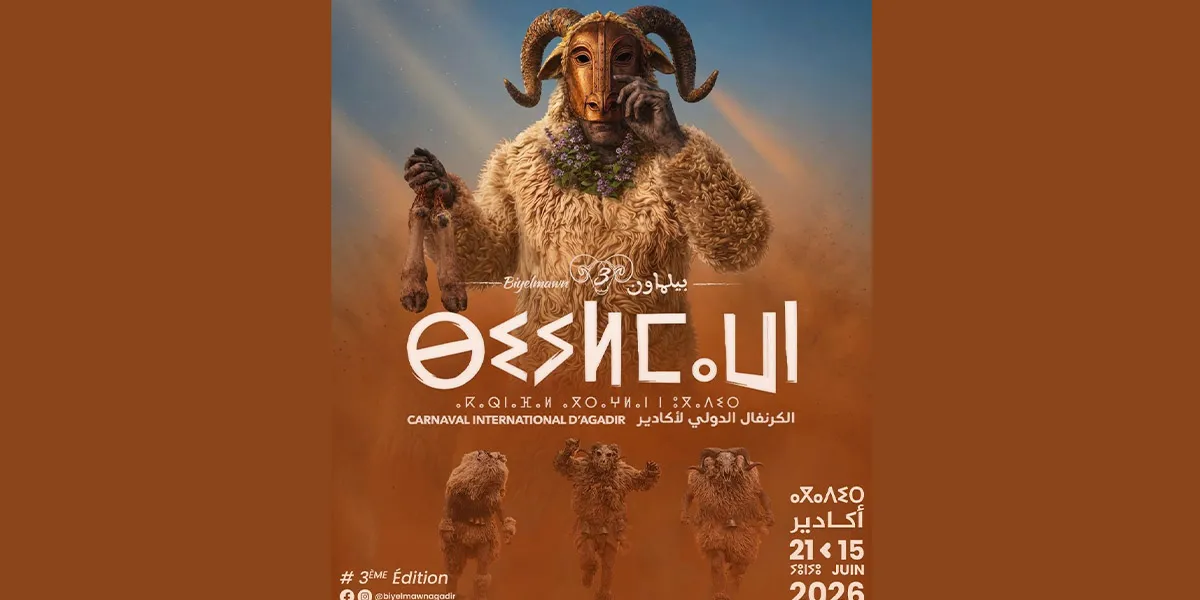

Celebrating Heritage Through the Bilmaoun Festival
The Bilmaoun festival is not merely a celebration; it is a profound ancestral tradition rooted in Amazigh heritage. Scheduled to take place from June 15 to 21, 2026, in Agadir, this event has evolved into an international carnival that commemorates a millennia-old rite. This year's edition will feature a special celebration honoring the Canary Islands as the guest of honor, transforming Mohammed V Avenue into an open-air theater for the grand 'March of Joy and Performance'.
The Bilmaoun rite is intricately tied to the Tafsaska festival, or Eid al-Adha, celebrated across Souss locales. Traditionally associated with Eid-el-Kébir, the festival brings neighborhoods to life as men don sheep and goat skins, sewing the limbs to their hands and painting their faces black, symbolizing stormy skies and the hope for rain. Although the festivities commence after the sacrificial rituals of Eid, they often blend with carnival-like practices characterized by humorous disguises. The character of Bilmaoun stands as the most vivid representation of this pre-Islamic tradition.
An International Carnival to Shine
Continuing the legacy of previous years, Agadir is set to host the third edition of the Bilmaoun International Carnival from June 15 to 21, 2026, themed 'Bilmaoun, Joy in Amazigh Rhythms'. This particular edition will prominently feature the Canary Islands, showcasing a delegation of experts, scholars, heritage troupes, and exhibitors, thereby demonstrating the enduring cultural and civilizational ties between the two regions.
This carnival is organized under the auspices of the Agadir Municipal Council, aligning with the implementation of the Community Action Plan for 2022-2027, in partnership with various ministries and regional councils. The objectives are manifold: to build upon the success of the first two editions, to solidify Agadir's status as the capital of Amazigh culture, and to embed the event in the annual cultural agenda as a pivotal celebration of performing arts and joy. The program promises to be rich and varied, integrating scientific research and artistic creation, featuring comic strip contests, mask-making workshops, sessions on the Tifinagh alphabet, as well as heritage exhibitions and artistic presentations.
Various venues across the city will also host activities, including workshops for community center participants. An international conference will take place at the Sahara Cinema, focusing on the role of museums in preserving and promoting Bilmaoun as intangible heritage. Meanwhile, Ibn Zaidoun Garden will transform into a 'Carnival Village' with several pavilions and exhibits, and Al Amal Square will host two artistic evenings featuring renowned Amazigh music icons.
The pinnacle of the carnival will unfold when Mohammed V Avenue becomes an open-air stage for the 'March of Joy and Performance'. Parades by traditional folkloric troupes will interact with contemporary creations from youth across various regions, showcasing innovative costumes and masks. This vibrant tableau, merging heritage with modernity, will be further enhanced by international participation, giving the Bilmaoun International Carnival of Agadir 2026 a truly global dimension.
The Bilmaoun festival serves as a common heritage that transcends borders. Historians note that this ancient pagan rite does not belong to any single people or specific region. The Amazigh had their deities, such as Ammon and Yakouch, while the Greeks and Romans also recognized pastoral gods like Pan and Lupercus, associated with fertility and the protection of shepherds and nature. Similar practices can be found beyond Morocco, particularly in the Canary Islands, where the Carneros de Tigaday tradition continues to thrive on El Hierro, one of the archipelago's main islands, showcasing the enduring Amazigh cultural roots among the indigenous Guanche people. In Sardinia, the town of Mamoiada hosts the Mamuthones and Issohadores tradition, where participants wear sheep skins and masks. Other similar customs are celebrated in Germany and Austria through Krampus parades featuring costumes made of sheep and goat fur.
As reported by leseco.ma.