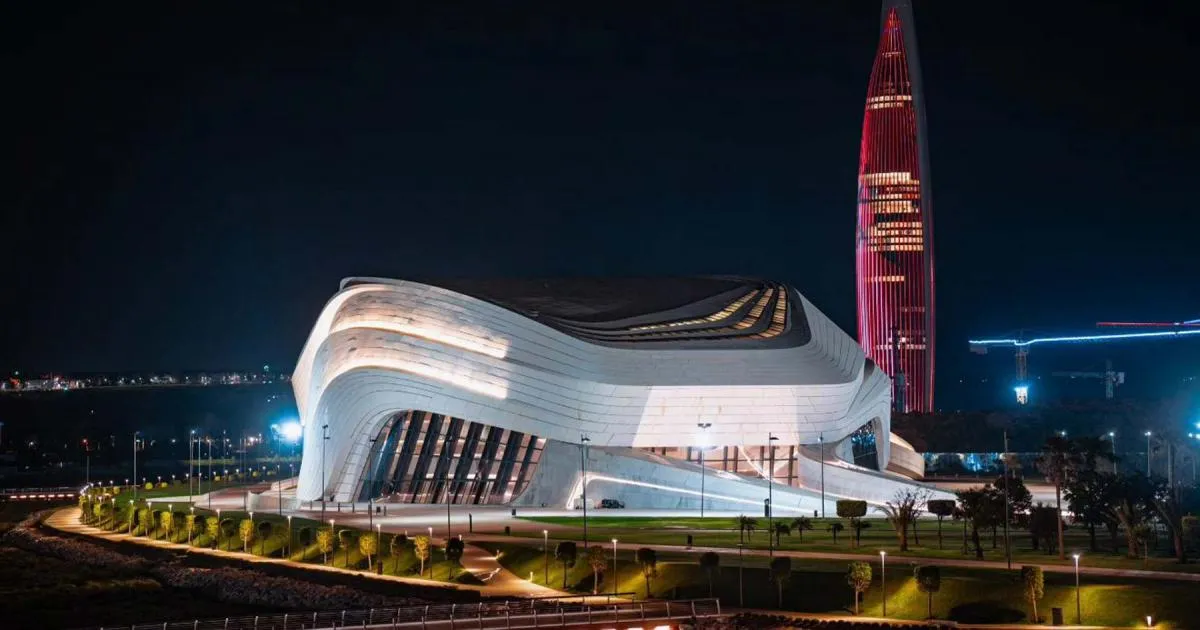
The recent inauguration of the Royal Theatre of Rabat transcends the mere opening of a new cultural facility; it emerges as a powerful declaration of Morocco's aspirations and soft power under the visionary guidance of King Mohammed VI. This significant event aims to position the Moroccan capital as a global 'City of Lights,' enhancing its cultural stature on the world stage.
This long-anticipated venue, masterfully designed by the late Iraqi-British architect Zaha Hadid, was celebrated with a gathering of distinguished guests, including members of the Moroccan royal family and prominent figures from the cultural sector. Notably, French First Lady Brigitte Macron was also present, highlighting the political and diplomatic significance of the occasion. The attendance of Princesses Lalla Khadija, Lalla Meryem, and Lalla Hasnaa further emphasized the event's importance in the context of national pride and cultural diplomacy.
Strategically situated along the banks of the Bouregreg River, between the renowned Hassan Tower and the Mausoleum of Mohammed V, the Royal Theatre stands at a pivotal intersection of Morocco's rich historical narrative and its vibrant modern urban landscape. This location not only symbolizes the country’s historical legacy but also its ambitious cultural and architectural aspirations, forming a crucial part of a broader redevelopment initiative aimed at transforming Rabat into a leading cultural capital.
The theatre is a cornerstone of the extensive 'Rabat, City of Lights, Morocco's Cultural Capital' initiative, which integrates urban revitalization, heritage conservation, and the development of large-scale cultural infrastructure. The opening night featured a captivating performance that showcased both Moroccan and international classical music, celebrated as a tribute to artistic excellence and national identity.
Brahim El Mazned, the newly appointed Deputy General and Artistic Director of the theatre, described it as a representation of 'architectural audacity and cultural ambition,' echoing the Moroccan monarchy’s vision. He emphasized that the opening of the Royal Theatre marks a significant milestone in the cultural evolution and international standing of Rabat and Morocco as a whole.
The inaugural performance was a spectacle of around 100 Moroccan artists, featuring the Orchestre Philharmonique du Maroc and the Orchestre Symphonique Royal, under the baton of conductor and pianist Dina Bensaïd. The program artfully combined Western classical masterpieces from composers such as Tchaikovsky, Bizet, and Verdi with the rich musical traditions of Morocco and Andalusia, performed by talented artists including oud virtuoso Driss El Maloumi and vocalists Ahlima Mhamdi and Samira Kadiri.
The theatre boasts a main auditorium with a capacity of 1,800 seats, alongside a smaller theatre and an expansive 7,000-seat outdoor amphitheatre, enabling it to accommodate a wide array of performances, from orchestral concerts to contemporary theatre. Equipped with state-of-the-art acoustic and stage technologies, the Royal Theatre is designed to serve as a platform for international productions while also showcasing the wealth of Moroccan artistic creativity.
El Mazned, a seasoned figure in Morocco's cultural landscape with over 25 years of experience, has previously spearheaded significant initiatives such as the Timitar Festival in Agadir and the Visa For Music platform in Rabat, the first professional music market catering to Africa and the Middle East. His appointment as the theatre's director signals a commitment to establishing the venue as a nexus for cultural exchange between Morocco, Africa, and the global community.
The journey to realize the Royal Theatre has spanned nearly two decades, with the initial concept originating in 2010 at King Mohammed VI's behest. The theatre's design by Zaha Hadid, the first female recipient of the Pritzker Prize in architecture, has been brought to life with a construction completion date in 2021. However, the venue's opening was delayed due to the pandemic and subsequent programming requirements, with the total investment in the project estimated to be around €200 million.
Beyond its architectural beauty, the Royal Theatre is viewed as a strategic asset for Morocco's cultural diplomacy and economic growth. Authorities recognize culture as a catalyst for tourism, urban renewal, and international recognition, positioning Rabat as an increasingly attractive destination for significant cultural and artistic events.
This inauguration also underscores Morocco’s broader initiative to project an image of stability, modernity, and openness within a region often characterized by political turbulence. By prioritizing culture in its developmental framework, Rabat is articulating a long-term vision where cultural infrastructure acts as a vehicle for influence and national branding.
Ultimately, the Royal Theatre of Rabat embodies a harmonious blend of heritage and modernity, local identity and global engagement. It serves not only as a venue for performances but as a cultural institution that reflects Morocco's aspirations to enhance its soft power and redefine its position on the international cultural landscape.
As reported by middle-east-online.com.