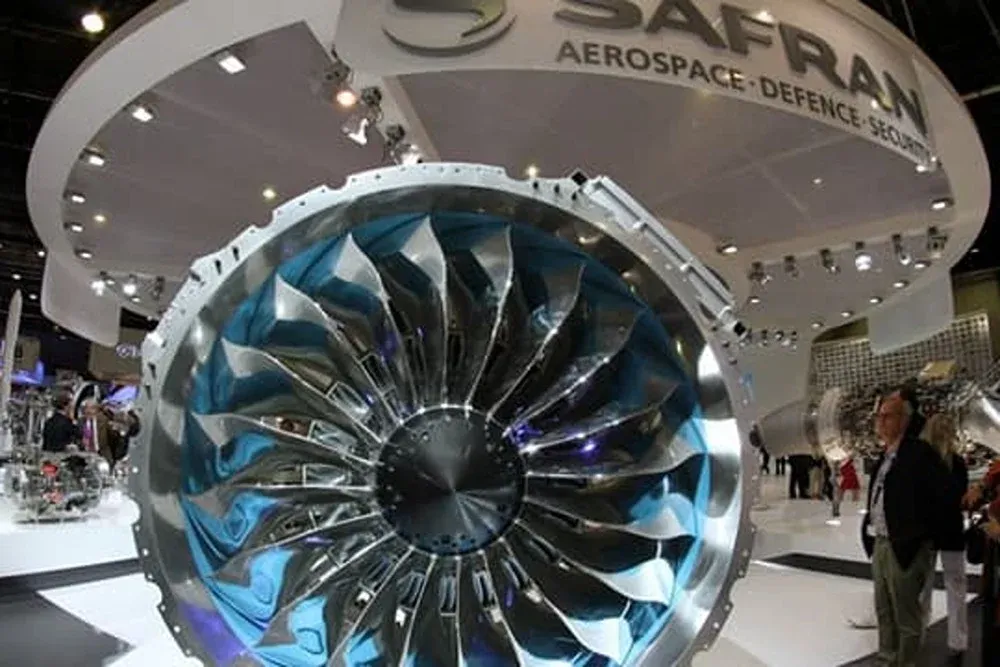

Safran's Comprehensive Portfolio on Display
Safran, a prominent player in the aerospace sector, is set to make a significant impact at the Marrakech Air Show, scheduled from October 7 to 10. The company will present a diverse array of products at stand E2, showcasing nearly all of its business segments, including helicopter propulsion, military optronics, electrical equipment, and commercial aircraft engines. This carefully curated selection not only highlights Safran's technological prowess but also underscores the solid industrial foundation that the French group has been methodically building in Morocco over the years.
The products on display at the show include the Makila helicopter engine, the Euroflir 410 optronic system, rugged electric harnesses designed for severe environments, and the LEAP-1B engine, which is the exclusive powerplant for the Boeing 737 MAX. Each of these offerings represents a distinct facet of Safran's operations, with several products already deeply integrated into Morocco's industrial landscape.
Building a Strong Industrial Presence in Morocco
The Euroflir 410 optronic system, developed by Safran Electronics & Defense, serves as a gateway into the defense sector for the company. This airborne optronic system is equipped with up to ten video and laser sensors, operates across four spectral bands from visible to mid-infrared, and is capable of executing various missions, including surveillance, marking, and laser designation, depending on its configuration.
On the other hand, the Makila engine caters to the needs of heavy helicopter propulsion. This engine family powers Airbus Helicopters' Puma, Super Puma, and Cougar models, alongside the H225 and H225M Caracal, offering a remarkable power range of 1,800 to 2,100 shaft horsepower for aircraft weighing between nine to twelve tons.
As for the LEAP-1B, produced by CFM International—a joint venture between Safran Aircraft Engines and GE Aerospace—it exemplifies the civil aviation market and serves as the exclusive engine for the 737 MAX. While the LEAP-1B is making its way to Marrakech, it is the LEAP-1A variant that currently underpins Safran's industrial presence in Morocco.
In Casablanca, Safran is establishing an assembly line dedicated to the Airbus A320neo, with a production target of 350 engines annually by 2027. Complementing this effort is a maintenance and repair workshop aiming for a capacity of 150 engines per year, which is expected to create approximately 600 jobs in the long run.
This foundation builds upon Safran's existing operations in Morocco, where Matis Aerospace—owned by Safran Electrical & Power and Boeing—produces around 150,000 wiring harnesses annually for Boeing, Airbus, and Dassault, along with harnesses for the LEAP, CFM56, and GE90 engines. Another production site for harnesses is located in Rabat-Aïn Atiq, alongside facilities focusing on nacelles and composite subassemblies.
Moreover, Safran's commitment extends beyond propulsion. In February 2026, the company announced plans to construct a landing gear systems factory in Casablanca, with an investment exceeding 280 million euros. Spanning 26,000 square meters, this facility is slated to commence operations in 2029 and will employ nearly 500 individuals.
Currently, Safran employs over 5,500 workers across ten sites in Morocco, a number that is anticipated to grow with new hiring related to the LEAP program's activities, particularly in industrial supervisory roles.
As reported by fr.hespress.com.