
Heightened Security Measures Amid Calls for Mass Migration
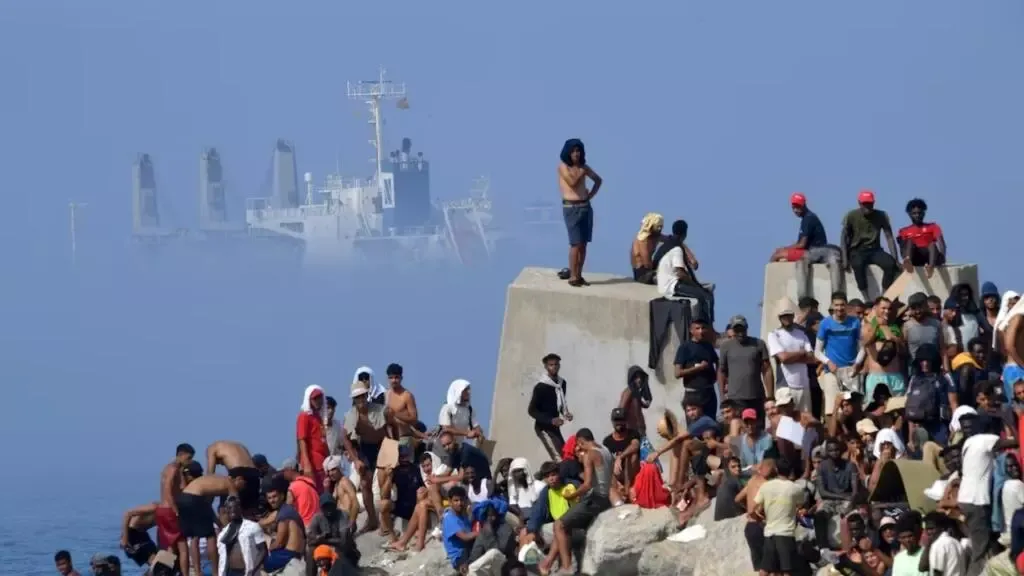
On August 15, the border between Ceuta, a Spanish enclave, and Morocco has transformed into a hub of heightened security concerns. This escalation follows a surge in social media calls for another mass crossing attempt, echoing the recent influx of approximately 70,000 to 80,000 individuals into Ceuta just two weeks prior. In response, Morocco has deployed additional security and military forces in the vicinity of Fnideq, while Spain has bolstered its police and Civil Guard presence with an influx of 2,000 troops. The European Union has also intervened by sending experts to the area as thousands of migrants, including unaccompanied minors, remain stranded in Ceuta under dire humanitarian conditions.
Social Media Fuels Migration Fears
The current fears have been fueled by a proliferation of social media posts in Morocco, many featuring the date "1508"—a reference to August 15—and the term "attack," which encourages would-be migrants to gather at Fnideq with the intention of reaching Ceuta. Posts with messages such as "We meet there on August 15" and "This is our last chance" have circulated widely, with some coordination taking place in private WhatsApp groups. Investigative reports have highlighted organized discussions among group members regarding crossing dates, routes, supplies, and even the potential collective purchase of motorboats. Additionally, queries about overcoming Spain's maritime barriers at the Tarajal breakwater have surfaced.
Analyzing the digital landscape, the intelligence firm Golden Owl, linked to the University of Alicante, has tracked over 5,000 accounts and identified a structured effort behind this mobilization. Their analysis revealed that 25 digital entities across various Mediterranean countries promoted the operation labeled "Asalto Karyaj a Ceuta" from July 24 to 31. Margha Hierro from Golden Owl noted that this is not a spontaneous movement led by a single individual but rather a well-organized campaign. Media outlets have also pointed to the use of astroturfing techniques to create the appearance of a grassroots movement through artificially inflated accounts and interactions.
Moreover, misinformation has spread, including a fake statement attributed to the Spanish government accompanied by an image of Prime Minister Pedro Sánchez, falsely claiming that the borders would be opened on August 15. This is not the first time such rumors have incited mass movement; a similar situation occurred in late July, which prompted tens of thousands to rush towards Ceuta. Social media was also previously utilized in the summer of 2024 to call for mass crossings, with reports indicating that over 700 individuals entered the enclave on certain days.
In response to these developments, both Morocco and Spain have entered a state of exceptional alert. The Moroccan Interior Ministry has announced that it has implemented "all necessary measures" to thwart any illegal crossings and to intercept anyone attempting to do so. Spokesperson Rashid Khalfi described these actions as part of a "continuous monitoring system" at the Ceuta and Melilla borders, urging the public to disregard the "suspicious and misleading" calls that endanger lives. Morocco has reinforced security at the Fnideq crossing with hundreds of security personnel alongside military units, while additional barriers and fencing have been erected on the Moroccan side. Reports indicate that the Royal Gendarmerie has mobilized in the area, and patrol boats have been positioned offshore.
On the Spanish side, the number of police and Civil Guard personnel in Ceuta has increased from just over 1,100 to approximately 1,600, augmented by around 2,000 troops for support. Spanish authorities have reported the deployment of 880 national police officers, 714 Civil Guard members, and 225 riot police. Interior Minister Fernando Grande-Marlaska has announced the dispatch of an additional police response unit comprising 45 officers, along with 20 personnel from the Central Foreigners and Borders Unit to assist the refugee office in processing international protection applications.
Despite the measures taken, the situation remains precarious, with reports of a significant number of migrants still stranded in Ceuta. The numbers vary; while Spanish authorities estimate that between 72,000 and 80,000 entered during the late July crisis, Morocco's figures are significantly lower, suggesting around 40,000. Authorities have confirmed the return of approximately 70,000 individuals to Morocco and have praised the cooperation with Moroccan officials in this regard. However, estimates of those remaining in Ceuta differ widely, with some local reports indicating around 2,000 individuals, including over 1,000 unaccompanied minors, while El País estimates the number of irregular migrants still on the ground to be about 5,000.
As the situation unfolds, the humanitarian conditions for those stranded have become another focal point of the crisis. At the "Trampolín" beach, a small coastal stretch of approximately 140 meters has turned into an open shelter for hundreds of migrants, as temporary shelters reach capacity. Reports suggest that around 400 individuals have been sleeping on the beach, while approximately 350 women and children have sought refuge in an outdoor playground transformed into a makeshift camp. Various NGOs estimate that the total number of migrants in Ceuta is around 7,000, including 4,000 minors, most of whom are living on the streets and relying on local community assistance for survival. Maria Jiménez, a spokesperson for the Elin Association active in the enclave, has expressed deep concern about the situation, emphasizing the urgent need for basic necessities and the establishment of a registration process for migrants.
Despite the dire circumstances, many migrants express a preference to remain in Ceuta rather than return, having endured years to reach this point. Jiménez highlights the challenges faced by the 4,000 minors, who are primarily in rural areas, relying on local residents for food and basic support. The authorities' response has been criticized as insufficient, with calls for immediate action to ensure the safety and dignity of those affected. The ongoing situation underscores the complexities of migration dynamics in the region and the urgent need for comprehensive solutions.
As reported by mc-doualiya.com.