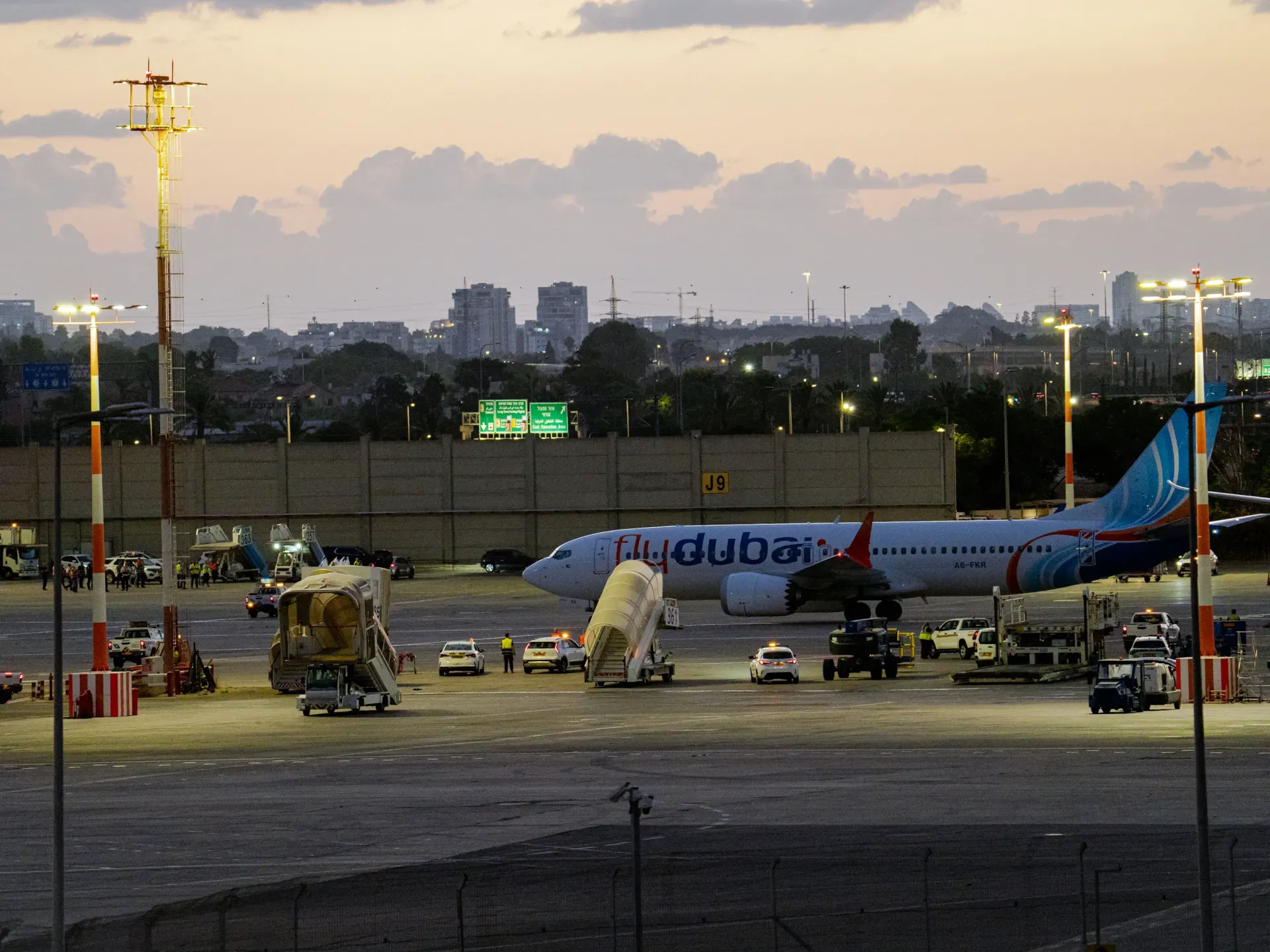

Israeli officials have swiftly delved into the details surrounding a "security incident" involving FlyDubai flight FZ 1073, which was en route from Dubai to Tel Aviv on Wednesday. The incident has led to allegations against the Emirati airline for breaching an agreement that mandates the pilots and crew members on its flights to be from countries that maintain diplomatic relations with Israel.
The flight was forced to divert to Prince Sultan bin Abdulaziz International Airport in Tabuk, northwestern Saudi Arabia, following what the airline described as a "dispute in the cockpit." Subsequently, FlyDubai dispatched a replacement aircraft to ensure the passengers could continue their journey to Tel Aviv. While the company emphasized that it is premature to comment on the causes and motivations behind the incident, which is under official investigation, various Israeli authorities and media outlets quickly accused FlyDubai of violating the aviation agreement governing its operations on routes to Israel. This has led to an extensive investigation overseen by Israel's internal security service (Shabak).
Israeli Prime Minister Benjamin Netanyahu and Defense Minister Israel Katz have, even before any preliminary investigation results emerged, suggested that there was an attempt to hijack the aircraft and implied a potential terrorist act. This has prompted opposition figures in Israel to accuse them of politicizing the incident for electoral gain. Netanyahu stated that the pilot who thwarted the attack is of Indian nationality, asserting that his actions saved 174 lives, including those of Israeli citizens and nationals from other countries. This follows conflicting statements from Israeli officials regarding the nationalities of the pilot and co-pilot involved.
In the aftermath of the incident, FlyDubai announced a temporary suspension of its flights to and from Israel as the investigation continues, clarifying that this measure would allow the relevant authorities to gather facts pertaining to the incident. Reports from the Israeli Broadcasting Authority indicate that security officials have interrogated the co-pilot by Saudi authorities, and so far, no evidence has emerged to suggest the involvement of a "terrorist organization" or a state in the incident. Current evidence indicates that the assailant acted independently and does not suffer from any mental disorder.
Conversely, an Israeli source cited by Yedioth Ahronoth claimed that the co-pilot holds Omani nationality and allegedly planned to crash the aircraft at a symbolic location within Israel, although independent verification of this claim remains unavailable. U.S. Attorney General Todd Blanch mentioned that the United States is coordinating closely with international counterparts regarding the incident, with investigations ongoing in both Israel and other locations. He noted that there is a "close relationship" with Israel and coordination since the incident occurred, but refrained from speculating on the matter as investigations continue and stated he had no additional information.
Preliminary investigations reported by Yedioth Ahronoth indicate that investigators are exploring the possibility that the pilot prevented the co-pilot from crashing the plane, potentially with assistance from some Israeli passengers. It is suggested that the pilot used an emergency axe designed for breaking windows to subdue or attack the co-pilot during the attempted takeover. Investigators have dismissed earlier theories that the co-pilot smuggled the axe aboard the aircraft due to the stringent security checks crew members undergo before departure. Conversely, investigators are also considering the opposing possibility that the co-pilot, who is suspected of planning the alleged attack, used the axe against the pilot who tried to stop him.
Videos circulating on social media captured two men on the aircraft's floor with severe injuries while others administered emergency medical assistance, with some guarding the cockpit. One individual was overheard speaking Hebrew, stating, "We are guarding the pilot," while another video showed passengers crying and screaming in panic as the plane shook. According to a statement from Tabuk Airport reported by the official Saudi channel, both the captain and co-pilot sustained injuries and were transported to the hospital for necessary care, though details regarding their injuries remain undisclosed.
According to the Jerusalem Post, an Israeli transport ministry source stated that FlyDubai's agreement to operate flights to Israel explicitly requires that all pilots on this route must hold nationalities from countries that have normalized relations with Israel. The Times of Israel further reported that the agreement between the UAE and Israel stipulates that pilots operating flights into Israel must possess passports from countries that have diplomatic relations with it. Unconfirmed Israeli reports suggested that the co-pilot suspected of trying to seize control of the plane is of Omani nationality, prompting Israeli Transport Minister Miri Regev to declare that this constitutes a "clear breach of the agreement" necessitating an investigation by the Shabak.
The Israeli Broadcasting Authority noted that investigations are probing how a pilot from a country without diplomatic relations with Israel was included in the flight crew. An Israeli official told the Jerusalem Post that the Omani pilot had not previously landed in Israel. A joint investigation involving the Mossad, Shabak, and the Israeli military is also examining whether there were any prior indicators of the incident.
In a swift response, Minister Regev requested that the Shabak halt all FlyDubai flights entering and leaving Israel, with a transport ministry official quoting her as describing the incident as a "major event" where a "catastrophe was averted." Hebrew media outlets reported that Prime Minister Netanyahu agreed to suspend the airline's flights to Israel until investigations are completed, as reported by Maariv from an unnamed source. Furthermore, Regev called for the immediate reinstatement of El Al's flights to Dubai under Israeli security screening procedures, following a period during which Israeli companies were barred from flying there due to disputes over security requirements.
Additionally, security sources told Reuters that Saudi Arabia had refused an Israeli request to allow military aircraft, specifically "Super Hercules" planes, to directly evacuate stranded Israeli passengers from its territory, citing the lack of diplomatic relations between the parties. Instead, FlyDubai sent a replacement aircraft to complete the passengers' journey to Tel Aviv.
As reported by aljazeera.net.