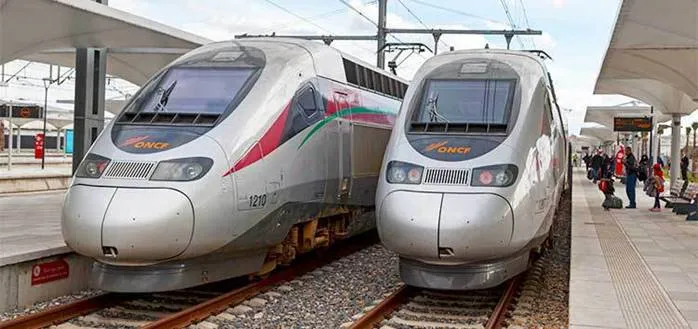

Accelerating the Future of Transportation in Morocco
The ambitious High-Speed Rail Line (LGV) project linking Kenitra to Marrakech has reached a pivotal milestone. The National Office of Railways (ONCF) has recently issued a substantial tender exceeding 151 million dirhams for the procurement of new railway tracks, signaling a significant acceleration of this monumental construction project as the 2030 deadlines draw nearer.
To equip the future tracks for this major extension, the ONCF is committed to adhering to high technical standards. This new contract involves the supply of 60 E1 type new rails, each measuring 36 linear meters, which is the standard profile designed to ensure the stability and safety of trains operating at speeds exceeding 320 km/h. The financial magnitude and stringent requirements of this tender are underscored by a provisional guarantee set at 22.6 million dirhams for bidding companies. This order complements an already extensive logistical framework that ultimately anticipates the installation of 100,000 tons of rails and 800,000 sleepers along the entire route.
A Year of Transformative Construction
One year after the commencement of the large-scale works on site, the transformation of the national railway axis is accelerating at an unprecedented pace. Key indicators reflect an extraordinary mobilization of both Moroccan and international companies. This intensive logistical deployment is aligned with a tight schedule, as this extension is incorporated into the state's program contract and is expected to be fully operational by 2029.
By this deadline, the Moroccan railway network is set to enter a new dimension. Time savings will radically alter national mobility, enabling travel from Marrakech to Casablanca in just 1 hour and 15 minutes, and connecting the ochre city to Tangier in a mere 3 hours. This represents a significant advantage for the Kingdom, which is preparing to host the FIFA World Cup in 2030.
As reported by ecoactu.ma.