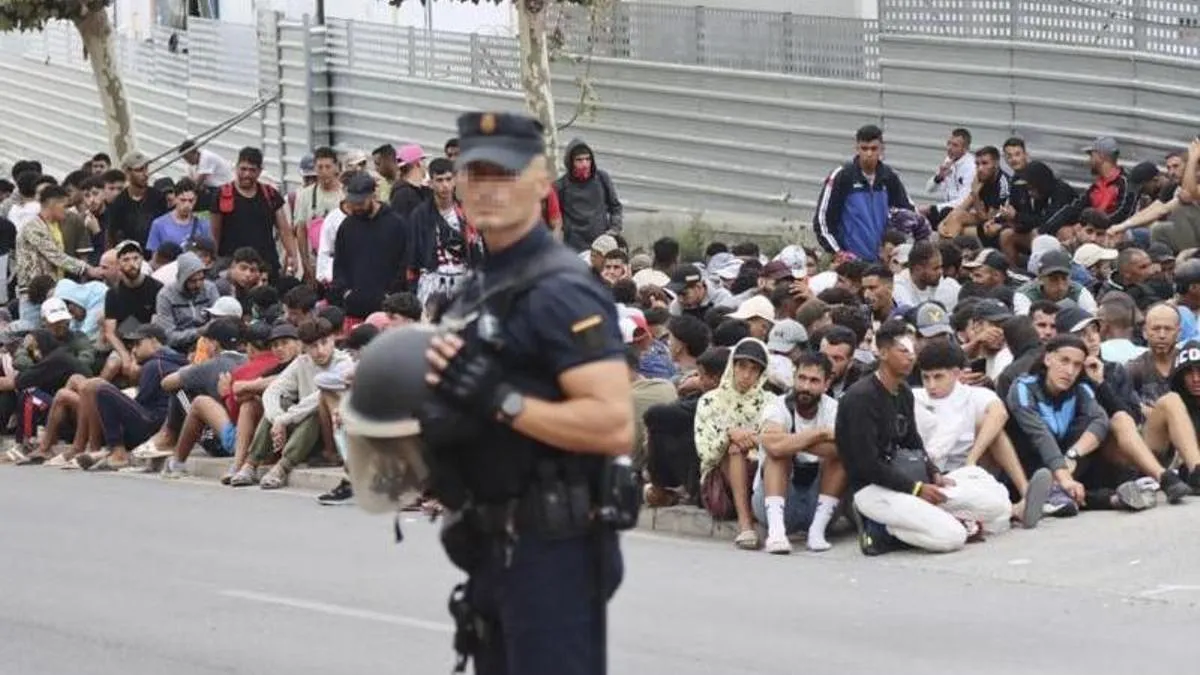

The silence has permeated the usual channels of communication between Spanish and Moroccan police units tasked with managing irregular immigration and border security. A preliminary request from the Spanish Security Forces for information from Morocco has gone unanswered, specifically regarding the identification of approximately twenty "unarmed" agents that the National Police detected directing a crowd of migrants during the events of July 30 and 31, when a massive influx occurred in Ceuta. Sources familiar with the investigation indicate that Rabat has not yet responded.
These sources express skepticism about any imminent resolution to the Moroccan silence, despite the potential for an official request from Judge María Tardón, which might demand the names of these individuals if she chooses to proceed with such a request. Nonetheless, identifying these leaders is crucial to ascertain whether Rabat played a role, as suspected, in organizing and/or facilitating the surge of migrants.
The report from the National Immigration and Border Center (CENIF), the intelligence agency of the General Commissariat for Foreign Affairs, was submitted to Judge Tardón on the previous Monday. This dossier references the actions of "unarmed" agents who dressed and behaved differently from the typical migrants during the tumultuous events of July 30 and 31. These individuals exhibited commanding behaviors, even towards Moroccan gendarmes, and within the city, acted like shepherds overseeing the human tide.
While the report does not specify an exact number of identified individuals, it does present photographs of at least 21 distinct persons, with some supervising the movements of the crowd while others engaged in phone conversations. This behavior exhibits a pattern that includes a keen awareness of the surroundings, projecting confidence, centrality, differentiation, and leadership in contrast to the masses surrounding them.
In contrast to information flow in other areas, such as jihadist terrorism and, to a lesser extent, drug trafficking, where collaboration with Morocco has been robust, the same cannot be said for this situation, as sources reveal that no information has been forthcoming from Moroccan interlocutors following an unofficial attempt to gain clarification.
Graphic material from various sources collected by investigating officers needs to be compared with images captured at the Ceuta border, utilizing the "smart border" facial recognition system that has been operational at the Tarajal crossing since April.
The events in Ceuta and the judicial investigation currently underway are straining three bilateral security agreements between Rabat and Madrid, some of which have proven effective in the past. On July 23, 2025, President of the National Court Juan Manuel Fernández, Chief Prosecutor Jesús Alonso—who now oversees the investigation into the Ceuta case—and several magistrates and prosecutors met with Moroccan judges. Following this meeting, the National Court announced that discussions included topics such as extraditions between the two countries, human trafficking, and illegal immigration. This was the last time that cooperation was significantly bolstered.
Since 2012, a Cross-Border Police Cooperation Agreement has governed the security relationship between Spain and Morocco. Its contact centers are located in Algeciras and Tangier, primarily focusing on the exchange of information regarding irregular immigration. The agreement aimed to establish balanced communication between the National Police, the Civil Guard, the Royal Gendarmerie, and the Moroccan General Directorate of National Security (DGSN), which oversees internal intelligence.
As of now, there has been no official identification of any of the leaders involved in the assault on the Ceuta border, despite direct communication between Spanish and Moroccan security forces being reinforced by a new agreement, the Spain-Morocco Security Convention of 2019, which came into force on April 30, 2022.
On a judicial level, a Judicial Assistance Agreement in criminal matters has been in effect since 2013, obligating Madrid and Rabat to provide each other with the broadest possible judicial assistance in criminal cases. The case concerning Ceuta has been assigned to Judge María Tardón under the legal framework addressing attacks against Spain's territorial integrity, with the reported deaths of over a hundred migrants during a supposedly organized surge adding significant weight to the legal implications.
Internal apprehensions are evident among police sources, who point to various investigative avenues to clarify the circumstances surrounding the assault on the Ceuta border. They seek to determine which Moroccan security units were deployed and active on the morning of July 30, the day of Morocco's Throne Day, their locations and numbers, how many were positioned in the Tetouan-Ceuta corridor, under the command of which superiors, and what instructions were given regarding surveillance and the opening or closing of traffic routes.
There remains much to inquire of Morocco, and uncertainties are mounting at a time that is not ideal. There is a palpable sense of nerves among security officials as the deadline approaches for the government to decide on the declassification of documents linked to the migration crisis.
Various sources confirm a climate of distrust among high-ranking officials and mid-level officers of the National Police, Civil Guard, and other services operating in the area, a sentiment that has been growing even prior to Prime Minister Pedro Sánchez's announcement in Congress. One source believes that this climate of mistrust is a significant barrier to uncovering details about the assault on the city that require urgent verification.
“Nothing new under the sun,” laments a Civil Guard source, confirming their perception of a longstanding tendency among different intelligence units to withhold critical information for investigations while only sharing less valuable details.
This also refers to the first of the police reports submitted to Tardón, the presiding judge of Instruction Court No. 3 of the National Court. The 50-page dossier from CENIF includes monitoring of phone numbers with Moroccan prefixes and WhatsApp accounts, among others, mostly linked to these initial numbers, which were reportedly not shared.
There is also a tense atmosphere regarding the relationship between these bodies and the Government Delegation. A source closely involved in police work in the city confirms that there are some dysfunctions in the relationships with the Delegation, but adds that “the police bodies attribute this to the excessive workload” that this entity has been managing since July 30. This source denies that these strained relations extend to Civil Guard and Police officials; “quite the opposite,” they assert. This statement contrasts with others who lament that “the CENIF report has been a hammer blow.”
As reported by elperiodico.com.