
Spain's Commitment to Military Preparedness in Disputed Territories
The Spanish government is intensifying its efforts to bolster military infrastructure on the disputed territories of Vélez de la Gomera, Alhucemas, and the Chafarinas Islands, areas that Morocco claims sovereignty over. The Ministry of Defense has initiated a series of construction and renovation projects aimed at enhancing the facilities for the Army of Spain, which maintains a small contingent in these strategically located positions near the Moroccan coast. Notably, Vélez de la Gomera is connected to Moroccan territory by an isthmus, making the geopolitical situation even more complex. Recently, Moroccan officials, including the Minister of Justice, have reiterated claims over these territories, further straining relations between the two nations.
The Spanish military presence is characterized by a rotating but consistent deployment, ensuring the protection of these areas. However, the geographical and historical context poses challenges for maintenance and supply operations, necessitating collaboration with various agencies to ensure operational effectiveness. In recent years, the Ministry of Defense has revitalized reform and maintenance projects for military infrastructures after a prolonged period of stagnant investments. These initiatives include repairing structures that have suffered from erosion and weather damage, improving living conditions for military personnel, ensuring potable water supply, and addressing issues related to moisture in walls and ceilings.
Infrastructure Developments and Upcoming Projects
Among the ongoing improvements are upgrades to communication systems and security measures within the military facilities. In 2021, the procurement of new antenna masts was initiated to enhance communication capabilities on the rocks, followed by contracts aimed at improving satellite communications via I3D network nodes. One of the most significant actions included the demolition of the dilapidated clock tower at the Alhucemas rock, which posed a risk of collapse.
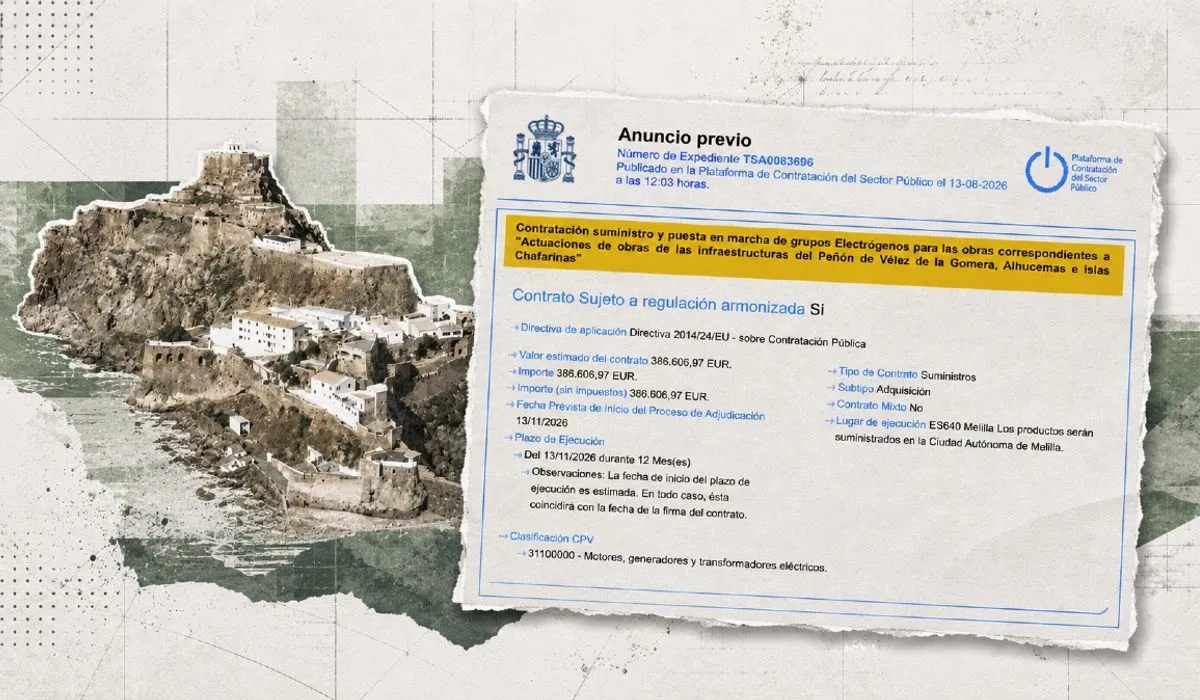
Furthermore, the Spanish government has recently opened a tender for the supply and installation of generators to support the ongoing infrastructure developments at Vélez de la Gomera, Alhucemas, and the Chafarinas Islands. The tender, managed by SEPI through TRAGSA, was publicly announced on August 15, with interested companies invited to submit their bids by September 11. The estimated timeline for project completion is twelve months, underscoring the government's commitment to enhancing military readiness in these contested territories.
This tender occurs at a critical juncture in relations between Madrid and Rabat, following the irregular entry of over 80,000 individuals into Ceuta on July 30. Interior Minister Fernando Grande-Marlaska asserts that cooperation with Rabat on security matters has been, is, and will continue to be exceptional. Conversely, Defense Minister Margarita Robles has firmly stated that Ceuta and Melilla are integral parts of Spain and must not be compromised. The recent migration crisis has prompted the Spanish government to establish additional humanitarian support for immigrants, including the deployment of temporary tents to accommodate 1,500 new individuals.
As the situation evolves, the regional implications are significant, with European partners expressing varying degrees of concern and proposing measures to address the crisis. Italy has even suggested extraordinary measures, including the temporary suspension of Schengen agreements with Spain, while Finland and Denmark have called for a review of free movement policies. This ongoing discourse highlights the complexity of the situation and the necessity for a coordinated response to both migration and territorial disputes.
As reported by vozpopuli.com.