
Spain's Diplomatic Stance on Ceuta and Melilla
The ongoing migratory crisis in Ceuta is escalating into a significant diplomatic issue. More than three weeks following the arrival of over 70,000 migrants in this autonomous city, the Moroccan government has begun to challenge the sovereignty of both Ceuta and Melilla. Moroccan Justice Minister Abdellatif Ouahbi's recent assertions that these territories represent a 'historical and geographic right' of Morocco have prompted the Spanish government, led by Pedro Sánchez, to express its 'firm rejection' of these claims.
During an interview on Moroccan public channel 2M, Ouahbi stated, 'The issue of Ceuta and Melilla will remain a topic of dialogue between us and Spain, and we will uphold our historical and geographic rights.' He claimed that one of the Moroccan government's objectives is to find a 'definitive solution to the current situation' so that Ceuta and Melilla 'return to the homeland (Morocco).' This is not the first time Ouahbi has addressed this matter; on August 11, he reiterated Morocco's stance, emphasizing their commitment to sovereignty and the desire to resolve the issue through dialogue.
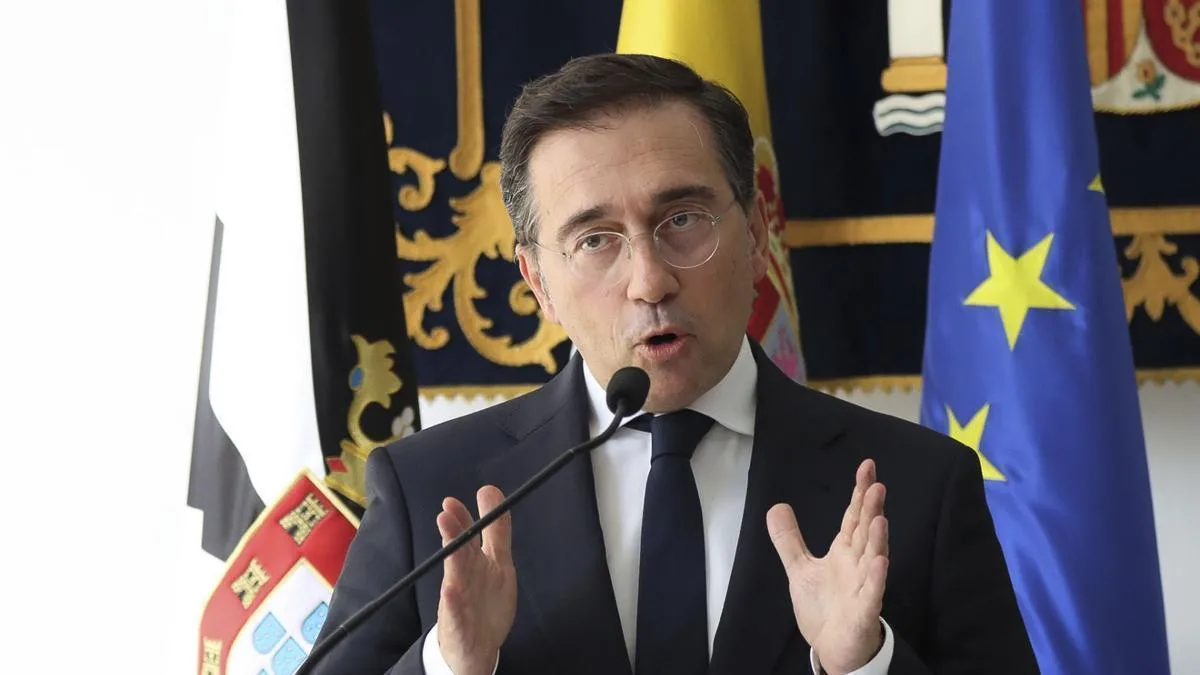
In response to these remarks, Spanish Defense Minister Margarita Robles firmly declared, 'Ceuta is not just Spanish; it is very Spanish.' Nevertheless, following Ouahbi's latest comments, sources from the Ministry of Foreign Affairs, under the direction of José Manuel Albares, issued a clear statement asserting that 'Ceuta and Melilla are two Spanish cities that are borders of Spain and the EU. They are part of Spain's internationally recognized territorial integrity and sovereignty, and they are also integral parts of EU territory.'
The statement further emphasized, 'We categorically reject any differing proposals regarding Ceuta and Melilla,' concluding that 'this position has been clearly communicated today through diplomatic channels' to the neighboring government. Despite this, Minister Albares has not publicly addressed the issue or made any statements on social media.
The Historical Context and Ongoing Tensions
Beyond the Foreign Affairs statement, no member of Pedro Sánchez's government has publicly commented on the situation. Since the mass influx of migrants on July 30, the government has aimed to maintain a low profile regarding relations with Morocco. The Prime Minister admitted shortly after the incident that what transpired in the autonomous city was a 'violation of Spain's territorial integrity,' yet he consistently refrained from placing blame on Morocco. He emphasized that communication with Moroccan authorities has been 'constant, fluid, and reasonable.'
Other ministers have also adopted a similar approach, avoiding any criticism of Morocco in the past weeks and indicating that cooperation with Moroccan authorities has been positive. In light of Ouahbi's comments from ten days ago, government sources sought to downplay the situation, characterizing relations with the kingdom of Mohammed VI as 'excellent.'
The Moroccan claim over both cities dates back to its independence in 1956. The late King Hassan II had previously urged Spain to create a 'reflection cell' regarding the future of these enclaves, which went unanswered. Currently, the Moroccan government insists on establishing a 'dialogue commission' to analyze the matter between the two nations. This claim has recently gained support from the United States and Israel.
Following the events of July 30 and 31, a report from the U.S. Congress's Appropriations Committee was revisited, stating that 'the cities of Ceuta and Melilla, administered by Spain, are located in Moroccan territory and continue to be the subject of Morocco's historical claim.' The report backed Secretary of State Marco Rubio's efforts to promote dialogue between the two countries. Additionally, Israel's ambassador to the United Nations, Danny Danon, urged Spain to 'explain to the world why it still maintains colonial enclaves in Africa.'
As reported by elperiodico.com.