
Spain Strengthens Border Security Measures with Morocco
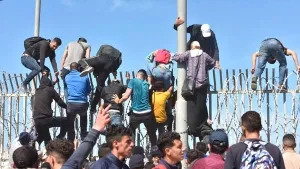
In response to the increasing flow of irregular migrants, Spanish authorities have recently enacted a series of stringent measures aimed at enhancing border control with Morocco. This initiative comes on the heels of significant collective migration events witnessed at the Tarajal border crossing in Ceuta at the end of July, as reported by local media outlets. The Spanish Navy has deployed two warships, the 'Santa Maria' and 'Navarra', to the waters off Ceuta, joining the maritime support vessel 'Rayo', which arrived in the area earlier this week. This deployment is part of a broader strategy to bolster maritime surveillance around the city, reflecting Madrid's commitment to addressing the surge in irregular migration towards Ceuta.
According to the same reports, the two frigates belong to the 41st escort squadron and are stationed at the 'Rota' naval base. They represent significant assets within the Spanish fleet, designed for air defense, anti-submarine warfare, and protecting maritime navigation, while also participating in maritime security operations. These vessels are equipped with capabilities to assist Spanish security forces in monitoring coastlines and combating irregular migration and drug trafficking, as well as operating military helicopters for various maritime missions.
In a related move, the Spanish Ministry of the Interior has decided to expand the maritime barriers system to include the city of Melilla, following its implementation in Ceuta. This expansion aims to empower security forces to enforce immediate return procedures for migrants attempting to enter Spanish territory by swimming past these barriers. New directives issued by the Secretary of State for Security on August 1 outline that these maritime barriers will be integrated into the border surveillance framework for Ceuta and Melilla, establishing the legal and operational guidelines for security forces to respond effectively to attempts at crossing the sea.
The Spanish Interior Ministry emphasized that the new measures are designed to provide "legal security" for police and civil guard personnel during return operations along the maritime line in Ceuta and Melilla, particularly when individuals are detected attempting to breach these barriers to reach Spanish soil.
Political Calls for Excluding Morocco from World Cup 2030 Hosting
Amid these developments, political parties in Spain and Portugal have called for Morocco's exclusion from the joint hosting of the 2030 FIFA World Cup alongside Spain and Portugal, following the recent crisis stemming from the mass influx of irregular migrants into Ceuta. The political party Vox has publicly demanded Morocco's removal from the organization of this global sporting event, while both Podemos and Sumar parties have expressed that Spain should not collaborate with a regime that exploits its citizens for geo-strategic purposes. Vox has submitted a proposal to the Spanish Congress urging the exclusion of Morocco from the global football event, and Sumar has echoed this sentiment by presenting a proposal to the Spanish parliament to withdraw from hosting the 2030 World Cup with Morocco, in protest against the arrival of tens of thousands of migrants in recent days.
Pablo Fernández, the leader of the Podemos party, took to social media to assert that Spain should not host the World Cup 2030 with Morocco, a country he claims does not respect human rights. In line with this, the Portuguese ecological party 'LIVRE' has urged its government and the Portuguese Football Federation to exclude Morocco from this global sporting event, deeming it an unreliable partner after causing a crisis of mass migration aimed at pressuring and extorting Spain.
As reported by el-massa.com.