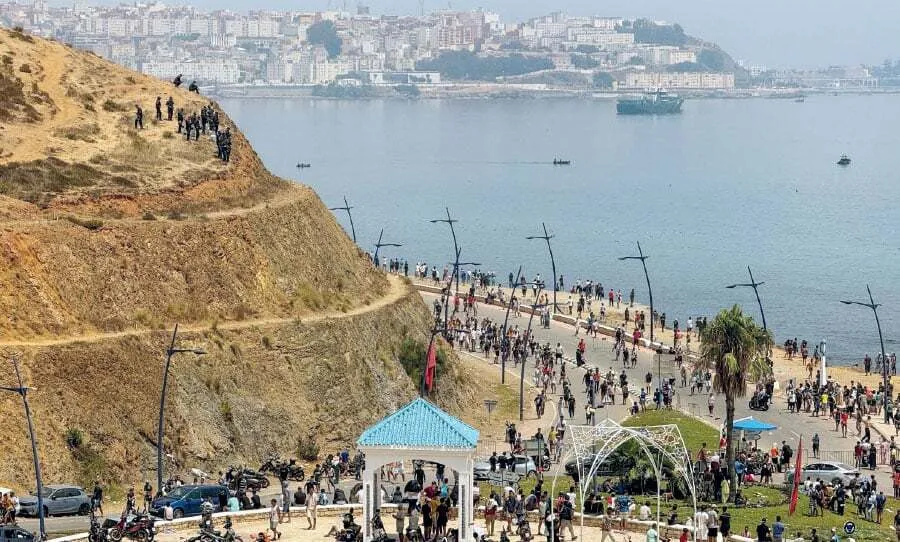

Ceuta, Morocco: In response to a surge of social media messages urging migrants to attempt another mass crossing into Ceuta, Spain has significantly bolstered its police and military presence in the North African enclave. This heightened security comes just two weeks after a staggering influx of tens of thousands of migrants into the city, an event that drew significant attention and raised urgent discussions regarding migration policies in Europe.
On Friday evening, soldiers dressed in formal uniforms were stationed to guard large stores and official buildings, while police vehicles conducted intensive patrols throughout the main streets of the area. However, despite these security measures, outdoor cafes remained bustling with patrons, and the city center exhibited a sense of calm, contrasting sharply with the chaotic scenes that followed the mass rush on July 30, which tragically resulted in numerous fatalities.
Across the border, dozens of Moroccan security personnel clad in black monitored the beach at Fnideq, the launching point for many migrants who swam around the maritime barrier in Tarajal, Ceuta. According to estimates from the Spanish government, at least 96 individuals lost their lives during this perilous attempt, while over 72,000 managed to enter Ceuta. Although the vast majority of these individuals voluntarily returned to Morocco shortly thereafter, the crisis has ignited deep divisions within the European Union and fueled anti-immigration rhetoric among far-right parties globally.
In the wake of the crisis, Spain has established a maritime barrier and deployed over 500 additional security personnel from the mainland, with the Interior Ministry announcing that these forces will remain on-site for as long as necessary. Spanish Interior Minister Fernando Grande-Marlaska stated to reporters in Ceuta on Thursday, "We will continue to deploy any number of personnel needed to restore normalcy as soon as possible and prevent a recurrence of the events that took place on July 30." He noted that approximately 5,000 migrants are still present in Ceuta, with authorities beginning to assess adult cases, processing over 500 asylum requests, the majority of which have been denied.
Grande-Marlaska further clarified that individuals who entered illegally would not be permitted to remain in the enclave, travel to mainland Spain, or obtain legal status, except in cases involving vulnerable individuals. He emphasized that Spain would repatriate those who do not qualify to stay.
Earlier this week, Morocco announced that it is monitoring the circulation of anonymous posts and messages on social media calling for mass crossings, warning that it would pursue legal action against organizers and participants. Local media reported heightened security measures near the borders with Ceuta and Melilla, another Spanish enclave in Africa, including the installation of new barbed wire on fences separating the territories.
Authorities have prevented several groups from boarding trains and buses heading north from cities like Casablanca, Fez, and Kenitra. However, witnesses indicated that certain groups from sub-Saharan Africa were avoiding security checks on the route to Fnideq by opting for mountainous paths instead. One witness reported that schools in Fnideq have been converted into barracks for the security forces deployed near the border.
On Wednesday, Interior Ministry spokesman Rashid Khalfi stated that the ministry has recently observed the circulation of anonymous posts on various social media platforms inciting attempts for illegal mass crossings into the cities of Ceuta and Melilla. The ministry classified these calls as dangerous practices that threaten the safety of individuals and aim to exploit migration issues for incendiary actions that are criminalized by law.
Khalfi affirmed that the authorities are closely monitoring the situation and taking necessary measures to counter any attempts at illegal crossings and to apprehend participants in such activities.
Ceuta and Melilla, situated in northern Morocco, along with the Chafarinas Islands and other rocky islets in the Mediterranean Sea, are administered by Spain, while Rabat considers them to be "occupied Moroccan territories." As reported by alquds.co.uk.