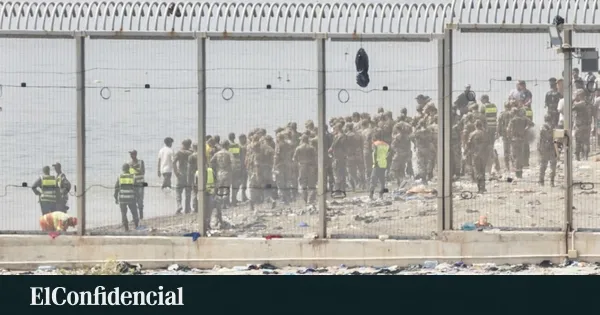

Spain has deployed approximately 9,000 personnel, including national police, civil guards, and military forces, in the autonomous cities of Ceuta and Melilla. This significant bolstering of security comes in response to heightened concerns over potential mass immigration, particularly as authorities have prohibited vacations for existing staff to ensure a robust law enforcement presence. The urgency of the situation is underscored by the fact that authorities have circled a specific date on the calendar—this Saturday—as Moroccan social media networks have called for a new mass entry attempt of migrants. Security sources consulted by El Confidencial emphasize that Morocco's actions will be crucial if there is a need to repel yet another wave of migrants.
The Interior Minister, Fernando Grande-Marlaska, provided precise figures regarding the presence of his department in Ceuta on Thursday. This includes 880 national police officers and 714 civil guards. Of these 1,594 security personnel, approximately 470 have been sent as reinforcements since the crisis began on July 30. In addition to these forces, the military presence has been confirmed, with an official spokesperson from the Ministry of Defense stating that around 3,000 soldiers are currently stationed in Ceuta. Their primary role has been to support the civil guard, conducting patrols in the streets and commercial areas to ensure safety and the continuity of operations in local businesses.
In Melilla, the national police force consists of around 620 agents, while the civil guard has an additional 650. The Interior Ministry announced on Tuesday that they would be reinforcing this city with just over a hundred riot police from the Civil Guard's Rapid Response Unit and the National Police's Anti-Riot Unit. Similarly, Defense has indicated that another 3,000 military personnel are present in Melilla. Although Ceuta has garnered most of the media attention in recent weeks, police sources warn that Melilla is also vulnerable to attempts at illegal entry. Spanish intelligence services perceive a greater threat in Melilla than in Ceuta this Saturday, particularly following the arrival of a wave of Sub-Saharan migrants.
Throughout the week, both police unions and professional associations of the civil guard have raised concerns about the lack of clear protocols or instructions to follow in the event of a new wave of immigration. Recent measures, such as the placement of a buoy off the coast of Ceuta and now in Melilla, have been criticized as ineffective in preventing mass arrivals. Instead, their purpose is to provide legal justification for rejecting migrants attempting to swim across, as established by a Supreme Court ruling on June 29.
Under current legal frameworks, a migrant must surpass a physical barrier to be expelled immediately. The government has known about this judicial criterion since 2024, as it was part of a legal procedure it was involved in. However, the floating barrier was only implemented after the events of July 30. By that time, Moroccan social media had been promoting the narrative that entry into Spain would be unimpeded, a misrepresentation of the judicial ruling.
Referring to the precedent set in July, should up to 80,000 individuals attempt to enter Ceuta simultaneously, there would barely be one officer for every 17 migrants, assuming all deployed forces were dedicated to this task, which is not a realistic scenario. This week, both Grande-Marlaska and Foreign Minister José Manuel Albares emphasized a deterrent message aimed at the trafficking networks and groups organizing another mass call for migration. They reiterated that anyone entering Spain illegally would face immediate expulsion.
In a rare move, the civil guard has issued a message on its official Instagram account in Spanish, Arabic, and French, warning potential migrants not to believe promises of being able to stay in Spain: "Don’t be deceived. Everything you are promised is a lie. If you launch into the sea, you will likely die. If you manage to cross, you will have entered illegally and will be returned." All eyes are now on Morocco's movements. Both the Spanish Prime Minister Pedro Sánchez and his ministers have refrained from criticizing Rabat’s actions during the recent migration crisis, which Sánchez described as "an attack on the territorial integrity" of Spain.
On the contrary, the Spanish government has expressed gratitude for Morocco's cooperation and highlighted the importance of collaboration with Moroccan authorities. Many sources do not believe that Morocco will allow a repeat of the July scenario, where tens of thousands of mostly young people fled towards Spain, especially with numerous international media outlets poised to observe this weekend as a test of Morocco's resolve. Reports have indicated that Moroccan intelligence permitted the mass arrival on July 30 as a retaliation measure against a series of journalistic investigations published in European media regarding their espionage methods. However, the Moroccan government misjudged the scale of the migration wave that ensued, leading to internal discontent from King Mohammed VI regarding the international image of his country.
Earlier this week, Moroccan media had already hinted at increased monitoring and stricter controls along the route connecting Tangier and Tetuan, which leads towards Castillejos, the border town adjacent to Ceuta. Local news outlets illustrated their reports with images of significant traffic jams on this route. Morocco has implemented reinforced measures along its border fencing, indicating a proactive approach that was notably absent during July's crisis. The situation remains tense as Spain continues to prepare for the possibility of further migration attempts.
As reported by elconfidencial.com.