
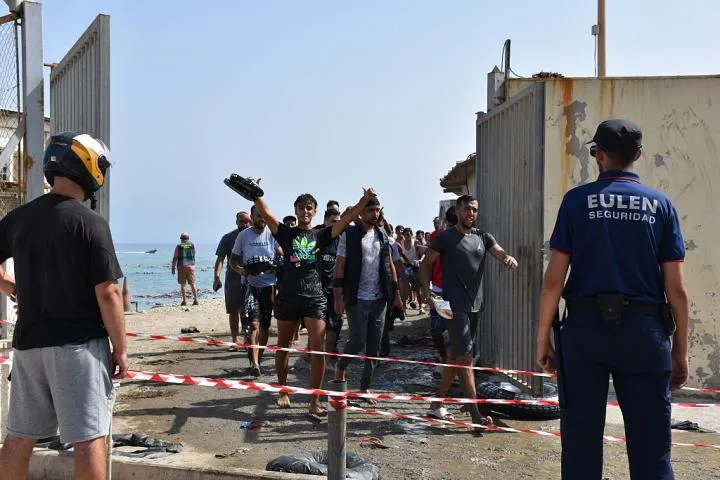

Spain's Interior Minister, Fernando Grande-Marlaska, recently announced that approximately 72,000 migrants have entered the city of Ceuta illegally from Morocco, according to the latest official data. He confirmed that nearly 70,000 of these individuals have already returned to Morocco, while Spanish authorities continue to manage the repercussions of the crisis that erupted last week.
Grande-Marlaska's comments came after his participation in an extraordinary meeting of EU Interior Ministers held via video conference on Tuesday to discuss the developments of the crisis. He noted that participants praised what he described as the "immediate response" provided by Spanish authorities, emphasizing that the meeting concluded with the assessment that the Schengen Area had not faced any threat or breach due to the events occurring in Ceuta.
The Spanish official underscored that, prior to the crisis, security agencies lacked any intelligence reports or indicators that might have suggested a recurrence of scenarios similar to those experienced in 2021, asserting that the situation was unexpected based on the information available to Spanish authorities.
In related news, the Spanish government's delegation in Ceuta reported that the number of bodies discovered since the onset of the crisis has risen to 75, with search and rescue operations still ongoing amid fears that the casualty count may increase.
On another front, the Minister of Inclusion, Social Security, and Migration, Ilma Saith, announced an exceptional financial allocation of 25 million euros aimed at supporting the care of unaccompanied minors who arrived in Ceuta during the recent wave of migration. However, no official figures have been provided regarding the number of children and minors that the city has currently received.
Conversely, Moroccan authorities have asserted that their management of the situation has been proactive and responsible. They highlighted that they had warned Spanish authorities prior to the crisis about the potential repercussions of certain judicial and administrative decisions that could affect bilateral cooperation in managing migration. Furthermore, they emphasized that they had mobilized various security and military resources to prevent the situation from escalating and to swiftly regain control over the borders.
As reported by assahifa.com.
