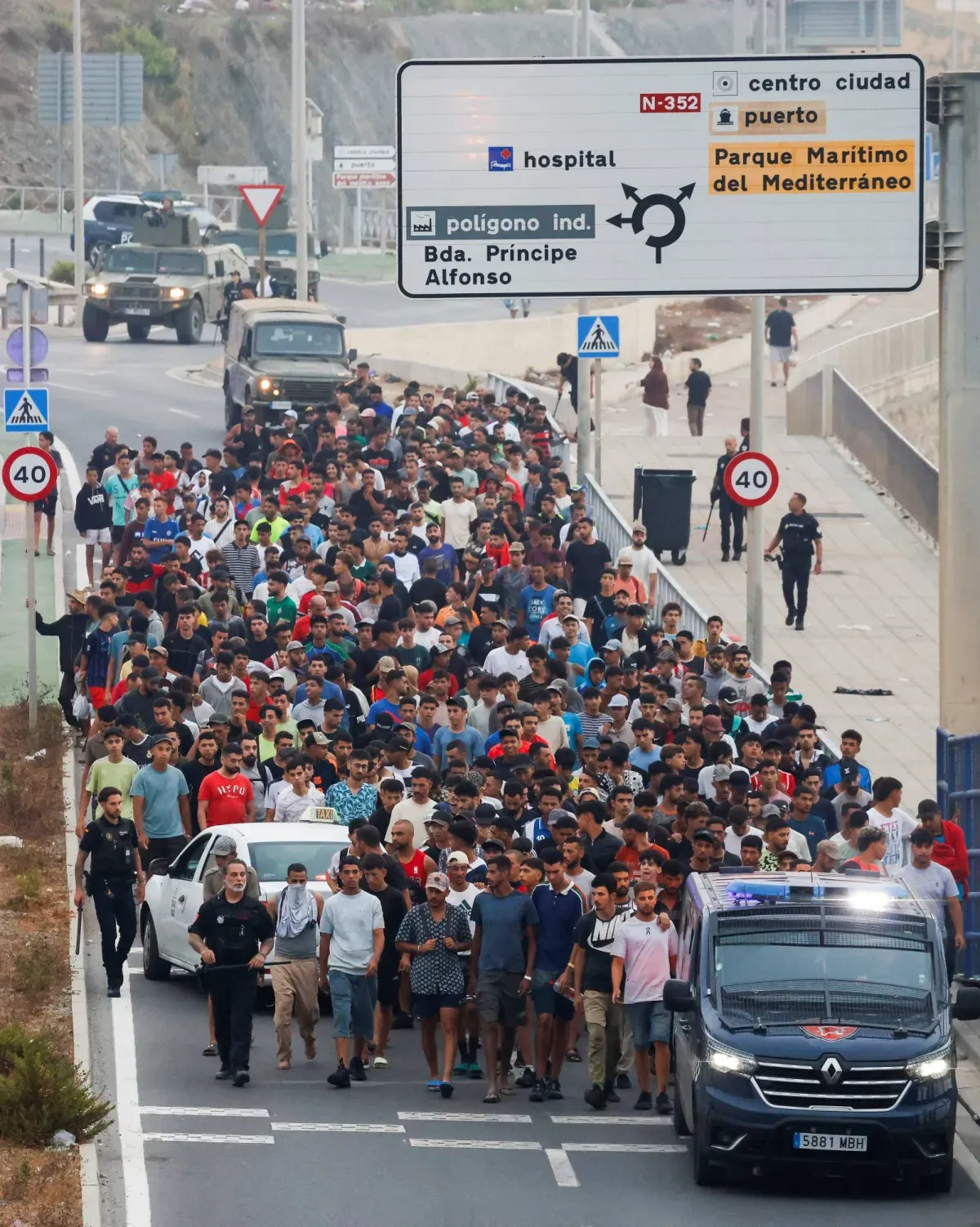

In recent days, nearly all migrants who surged into the Spanish enclave of Ceuta, located on Morocco's northern coast, have been returned to Morocco, as reported by Spanish authorities. This development comes amid significant criticism from other European Union countries regarding the handling of the sensitive issue of immigration. Authorities have indicated that the situation is now "almost normal," following a chaotic influx of migrants.
According to Spanish Interior Minister Fernando Grande-Marlaska, at least 67 migrants tragically lost their lives while attempting to reach Ceuta. During a press briefing held in Ceuta following an emergency meeting to address this unprecedented crisis, Grande-Marlaska described the situation as a series of "tragic and unfortunate incidents". He noted that within a mere 48 hours, circumstances had shifted dramatically, returning to a state of near normalcy.
By Friday evening, the Spanish government confirmed that nearly all migrants who had entered the enclave in the preceding days had been sent back to Morocco, amounting to approximately 48,000 individuals according to official data. However, on Saturday morning, young individuals continued to cross the border back into Morocco, observed by police and civil guards amid dense fog. Reports indicated that soldiers were urging those remaining on the beach to turn back, while some were seen emerging from the water, utterly exhausted. One Moroccan, Sofiane, aged 42, stated that he swam for "3 to 5 minutes" in hopes of reaching Madrid, hundreds of kilometers north, to visit his mother who is suffering from cancer.
Since the start of the week, the influx of migrants—largely comprised of young Moroccans—has surged, with estimates from local officials in Ceuta, such as Mayor Juan Jesus Vivas, placing the number at around 60,000, while the Spanish Interior Ministry estimated it at 50,000. Ceuta, with its population of 84,000, alongside the Spanish enclave of Melilla, serves as one of the few land borders between Africa and Spain. To deter migrants from crossing into Ceuta via swimming, a floating barrier stretching 500 meters has been deployed in the Mediterranean Sea, as disclosed by the Interior Minister.
Reports from the Agence France-Presse revealed hundreds of migrants, many from sub-Saharan Africa, waiting outside a closed shelter surrounded by police. As images of the migrant influx circulated, far-right European factions called for enhanced security measures at the Schengen borders. Since Thursday, Italy has advocated for Spain to be suspended from the Schengen Agreement, a stance supported by Finland and Denmark. However, Spain dismissed this proposal as demagogic. The Italian Interior Ministry announced that increased scrutiny would be implemented at air and sea borders with Spain for non-European citizens arriving from Spain. French Interior Minister Laurent Nuñez affirmed that Spain leaving the Schengen area "is out of the question," emphasizing the strong cooperation between France and Spain. He also stated that the reinforcement of police presence along the French-Spanish border would continue "as long as necessary" and that the number of police and gendarmerie officers deployed had increased fivefold to 334.
Spanish Prime Minister Pedro Sánchez visited Ceuta on Friday morning alongside the Interior Minister, condemning the migrant surge as an "attack and violation of Spain's territorial integrity." He accused "mafias" of spreading rumors regarding the opening of the borders between Morocco and Spain. In a post on X (formerly Twitter), Sánchez, who advocates for an open migration policy contrary to several other European nations, asserted that this is not a time for division but rather to continue building a strong and united European Union.
The Spanish government had previously announced a wide-ranging plan to regularize undocumented migrants, with 1.2 million applications submitted. On Saturday, Sánchez criticized the "selfish" stance of certain EU countries and called for an urgent video meeting of the interior ministers from the 27 member states. This current wave of irregular migration to Ceuta marks the largest since 2021 when around 10,000 migrants arrived amid a diplomatic crisis between Spain and Morocco, taking advantage of a relaxation in border monitoring by Rabat during a diplomatic spat with Madrid.
The ongoing crisis follows Sánchez's visit to Algeria on July 20, which was the first by a Spanish Prime Minister in four years and reflected an improvement in relations between the two nations after years of tension. On Friday evening, hundreds gathered outside the Moroccan embassy in Madrid, reportedly to "defend Spanish identity," according to agency correspondents. In Washington, former President Donald Trump, who prioritized combating irregular migration, described the images from Ceuta as akin to an "invasion of the country," accusing Spain of making "deliberate efforts" to facilitate irregular migration.
As reported by aawsat.com.