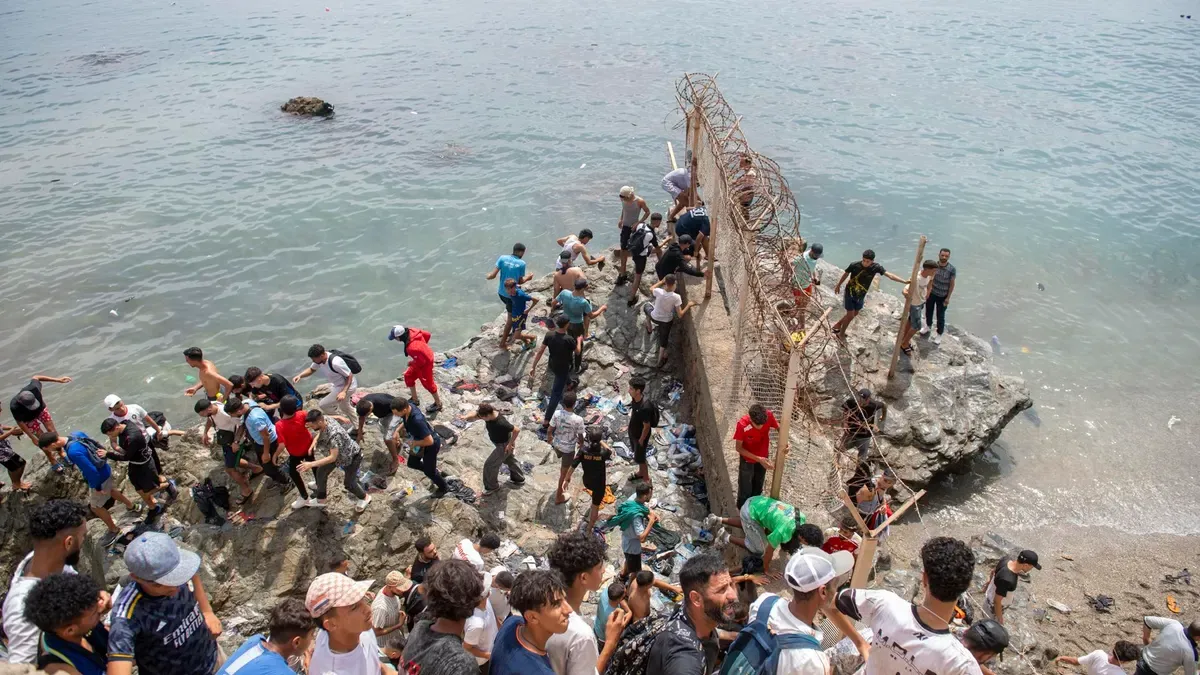

Spain faces a significant challenge regarding its defense, one that cannot be remedied solely through military enhancement, as it stems from deeper, structural, and cultural self-perception issues. The reality is that possessing an extensive arsenal is futile if, in the face of hostility, one fails to recognize the attack. The core issue surrounding Spain's defense of its sovereignty relates to how it will engage with Morocco after decades of complying with foreign strategies. Morocco is a formidable entity; the prevailing diplomatic approach suggests it is preferable to endure present aggressions rather than risk future, potentially more severe conflicts by upsetting the well-being of the Moroccan monarchy.
In the face of Morocco, Spain finds itself with a politically timid left, a servile social democracy, a hesitant right, and an extreme right that appears to be betraying national interests. There is a palpable reluctance to confront the reality of having an unreliable partner to the south, embroiled in an open territorial conflict and driven by an irredentist nationalist ideology that will not relinquish its aspirations for a Greater Morocco. There is a particularly concerning element regarding the systemic PSOE's subservience to the Moroccan lobby in Spain, which often prioritizes the interests of King Mohammed VI over those of Spain itself. This is not merely a rhetorical flourish; there exists a consultancy linked to a former socialist minister advocating for Moroccan interests within the EU.
King Mohammed VI has indeed launched an attack on Spain, utilizing a weapon that the National Security Strategy explicitly identifies: leveraging migratory flows as part of a hybrid warfare strategy. This threat is so tangible that the administration of Pedro Sánchez deemed it significant enough to include in its national security concerns. The European Union is acutely aware of this, as evidenced by its reactions during similar situations, such as when Belarus employed similar tactics against Poland or Russia did with Finland. No nation accused Poland of being unable to manage its borders amidst such aggression, nor did anyone threaten to annul the Schengen treaty or lean on Belarus as a reliable partner for managing migration flows. Everyone recognized this as an unconventional assault on Poland's sovereignty.
A multilayered strategy has led Spain to its current predicament. The most pressing issue is that Spain has a reactionary immigration policy. The current government's approach, similar to that of Frontex, has remained unchanged from previous PSOE or PP administrations and relies on outsourcing border control to the Moroccan dictatorship. This effectively means an absolute dependence on the political will and interests of Mohammed VI, just as it was with his predecessor Hassan II, and now extends to his successor. If Spain relinquishes sovereign control over such a crucial policy as migration, it should not be surprising that the country entrusted with this control operates in accordance with its own interests, which will never align with those of Spain.
The immigration policies of Spain and the EU, as implemented by Frontex, mirror the hardline stances advocated by figures like Donald Trump. They promote militarized borders that transform the immigration phenomenon into a form of necropolitics. Numerous examples abound to illustrate why this system fails, especially in light of constant migratory flows and specific events that render hard borders irrelevant. This model is unsustainable; for decades, the policy has been inhumane, cruel, and completely ineffective—failing to achieve its goal of curbing migration flows while simultaneously fostering a brutal and inhumane environment. It is unacceptable to maintain such a disastrous immigration policy for decades while demanding alternatives from critics without properly assessing the current situation and establishing an accurate diagnosis of the catastrophe at hand. Changing this model is no simple task; it cannot occur overnight and requires structural, social, political, and geopolitical changes that seem unrealistic given the current power dynamics. This reflects a capitalist model favoring the free movement of goods while restricting that of people, contrasting starkly with another possible approach.
The geopolitical implications and subservience to the Majzen are also a shared responsibility. Appeasement does not work with autocracies involved in territorial disputes. After conceding to Morocco regarding Western Sahara—without a clear understanding of the motivations behind it—there are concerns that Ceuta and Melilla may be next. Regardless of our beliefs about these autonomous cities and whether our sovereignty is negotiable, it is crucial to recognize that, for Morocco, this is a priority, and it has been preparing for decades to challenge Spain's sovereignty over these territories. In 2021 and again in 2026, messages have been communicated from the Alaouite autocracy indicating that its relations with Algeria serve to remind Spain that control over Ceuta and Melilla is only assured when Mohammed VI decides. Moreover, it is evident that Europe will not necessarily side with Spain, that the current government speaks of attacks on territorial integrity without daring to directly name Morocco, and that the opposition may align with Mohammed VI's interests to undermine Pedro Sánchez. This test has proven successful for Morocco, even if it jeopardizes a world event in the process.
Pedro Sánchez's geopolitical stance, which opposes the United States and Israel, was never going to be without consequences. In April 2026, two parallel projects were introduced in the US Senate and Congress by Republicans Díaz Balart and Ted Cruz, questioning Spain's sovereignty over Ceuta and Melilla by referring to them as "Moroccan territory administered by Spain" and urging Marco Rubio to advance negotiations regarding the sovereignty of these Spanish territories. This position became apparent after Spain denied the use of its bases in Morón and Rota for US attacks on Iran. Ignoring the situation or dismissing it as merely another migratory crisis, rather than recognizing it as a hostile act of hybrid warfare by Morocco and the US, amounts to a betrayal of Spanish sovereignty.
The movement of 72,000 Moroccans, exploited by their own dictator, occurred in a context that cannot be overlooked, closely tied to Spain's assertion of sovereignty in its dealings with Algeria. In the days leading up to Morocco's hostile actions, specific events transpired: Francina Armengol welcomed Sahrawi children in Congress on July 15, emphasizing Spain's historical responsibility toward Western Sahara; Pedro Sánchez visited Algeria on July 20 to establish diplomatic equilibrium in North Africa; and on July 23, Congress approved a bill granting nationality to Sahrawis, while the PSOE attempted to suppress references to the "Sahrawi people" to avoid offending Morocco. On July 30, Morocco celebrated Throne Day, exploiting the desperation of its citizens as a weapon in hybrid warfare against Spain, demanding accountability for perceived slights. For Morocco, it is intolerable that Spain seeks to establish balanced relations with Algeria, yet this is a sovereign decision of Spain that should not be subject to the interests of third countries.
It is imperative to question why the entire Spanish political class fears Morocco and hesitates to present a clear discourse that confronts reality. A nation like Spain cannot remain enslaved to its relationship with a tyrant. The Alaouite dictatorship is an adversary of our sovereignty. These are crucial points for establishing a transparent discourse, particularly from the left, which aspires to internationalism, because the worst form of sovereignty is one exercised from abroad by entities hostile to human rights and complicit with imperialism.
As reported by lasexta.com.