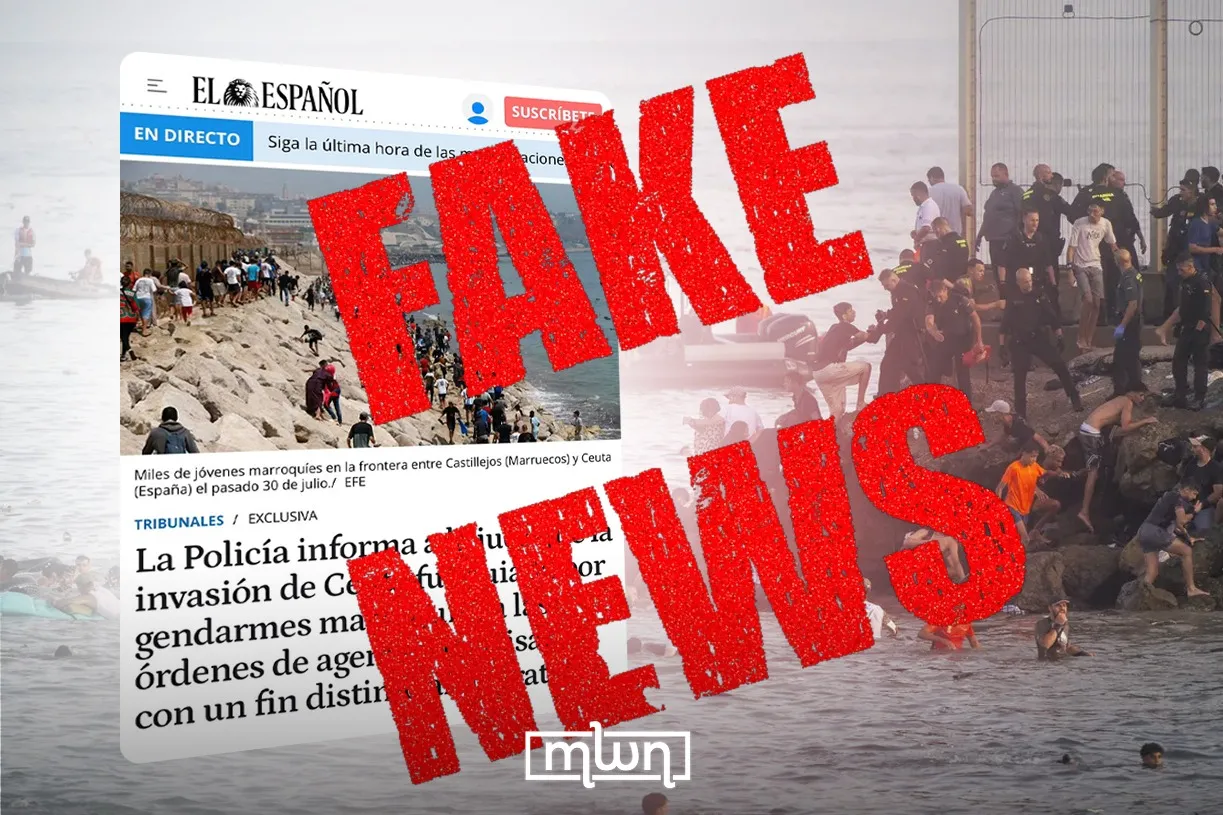

Marrakech – The assertion that "Morocco is becoming a collateral victim of the internal struggles taking place within the Spanish state" was made by Moroccan author and political analyst Samir Bennis. This statement, which surfaced on social media, exposes an ongoing conflict within Spain that repeatedly affects Morocco, particularly in the context of accusations surrounding migration issues. Recently, new reports from El País confirmed that Spain’s National Police director, Francisco Pardo Piqueras, had informed Interior Minister Fernando Grande-Marlaska that there is no evidence linking the Moroccan state to the mass migration events that took place in late July at the occupied city of Ceuta. Despite this clarification, Bennis criticizes the distortion of facts presented by El Español, a publication he describes as a "far-right newspaper run by a fascist," for suggesting that Moroccan authorities orchestrated these migrant crossings.
This disavowal by police officials marks yet another instance in a long line of accusations against Morocco, which, according to Bennis, are unfounded and politically motivated. Prime Minister Pedro Sánchez recently echoed this sentiment, asserting that no intelligence reports connected Rabat to the July influx and commending Morocco for its effective cooperation in managing border security. Meanwhile, Moroccan authorities have categorically rejected any claims suggesting that they orchestrated the migrant crossings, attributing the events instead to disinformation and human trafficking networks.
The narrative propagated by certain media outlets, particularly El Español, alleges that Moroccan gendarmes collaborated with disguised agents to facilitate the entry of thousands of migrants, framing the situation as an "invasion." However, the head of Spain's National Police swiftly countered this claim, clarifying that no evidence exists to support such accusations. Bennis emphasizes that the real issue lies in the internal contradictions and struggles within the Spanish government, highlighting a divide between intelligence and defense sectors who view Morocco as a cooperative partner, and right-wing factions that seek to blame Morocco for political gain.
Moreover, Bennis categorically challenges the lack of concrete evidence linking Moroccan authorities to the alleged orchestrated migration, arguing that the accusations are grounded in conjecture rather than substantiated claims. He articulates a pressing need for accountability and transparency, questioning the accuracy of the reports that have been used to vilify Morocco. Bennis notes that the Spanish political landscape is characterized by a fraught relationship with Morocco, shaped by historical narratives that persistently frame the North African nation as a threat to Spain's sovereignty.
In a pointed critique, Bennis scrutinizes Alberto Núñez Feijóo, the leader of the Partido Popular, for perpetuating unfounded claims against Morocco even after official clarifications absolved Rabat of responsibility for the migration crisis. He argues that such rhetoric not only harms diplomatic relations but fundamentally undermines the trust that is essential between neighboring countries. The ongoing campaign against Morocco, which Bennis likens to a political 'Moor-hunt', risks leaving lasting scars on international relations and the perception of Morocco within Spain.
In closing, Bennis warns of the profound consequences that arise from this cynical political maneuvering, as it jeopardizes mutual trust and cooperation between Spain and Morocco. The potential fallout from these actions may be much more significant than any temporary political gains, as reputations tarnished by electoral strategies will take considerable time and effort to repair. Ultimately, the political exploitation of Morocco's image serves to perpetuate an outdated colonial mindset that fails to recognize Morocco as a sovereign nation, but rather views it as a challenge to be contained.
As reported by moroccoworldnews.com.