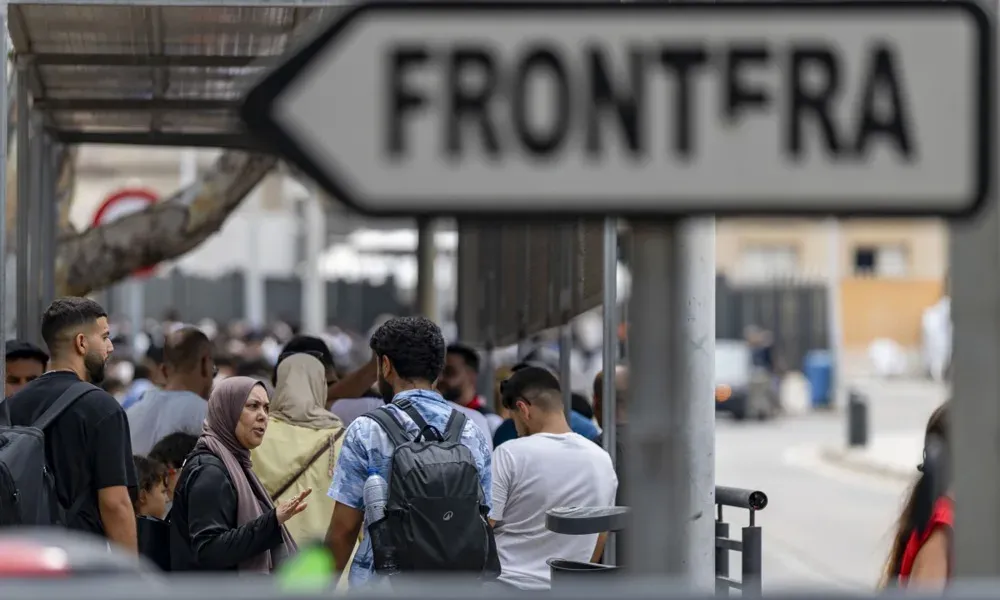
On Thursday, Spanish Prime Minister Pedro Sánchez firmly dismissed ongoing allegations suggesting that Moroccan authorities played a role in orchestrating the recent tragic mass migration of individuals from Morocco to the Spanish exclave of Ceuta. This statement comes amid increasing pressure regarding his administration's handling of the crisis. Just a day prior, widespread protests erupted in cities throughout Spain, where tens of thousands of citizens voiced their concerns over the humanitarian situation unfolding in Ceuta, demanding immediate solutions and calling for Sánchez's resignation.
In late July, an unprecedented surge saw approximately 72,000 migrants attempt to enter Ceuta, a small Spanish territory in North Africa that is home to just 84,000 residents. While most of these individuals were either sent back to Morocco or returned voluntarily within a few days, around 5,000 remained in Ceuta weeks later, including 1,200 minors, according to the national government. However, local authorities in Ceuta have reported higher figures than those acknowledged by Sánchez's administration.
During his address, Sánchez stated that 141 individuals lost their lives while attempting to reach Ceuta, yet neither his office nor the Spanish Interior Ministry provided clarity on how this figure was determined. The circumstances surrounding the mass crossing continue to raise significant questions, particularly as the Spanish government attributes the influx to a social media campaign.
Recent reports from Spanish media indicated that a police document pointed to a possible leniency of Moroccan security forces during the incident, but Spanish officials refuted claims that the document implicated Morocco. Nevertheless, Sánchez acknowledged that during a critical 10-hour period on July 30, when the influx peaked, Morocco’s Gendarmerie police “allowed the border to be crossed” into Ceuta. Despite this admission, Sánchez's government has refrained from openly criticizing Morocco, though he condemned remarks from two Moroccan ministers who questioned Spain’s sovereignty over Ceuta and Melilla, another of Spain's territories in North Africa. In response, Sánchez mentioned that his government had summoned the Moroccan ambassador in Madrid to address these comments.
While Sánchez rejected the notion that Moroccan authorities coordinated the incident, he reiterated that the Moroccan police had permitted the border crossing to occur. He also indicated that his administration would eventually release crucial reports concerning the border breach but did not specify a timeline or details regarding the content of these reports.
Moreover, Sánchez increased the official death toll from the incident to 141, a significant rise from the previous estimates of 96 provided by authorities in Ceuta and Morocco's National Human Rights Council. Despite citing this revised figure, neither his office nor the Interior Ministry could clarify how it was calculated when approached by The Associated Press.
Opposition leader Alberto Feijóo sharply criticized Sánchez’s approach during parliamentary sessions, expressing that Spaniards are both perplexed and outraged by perceived violations of their territorial integrity. He echoed sentiments from millions of protesters across the nation, pledging solidarity with the people of Ceuta and asserting that the state has not abandoned them.
As the humanitarian crisis in Ceuta deepens, Sánchez is increasingly under scrutiny for his administration's response to the overwhelming influx of migrants, which has strained the resources of the small community ill-equipped to manage such challenges. Conflicting statements from top government officials regarding the circumstances surrounding the border rush have only added to the confusion. Just last week, the defense ministry indicated that Spain’s intelligence agency had provided advance warning of the impending crisis, while the interior ministry and other sources claimed otherwise.
Ceuta and Melilla represent the only land borders within the European Union that connect to Africa, making the management of such crises particularly sensitive for the Spanish government. As Sánchez navigates this challenging situation, the call for transparency and accountability only grows louder.
As reported by africanews.com.