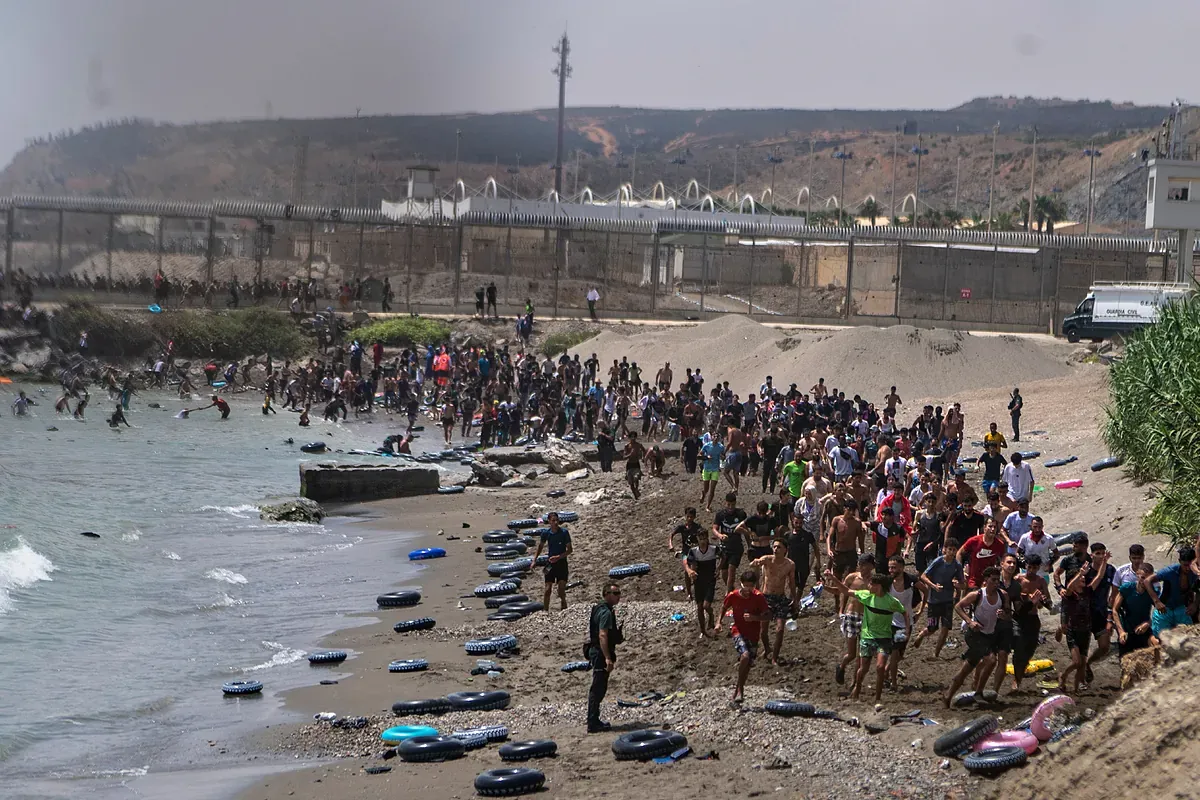

The Spanish government has pledged to utilize every available resource to ensure the safety of the citizens of Ceuta, as stated by the president following his recent visit to the autonomous city. However, this promise came just hours after a significant breach in security occurred on Spanish soil. An astonishing 72,000 individuals entered Ceuta irregularly from Morocco, an event described by Pedro Sánchez as a "violation of Spain's territorial integrity." This incident raises serious concerns, especially considering Spain's status as the fourth-largest economy in Europe, backed by a substantial defense budget and well-defined international borders.
Interior Minister Fernando Grande-Marlaska commented on the situation, noting that multiple factors contribute to such occurrences, suggesting that there is not always a direct accountability for these failures. His remarks came in the wake of Ceuta experiencing a dramatic population surge, which highlighted significant vulnerabilities within the state's mechanisms—creating a daunting legacy for the future. This event also led to tensions within the European Union, where Spain's government faced scrutiny from all 27 member states, particularly from Italy. The criticism of Sánchez's migration policies by 22 countries, coupled with political tensions with Italian Prime Minister Giorgia Meloni, paints a challenging picture for Spain’s recovery from this crisis.
The government has been reluctant to hold anyone accountable for border security, with Marlaska stating that no reports had indicated an impending influx of migrants. Despite this, he expressed confidence in the capabilities of Spain's National Intelligence Center (CNI) and other intelligence services. Furthermore, the government has attempted to absolve Morocco of blame for the situation, even though Rabat has previously intervened to prevent similar mass migrations. While Moncloa has refrained from assigning blame, it has become evident that both intelligence failures and misplaced trust in Morocco contributed to the crisis.
Juan Jesús Vivas, the president of Ceuta, has repeatedly asserted that he alerted the government about the increasing flow of immigrants crossing the border in the days leading up to the surge. However, the government has tried to separate this migratory phenomenon from the unprecedented event of July 30, which it deemed an "attack on territorial integrity." Alarmingly, no state mechanisms warned the government about the simultaneous arrival of 72,000 individuals at the border.
Marlaska's pointed remarks regarding the CNI, despite not demanding accountability, led to internal conflicts within the government. Defense Minister Margarita Robles insinuated that there are intelligence services under the Interior Ministry's jurisdiction. Nonetheless, she did not deny that the intelligence under her portfolio failed to predict or alert about the surge. As of now, no one in the government has disputed the apparent intelligence failure.
This is not the first time Spain's security has been threatened by mass incursions. A smaller-scale incident occurred in 2021, when 14,000 people entered Ceuta from Morocco under circumstances that were clearly linked to actions taken by Rabat. At that time, Morocco's ambassador indicated that certain actions have consequences, alluding to Spain's acceptance of the leader of the Polisario Front. Additionally, tensions escalated in 2019 during mass protests organized by Tsunami Democràtic, which brought thousands to block El Prat Airport. Although the contexts differ, these instances reflect ongoing conflicts with the state manifesting through human actions against national security.
With the recent events, Marlaska acknowledged the intelligence failures, yet no significant figures within the government have suggested that there may have been issues in diplomatic relations with Morocco. This silence is notable, especially since both Sumar and Vox have directly pointed fingers at Rabat as the root cause of the situation. The opposition argues that the lack of accountability towards Morocco, while labeling the incident as an "attack on Spain's territorial integrity," raises many questions. Santiago Abascal from Vox asserts that Morocco felt emboldened to act in this manner because it anticipated no repercussions.
The implications of this security collapse resonate beyond immediate concerns. The mass entry on July 30 marked the largest irregular influx of individuals into Spanish territory since the Green March, representing a national crisis that has escalated beyond previous instances. The solution previously enacted—Spain's pivot on the Western Sahara issue—has not proven sufficient to prevent the recent surge. The recognized failure within national intelligence services and the absence of accountability towards Morocco complicate the aftermath of the crisis for Ceuta and Spain as a whole.
As reported by elmundo.es.