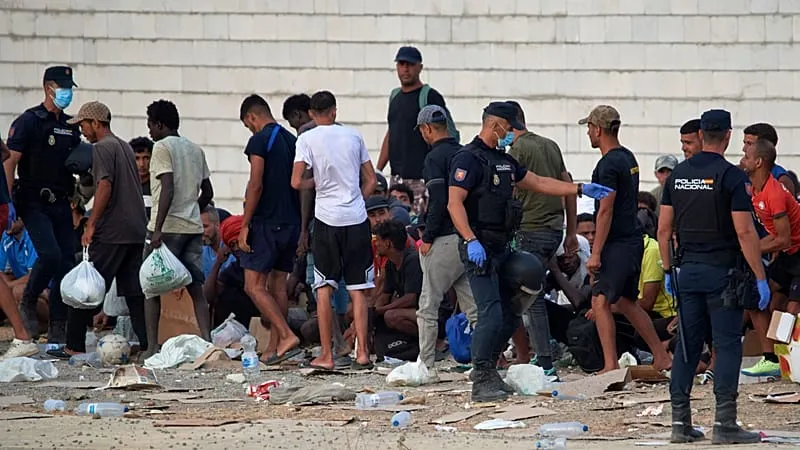

The Spanish Ministry of Health has urgently convened autonomous communities for a critical meeting focused on the provision of vaccines for migrants residing in Ceuta, following a massive influx from Morocco at the end of July. This extraordinary session of the Public Health Commission is scheduled to take place on Monday, August 24, at 12:00 PM via videoconference, as reported by multiple Spanish media outlets. The meeting will bring together representatives from public health services across various autonomous communities and cities.
According to the newspaper El Mundo, the sole agenda item is the establishment of a "solidarity mechanism for vaccines related to the situation in Ceuta." The primary objective of this session is to ensure that the autonomous city receives an adequate supply of vaccine doses aimed at immunizing the migrants who are currently enduring challenging conditions and to bolster protection against various infectious diseases.
Vaccination Plans Against Infectious Diseases
The vaccines that the Ministry of Health intends to administer include the combined vaccine for measles, mumps, and rubella, which protects against these diseases. Additionally, the Ministry plans to provide vaccinations for other illnesses such as chickenpox, poliomyelitis, tetanus, and diphtheria. The ongoing migration crisis is exerting additional pressure on the city's healthcare services. Between July 31 and August 14, the National Institute for Health Management (Ingesa) recorded 5,801 treatments related to this crisis. Moreover, the emergency team established by the Spanish Red Cross at Playa Trampolín attended to more than 2,500 additional individuals. A peak was reached on July 31, with 1,149 treatments in just one day.
The Ministry also reported 18 minors with a positive Mantoux test and two confirmed cases of tuberculosis. Physicians have noted consultations regarding gastroenteritis, scabies, and impetigo. The Spanish Army has identified at least 24 cases of scabies among its soldiers at the General Command in Ceuta. However, the Spanish Society of Epidemiology emphasizes that these diseases should not be directly associated with the migrants' status. Instead, health issues are primarily linked to overcrowding, poor sanitary conditions, and a lack of resources in which many of these individuals are forced to live.
As reported by aol.de.