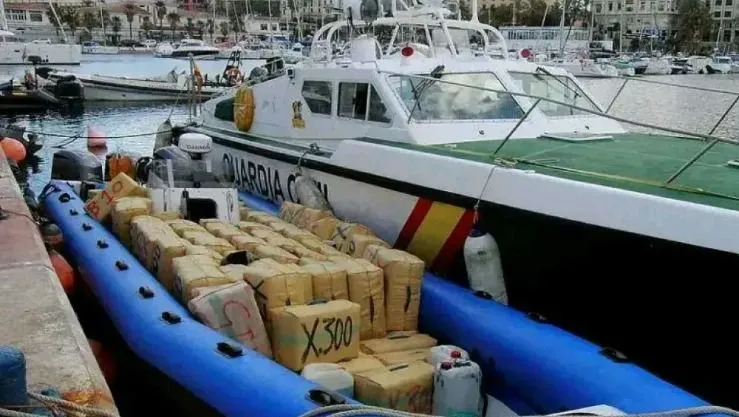

Morocco: The Main Source of Cannabis Smuggling into Spain
The Spanish Public Prosecutor's Office has identified Morocco as the primary source of cannabis being smuggled into the coastal regions of Andalusia, southern Spain. This revelation comes at a time when drug trafficking networks are becoming increasingly active and sophisticated, amidst a backdrop of rising violence and the proliferation of firearms alongside the growing cocaine trade. The prosecutor's findings were outlined in their annual report for 2025, presented during the opening of the judicial year at the Supreme Court in Madrid.
According to the report, drug trafficking represents the "greatest threat" arising from organized crime and severe offenses in the country. Spain has been recognized as a strategic location on global maritime drug routes, with cannabis cultivated in Morocco entering through the Andalusian coast. Meanwhile, the majority of cocaine from South America is brought in via ports before being distributed across Europe, as highlighted in the report by the newspaper "Info Bay".
Rising Seizures and Evolving Smuggling Tactics
In Andalusia, cannabis remains the most prevalent narcotic, but there has been a significant increase in the volume of seizures across various regions. For instance, in Huelva, authorities confiscated 63,103 kg of cannabis during 2025, a staggering increase of 201.8% from 20,975 kg in 2024. This surge in seizures reflects a clear evolution in smuggling techniques, as the prosecutor's office noted the use of large trailers equipped with hollow beams as double floors and tunnels dug under the border in the Spanish area of Ceuta. Additionally, fast boats have been increasingly used to transport drugs from the Strait of Gibraltar to the shores of Huelva, Almería, and Málaga.
Simultaneously, there has been a noticeable expansion in cocaine trafficking, which has gained significant traction in Cádiz, Seville, and Huelva. In Algeciras, cocaine continues to be smuggled via containers, while semi-rigid boats are employed in regions such as Barbate, Sanlúcar, and the Guadiana River to transport cocaine from ships at sea. In Almería, the quantity of cocaine seized rose dramatically from 324 kg to 1,255 kg, marking an increase of 287%. Moreover, seizures of Moroccan cannabis resin exceeded 18 tons compared to about 4 tons the previous year, representing a 350% increase. This shift has been attributed to the relocation of landing points to nearby geographic areas where criminal networks anticipate less law enforcement pressure.
The rapid boats are no longer solely for transporting cannabis; they are now used "naturally" for carrying cocaine loaded from ships in the open sea. The prosecutor's report also warned of the escalating violence associated with drug networks in Andalusia, noting the rise of organized and professional criminal groups that use their weapons not only against rival gangs but also "openly" against law enforcement.
In Cádiz, the report documented 24 incidents related to weapons possession, including the seizure of four AK-47 rifles in Jerez and Sanlúcar during three separate operations, alongside automatic weapons and machine guns in Barbate and Chiclana. Almería reported the confiscation of 78 firearms, including several machine guns and a rocket launcher, while Seville also witnessed an uptick in weapon seizures, with a police officer sustaining serious injuries during an operation in "Coría del Río".
The prosecutor concluded that the size, complexity, and violence of drug networks now exceed the available means to confront them, urging for urgent enhancements in human, material, and legal resources, as the phenomenon "erodes the foundations of social peace".
As reported by elbilad.net.