
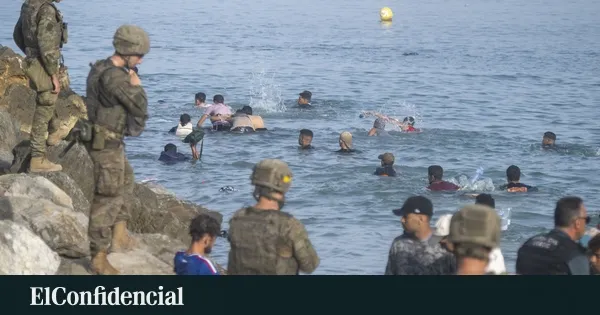

The Spanish government is determined to prevent a recurrence of the alarming scenes witnessed on July 30, when tens of thousands of migrants entered Ceuta in a massive influx. In response to a call circulating on social media encouraging a similar operation this coming Saturday, both the Ministry of Defense and the Ministry of the Interior have initiated precautionary measures. These measures include placing military and civil guard troops on high alert and suspending all leaves, vacations, and licenses for personnel in these departments in the coming days. This development has not gone unnoticed by Morocco, as local media have reported on the heightened activity in social networks.
The General Directorate of the Civil Guard has issued a directive signed by its head, Manuel Llamas, which was communicated to the commands in Ceuta and Melilla. These cities are home to 620 and 650 civil guards, respectively, who are now subject to a suspension of any previously approved days off. There is currently no specified end date for this restriction.
While the content of this directive, confirmed by El Confidencial and initially reported by Cadena Ser, does not explicitly address the recent social media calls for mass entry into Spanish territory from Morocco, it does highlight an increase in migratory pressure and the necessity to implement extraordinary measures during "situations of risk or serious emergency," according to police sources consulted by the newspaper.
On the same day, the Ministry of the Interior announced a reinforcement of security forces in Ceuta, including the deployment of nearly fifty additional riot police from the mainland for public safety tasks, along with drone units. However, unlike the military, which has suspended leaves, the police have opted to incentivize voluntary overtime hours for their 640 agents in Ceuta and 620 in Melilla, rather than cancel vacations.
Furthermore, the Ministry of Defense has restricted vacations for soldiers stationed in Ceuta through the General Command of Ceuta. Soldiers currently on leave must return to their bases unless they can provide exceptional justification, such as medical reasons.
Security forces and the National Intelligence Center (CNI) have been investigating the new call for action planned for the upcoming Saturday. They consider it credible and believe that social media played a critical role in creating the conditions that led to the surge at the end of July. Independent studies, including those by researcher José María Gil Garre and the Golden Owl company linked to the University of Alicante, suggest that the events at the end of last month were not spontaneous, revealing an organized structure operating through Facebook groups and other messaging platforms.
Sources within the security forces are optimistic that the events of July 30 will not be repeated, noting that the majority of individuals voluntarily returned to Morocco just hours after the mass entry, as they encountered a closed city and no means of access to the mainland. There is also hope that Morocco will act more promptly this time due to the negative image projected by the massive outflow of people seeking to escape their living conditions.
The regime of King Mohamed VI has attempted to repair its image through sympathetic media outlets, suggesting that the swift return of migrants soon after the mass surge was due to their realization that "Morocco is better than Spain." This narrative has been echoed in local press, with Al-Sabah, one of the principal Arabic daily newspapers in the region, highlighting the suspicious digital campaigns aimed at inciting another assault on Ceuta.
The Situation of Minors
One of the urgent concerns in Ceuta is the plight of unaccompanied minors. The military has collaborated with the National Police in managing these young migrants who have gathered at the Superior Police Headquarters of Ceuta, seeking registration for access to reception centers. This scene has been recurring since the previous week, with military personnel providing support to police officers.
Judicial sources reported that irregular minors began arriving at the police station early in the morning. The containment measures were "overwhelmed," with at least 400 minors crowded outside until 11:00 AM, when police and military forces managed to clear the area.
Ceuta's president, Juan Jesús Vivas, indicated that the city is currently catering to approximately 1,400 minors and has called for a comprehensive analysis of the context surrounding the massive entry of migrants. He noted that the number of minors under care had escalated from around 180 to about 800 in the week leading up to the crisis. Vivas emphasized the commitment to uphold the best interests of the minors while advocating for a specific strategy to address the exponential increase in arrivals, including allocating all necessary resources to facilitate family reunification for these minors, even if it requires legislative changes to expedite these processes.
As reported by elconfidencial.com.
