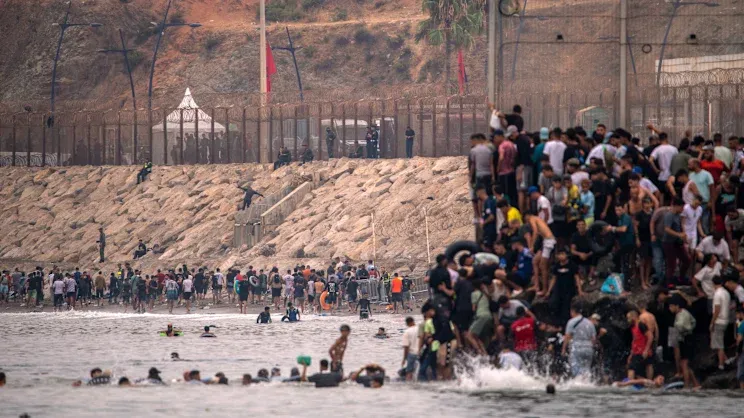

In a dramatic escalation of political blame, Spanish Prime Minister Pedro Sanchez has accused networks in Israel and Russia of disseminating false information that incited a significant border crisis, resulting in over 72,000 migrants crossing from Morocco into Ceuta, a Spanish enclave, just weeks ago. Sanchez has firmly rejected claims suggesting that Moroccan authorities played a role in encouraging these migrants to swim to the Spanish territory, attributing the crisis instead to a campaign of online misinformation propagated by foreign entities.
The discord between Sanchez's administration and Israeli officials has become increasingly pronounced, as Israeli Foreign Minister Gideon Sa’ar has vehemently denied Sanchez's accusations, labeling them as “shameless lies” intended to deflect attention from the Spanish government's own failings. This controversy underscores the growing political tensions surrounding the Ceuta crisis, particularly as Sanchez faces criticism regarding his migration policies while simultaneously condemning Israel for its military actions in Gaza and Lebanon.
From the onset of the crisis on July 30, when thousands stormed border checkpoints to reach Ceuta, a narrative emerged among migrants that entry into this city would guarantee them asylum in mainland Spain, following a Supreme Court ruling in June that restricted the immediate deportation of asylum seekers. Sanchez pointed to the spread of misleading information about this ruling, suggesting that extremist groups exploited the situation to politically attack Spain and sow division among European nations. He stated that both Russian and Israeli networks contributed to the dissemination of these “hoaxes,” exacerbating the already contentious issue of irregular migration that affects many European societies.
Despite this turmoil, Sanchez mentioned that Spanish authorities effectively responded to the crisis by repatriating the majority of migrants back to Morocco, with approximately 5,000 still remaining in Ceuta, facing significant challenges in securing basic necessities as local residents express opposition to their presence. Although some reports had indicated that Moroccan border guards encouraged these crossings, Sanchez dismissed such theories, asserting that no intelligence agency that collaborates with Spain had raised concerns about Moroccan involvement.
As the situation unfolds, European leaders remain divided on how to enhance border security under the Schengen Agreement, which facilitates free movement among member nations. Italy has opted to extend its suspension of Schengen rules with Spain for an additional 15 days, citing concerns about illegal migration, despite Madrid's protests. Sanchez has also faced backlash from European counterparts for his controversial decision earlier this year to grant residency to 500,000 undocumented migrants, a policy that further complicates Spain's position within the broader European migration landscape.
In the context of these geopolitical tensions, Sanchez has positioned himself as a staunch critic of Israeli Prime Minister Benjamin Netanyahu, particularly regarding the latter's military strategies in Gaza and Lebanon. Last year, Sanchez took a significant step by recognizing Palestine as a state, a move that led to strained relations between Spain and Israel. Moreover, Spain has joined South Africa in a legal claim against Israel at the International Court of Justice, accusing it of genocide, a claim that Israel vehemently contests.
As the exchange of accusations continues, Sa’ar's remarks reflect the ongoing discord, as he asserts that Sanchez's claims are a blatant fabrication aimed at deflecting from his government's inadequacies. The fallout from the Ceuta crisis not only highlights the complex interplay of migration and international relations but also serves as a reminder of the challenges that leaders face in addressing these multifaceted issues amid rising political tensions.
As reported by smh.com.au.