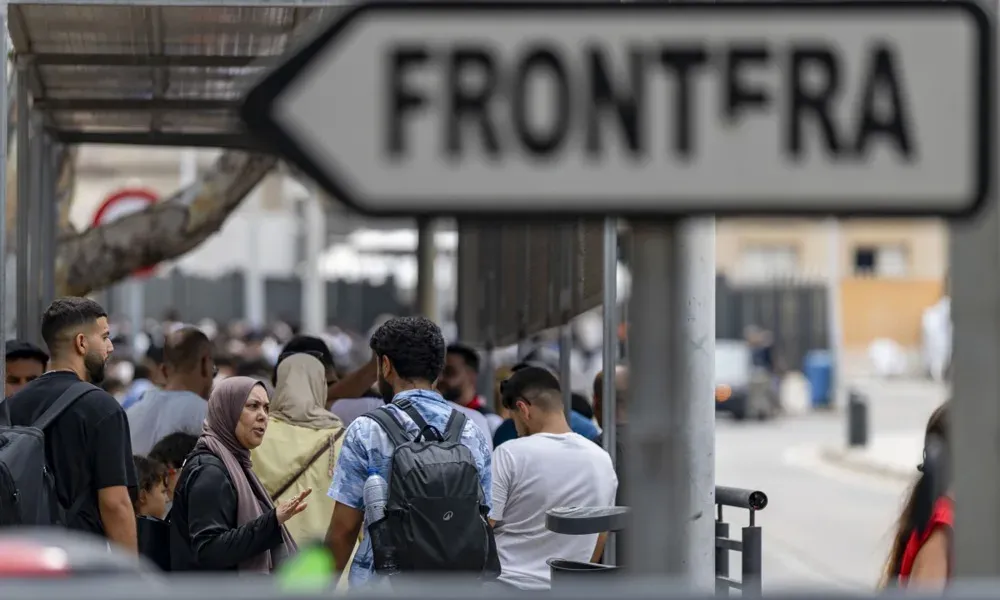
On Thursday, Spanish Prime Minister Pedro Sánchez firmly dismissed allegations suggesting that the Moroccan government played a role in orchestrating the tragic mass migration of individuals from Morocco into Ceuta, a Spanish exclave situated in North Africa. This statement comes as mounting pressure mounts regarding his administration's management of the ongoing humanitarian crisis that has unfolded in the region. Just a day prior, large-scale protests erupted across various Spanish cities, with tens of thousands of citizens expressing their discontent and demanding immediate solutions, including the resignation of Sánchez himself.
In late July, the situation escalated dramatically when approximately 72,000 migrants swam, climbed, and charged into Ceuta, which has a resident population of only 84,000. While most were quickly returned to Morocco or sent back across the border within days, around 5,000 individuals, including 1,200 minors, have remained in the city for weeks, as reported by the national government. However, local authorities in Ceuta have cited higher figures, further complicating the narrative surrounding this crisis.
During his address, Sánchez stated that 141 individuals had lost their lives while attempting to reach Ceuta, but neither his office nor Spain's interior ministry has clarified the methodology used to arrive at this number. Significant questions persist regarding the underlying causes of this mass migration, which the Spanish government attributes to an online campaign propagated through social media platforms.
Recent reports from Spanish media have indicated that a police document raised concerns about the alleged leniency of Moroccan security forces during the incident, although Spanish officials have refuted claims that this document implicates Rabat. Nonetheless, Sánchez acknowledged that during a critical 10-hour period on July 30, when the influx of migrants peaked, Moroccan Gendarmerie police “allowed the border to be crossed” in Ceuta. Despite consistently refraining from criticizing Morocco, Sánchez condemned remarks made by two Moroccan ministers that questioned Spain's sovereignty over Ceuta and Melilla, another Spanish territory in North Africa. In response to these comments, his government has summoned the Moroccan ambassador in Madrid.
While Sánchez has rejected claims of Moroccan authorities orchestrating the border breach, he has nonetheless emphasized that Moroccan police “allowed the border to be crossed.” He remarked that his government plans to release essential reports pertaining to the border incident, although he did not specify when these documents would become public or what they would entail. Moreover, he increased the official death toll from the incident to 141, a significant rise from the previously reported total of 96 by both Ceuta and Morocco's National Human Rights Council. He reiterated this updated figure on multiple occasions, yet neither his office nor the interior ministry could clarify how this number was calculated when approached by The Associated Press.
In the parliamentary session, opposition leader Alberto Feijóo harshly criticized Sánchez's handling of the Ceuta situation, expressing that “as Spaniards, we are simultaneously perplexed and outraged by the violation of our territorial integrity.” He conveyed solidarity with the people of Ceuta, stating, “We will not leave you alone; the State has not surrendered.” The growing humanitarian crisis in Ceuta has elicited frustration among residents, who feel ill-equipped to manage such a significant influx of migrants.
Amidst the chaos, top government officials have sometimes offered conflicting narratives about the events leading to the crisis. For instance, last week, the defense ministry indicated that Spain's intelligence agency had provided advance warning of the imminent border surge, while the interior ministry and other sources claimed there had been no prior notice. As the only European Union territories with land borders in Africa, Ceuta and Melilla remain at the center of this critical humanitarian issue.
Sánchez reiterated that his administration would release pivotal reports regarding the border breach, which has been deemed the deadliest incident of its kind in recent memory. However, the timeline for the release of this information remains unclear, leaving many to question the government's transparency and accountability in addressing this pressing crisis.
As reported by africanews.com.