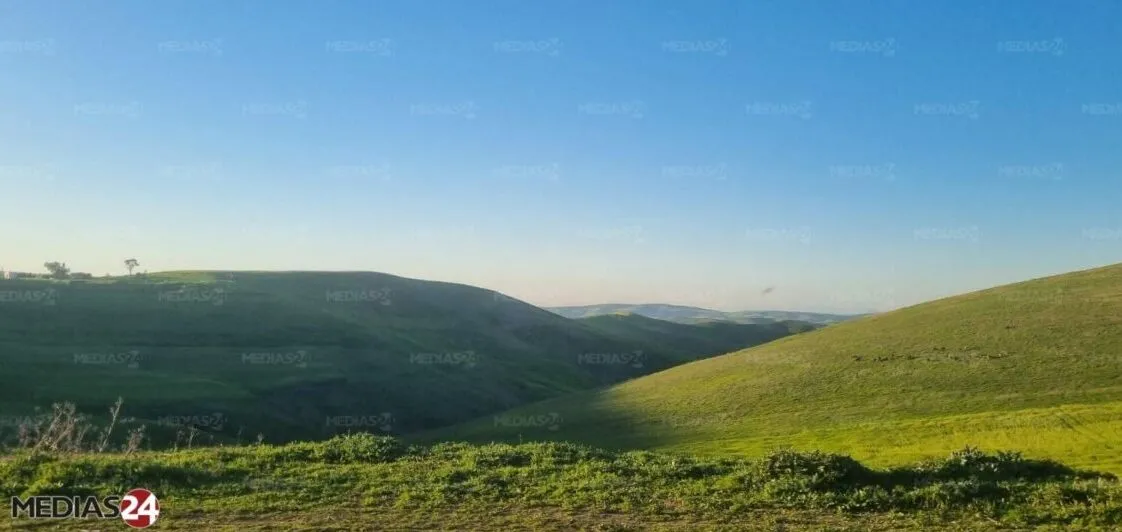

Overview of Spring 2026 Weather in Morocco
The spring of 2026 in Morocco has been characterized by notably diverse weather patterns, showcasing the region's climatic variability. Marked by late cold waves, spring snowfall in the Atlas Mountains, and early heat episodes, this season has proven to be one of the warmest recorded since 1981. According to the latest seasonal report from the General Directorate of Meteorology (DGM), the national average temperature exceeded the established normal by **0.29°C** based on data from 1991 to 2020. This temperature anomaly positions the spring of 2026 as the twelfth warmest since 1981, although it remains significantly lower than the anomalies recorded in the springs of 2023 and 2024, which were **+2.05°C** and **+1.18°C**, respectively.
Rainfall and Temperature Fluctuations
In terms of precipitation, the national deficit for the season was recorded at **9.6%**, a figure that closely aligns with the normal rainfall patterns according to the DGM. This deficit is considerably less severe than those witnessed in the springs of 2023 and 2024, which saw deficits of **-57.6%** and **-17.3%**, respectively. After the rainfall surplus observed in spring 2025 (+30.3%), the conditions in 2026 indicate a return to climatic averages. Noteworthy weather events during the season included a late cold wave from March 3 to 13, where temperatures plunged to **-5.2°C** in Midelt, **1.9°C** in Khouribga, and **2°C** in Taza, making March 2026 one of the ten coldest Marches on record since 1981. A subsequent cool spell from May 14 to 20 resulted in late snowfalls in the High and Middle Atlas regions. This was soon followed by an abrupt shift to an early heat wave that affected much of the country between May 20 and 27, with temperatures soaring past **43°C**, peaking at **43.6°C** in Sidi Slimane, **43.7°C** in Taroudant, and **43.8°C** in Smara. On May 25, Safi even set a new monthly record with a maximum temperature of **42.5°C**, surpassing the previous record of **40.5°C** established in May 2001.
The DGM emphasizes that the series of extreme weather episodes occurring within such a short timeframe underscores the critical need for consistent meteorological and climatic monitoring, as well as the importance of early warning systems. In light of increasing climatic variability, anticipating extreme phenomena remains a significant challenge for safeguarding populations and enhancing the resilience of various socio-economic sectors.
As reported by medias24.com.