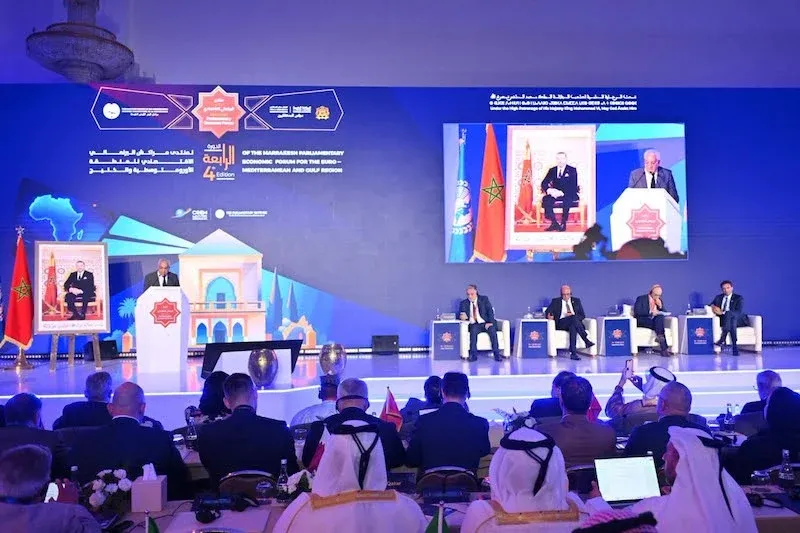

On Friday, international parliamentary officials gathered in Marrakech and emphasized that the recent crisis in the Strait of Hormuz during the latest conflict in the Middle East highlights the interconnectedness of global challenges and the urgent need to bolster economic cooperation between the Euro-Mediterranean region and the Gulf. They pointed out that the repercussions of this crisis have even reached the pockets of citizens in Europe and North Africa.
This discussion took place during the opening session of the fourth session of the Marrakech Parliamentary Forum for the Euro-Mediterranean and Gulf regions, which is being hosted in the red city on June 19 and 20, with a special session dedicated to Africa. Julio Centemero, the President of the Mediterranean Parliament, stated in his address that the situation in the Strait of Hormuz clearly demonstrates the close interconnection of today's global challenges, testing the resilience and endurance of both governments and communities.
Centemero elaborated that any local disruption in this strategic passage sends immediate ripple effects through energy markets, commercial logistics, investment confidence, and food supply chains, while also highlighting the environmental consequences resulting from changes in maritime traffic patterns. He asserted that this reality necessitates a collective ambition towards a shared future, explaining, "Although the Mediterranean, the Gulf, and the African continent consist of various nations, economies, and political realities, the challenges we face are borderless, and neither should our ambitions be limited."
Furthermore, he emphasized that amidst discussions on public debt and trade barriers, the common goal should be to enhance economic stability while maintaining openness, connectivity, and opportunities. He warned of the necessity to adopt a shared objective that ensures technological transformation becomes a catalyst for joint growth instead of a source of new divisions. This is precisely why the Mediterranean Parliament advocates for the establishment of an Artificial Intelligence center for the Euro-Mediterranean and Gulf region.
Addressing Economic Transformations
Hamad bin Salman Al-Musallam, the President of the House of Representatives of the Kingdom of Bahrain, commented that this crucial economic forum convenes to anticipate major economic transformations, diagnose regional challenges, identify strategic opportunities, and reaffirm the foundations of regional cooperation. He noted that striving towards a Euro-Mediterranean and Gulf framework opens more avenues for reinforcing economic integration among our countries and peoples.
In his opening remarks, Al-Musallam stated that the security and prosperity of the Mediterranean, as well as the security and stability of the Strait of Hormuz, are fundamental pillars in achieving the economic growth we aspire to in a time when interests intersect and challenges become complex. He expressed belief that parliaments play a vital role in international dialogue and cooperation, functioning as essential platforms for coordinating positions, bridging perspectives, and enhancing mutual understanding regarding the issues and challenges faced by our nations in today's world.
He also underscored that the significance of this economic cooperation amplifies in light of current international developments, particularly since the Mediterranean is one of the most important economic arteries globally, with over 30% of global maritime trade passing through it. Moreover, more than 20% of the world's oil supplies transit through the Strait of Hormuz. Al-Musallam pointed out that this passage is currently facing direct threats from Iran, which is closing it and disrupting navigation, in a blatant challenge to international law. He stressed that the rapid developments occurring in our region, especially due to aggressive Iranian actions, compel us to reassess the security of supply chains and energy routes.
He highlighted that attacks on oil tankers and threats to waterways, along with attempts to destabilize the Arabian Gulf, are not merely regional issues, but direct threats to global economic security, as they increase insurance costs and create volatility in energy markets, impacting the financial wellbeing of citizens in Europe and North Africa more than others. From this parliamentary platform, he called on the Parliamentary Assembly of the Mediterranean to issue a clear and unequivocal statement condemning Iran's brutal aggression against international navigation security and rejecting any attempts to blackmail the world by closing the Strait of Hormuz, asserting that maritime security is a collective responsibility and that those threatening Hormuz today may threaten other international straits and waterways tomorrow.
The Role of Parliaments in Economic Dialogue
Stephen Clemen, President of the Parliamentary Network of the World Bank and International Monetary Fund, remarked that the challenges outlined on the forum's agenda today—including public debt, investments in artificial intelligence, blue economy, food security, and the promises of the African Continental Free Trade Area (AfCFTA)—are exactly the issues that parliamentarians must hold institutions accountable for and translate dialogue into tangible outcomes. He expressed pride in his network's collaboration with the Parliamentary Assembly of the Mediterranean, noting, "Together, we share a common conviction: that through cooperation among our parliaments, we provide a strong and credible voice for multilateral institutions."
The fourth session of the forum, which includes a special session on Africa, is organized by the Moroccan House of Councillors and the Mediterranean Parliament, in collaboration with the General Confederation of Moroccan Enterprises and the Parliamentary Network of the World Bank and IMF. According to a statement from the House of Councillors, the forum's discussions will focus on several priority issues, including global economic challenges and prospects for regional economic integration, promoting investment in artificial intelligence and modern technologies, enhancing sustainable job opportunities, and addressing the impacts of climate change on food security and sustainable development.
As reported by hespress.com.