
As international conflicts and crises reshape global economic alliances and supply chains, the relationship between Morocco and Russia stands out as a partnership that has maintained a stable trajectory, even witnessing a notable increase in trade activities. This development comes at a time when Morocco has chosen a balanced approach regarding the ongoing Russian-Ukrainian conflict, steering clear of sharp Western alignments. The economic landscape has transformed significantly due to the Western sanctions imposed on Moscow since the onset of the war in Ukraine, pushing Russia to seek alternative partners and markets. This shift has allowed Morocco to leverage its geographical position and logistical capabilities, emerging as a prominent hub for trade associated with Russia, particularly in energy and agricultural products.
In recent statements to the Russian news agency RIA Novosti, Igor Beliaev, the Russian ambassador to Morocco, highlighted that the annual trade volume between the two nations is currently estimated between $1.5 billion and $2 billion. He noted that Russia exports to Morocco a variety of goods, including agricultural raw materials, industrial and chemical products such as urea, as well as insulin, cancer medications, vaccines, and pesticides. Conversely, Morocco exports fruits, vegetables, and seafood to Russia, which have seen increasing demand among Russian consumers. Despite the flourishing trade, Beliaev acknowledged that the level of economic collaboration still lags behind the political relations between the two countries, emphasizing the vast untapped potential for expanding trade partnerships. He also expressed Moscow's readiness to share its expertise with Morocco in areas like artificial intelligence and energy, reflecting a desire to broaden cooperation beyond traditional trade exchanges.
The Russian diplomat further noted that the political dialogue between Rabat and Moscow maintains a high degree of continuity, despite the evolving international system. He believes that the existing political relations could provide a solid foundation for enhancing economic and investment cooperation in the coming years. Recent international reports have spotlighted the growing trade dynamics between the two nations, with Morocco emerging as a key destination for Russian gas and diesel shipments following the redirection of Russian exports due to Western sanctions. Moroccan ports, particularly the Port of Tangier-Med, have become transit points for various shipments linked to the Russian market, taking advantage of Morocco's strategic location as a logistics hub connecting Europe, Africa, and the Atlantic Ocean.
In this context, media reports have recently highlighted the arrival of a tanker carrying approximately 30,000 tons of gasoline from the Port of Tangier to the port of Murmansk in Northwestern Russia, an operation described as exceptional, as Moscow has resorted to importing fuel from abroad to compensate for the shortages caused by the Ukrainian attacks on its refineries. Additionally, reports have emerged regarding the seizure by Swedish authorities, at Ukraine's request, of a Russian ship that had departed from the Port of Casablanca just days before its detention en route to St. Petersburg. Ukraine claimed that the vessel was transporting a cargo of Ukrainian grain looted from its occupied territories. These events underscore Morocco's integral role in a commercial network shaped by international transformations, as Moroccan ports increasingly handle shipments related to Russia in both directions, whether concerning energy, grain, or other goods.
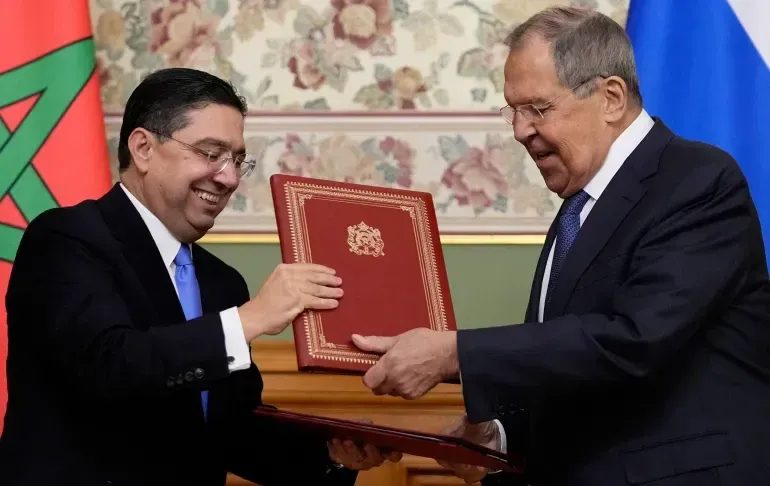
This development occurs against the backdrop of Morocco's cautious diplomatic stance since the outbreak of the war in Ukraine, as Rabat has maintained its relations with various parties while continuing its economic cooperation with Moscow, alongside enhancing its partnerships with the United States and the European Union, thereby broadening its maneuvering space. The rapprochement between the two nations is not limited to the economic sphere; the Russian ambassador announced that Foreign Minister Nasser Bourita is expected to visit Moscow at the end of September to participate in the seventh Arab-Russian Forum. He indicated that the foreign ministers of both countries maintain regular communication and frequently meet on the sidelines of international events.
As the war in Ukraine continues, along with the crises affecting food, energy, and maritime transport markets, economic interests seem to be playing an increasingly significant role in bridging perspectives between Morocco and Russia. The international transformations have established a new reality where trade has become one of the most vital channels of communication between the two nations.
As reported by assahifa.com.