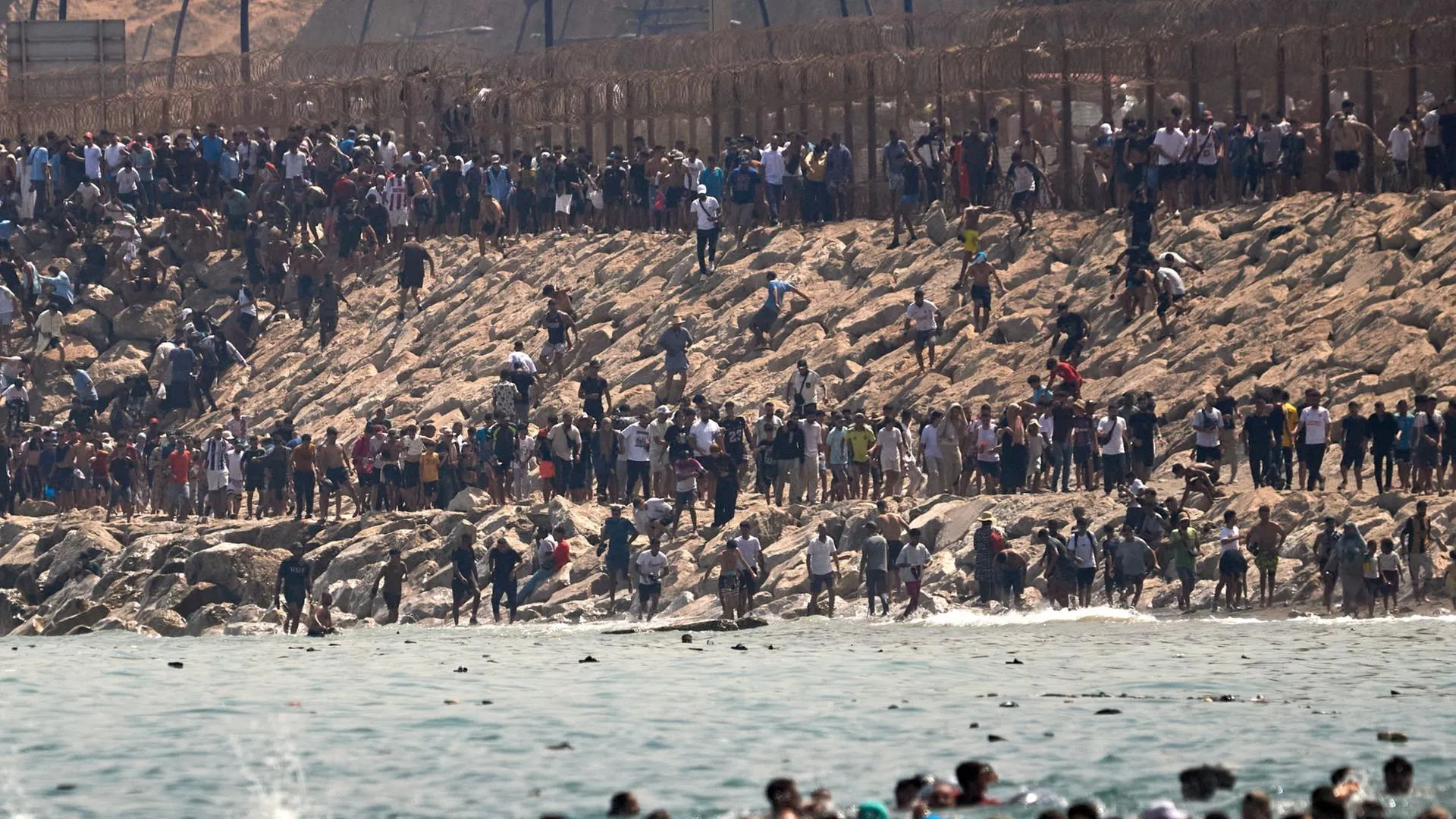

In a dramatic turn of events, thousands of migrants have reportedly crossed into the Spanish enclave of Ceuta in North Africa within just a few days, leading to a significant security response from the Spanish government. The situation escalated on Thursday when reports indicated a partial collapse of border security, a development that may be linked to a recent court ruling regarding migration procedures. In light of this crisis, Madrid has decided to deploy soldiers to Ceuta, with three trains carrying 20 soldiers each, along with a diving unit and a military ship, set to arrive by Friday.
The Spanish Ministry of the Interior has confirmed that special police units will be bolstered with an additional 200 officers to assist the Civil Guard in maintaining order and security in Ceuta. Officials report that more than 1,500 migrants had already arrived in Ceuta prior to Thursday, with the enclave being a unique geographical point as a part of the European Union that borders Morocco. The exact number of migrants arriving on Thursday remains uncertain, with media estimates ranging from hundreds to several thousands.
Tragically, the situation has resulted in the loss of at least nine lives, as individuals attempt to reach Ceuta. Reception centers are overwhelmed, forcing many migrants to live and sleep outdoors in dire conditions. Rachid Sbihi, head of the Civil Guard union, described the situation in Ceuta as chaotic, stating that the border has effectively collapsed and that thousands are crossing daily, making it impossible to provide accurate figures.
Achraf Maimouni from a Moroccan human rights association characterized the unfolding events as extraordinary, noting that the border at Tarajal was opened under unusual circumstances, allowing people to cross. However, the Moroccan authorities have yet to comment on the situation.
Legal Developments Impacting Migration
Regional President Juan Jesús Vivas has urged the central government in Madrid to declare a state of emergency for national security reasons and requested the dispatch of additional police and military forces to the Morocco-Ceuta border. However, the Madrid government has declined to declare a national state of emergency. A potential factor contributing to the current influx of migrants may be a ruling by the Spanish Supreme Court from early July, which states that individuals intercepted at sea while attempting to reach Ceuta cannot be immediately returned to Morocco. Instead, a formal immigration procedure must be followed, a ruling that the Spanish Interior Ministry claims has been exploited by smuggling networks.
In addition, videos of successful border crossings and calls for further attempts have been circulating on social media. According to a local reporter speaking to EFE, such attempts are being organized and coordinated in closed messaging groups. However, the reasons behind the temporary breakdown of land border security on Thursday remain unclear.
Government Response and Future Implications
Ceuta experienced a similar crisis in 2021, when over 8,000 migrants arrived within just two days during a severe political crisis between Spain and Morocco. Unlike that scenario, there are currently no indications of a political conflict contributing to the situation. Nonetheless, concerns are mounting in Ceuta regarding a potential escalation. All factions in the city parliament are now jointly calling for a more robust response, urging state security forces to be reinforced and military assistance to be employed to protect the border and public safety.
In response to the crisis, Prime Minister Pedro Sánchez and Interior Minister Fernando Grande-Marlaska have announced plans to travel to Ceuta on Friday to assess the situation firsthand. Spain and Morocco are also set to strengthen border controls and expedite deportations, signaling Morocco's willingness to cooperate. However, it remains to be seen how quickly the situation can stabilize and how the needs of the large number of migrants will be addressed in the interim.
As reported by tagesschau.de.