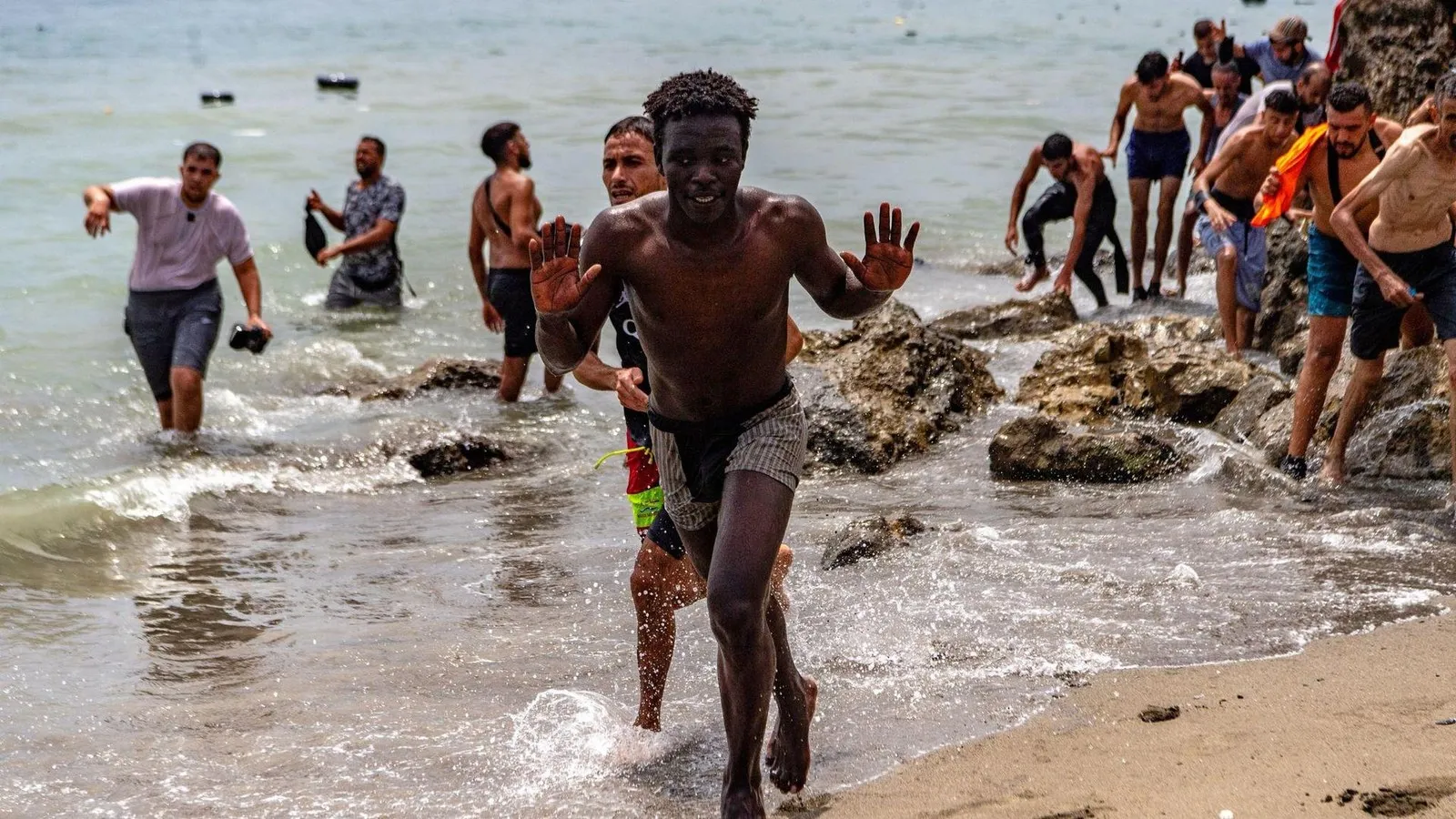

Ceuta Faces Unprecedented Influx of Migrants Amid Humanitarian Crisis
In recent days, hundreds of individuals have arrived by sea from Morocco to the Spanish exclave of Ceuta, located in North Africa. Juan Jesús Vivas, the president of the region, emphasized the dire state of affairs, stating on Thursday, "We are in a situation of total humanitarian and social emergency." Vivas acknowledged that over 1,500 migrants, including both adults and minors, had made the perilous journey across the water in just a few days. The reception centers are currently overwhelmed and unable to accommodate any more individuals. According to the Red Cross, more than 100 people were rescued from drowning alone on the night of Wednesday.
The majority of those attempting to reach the Spanish exclave, which is situated at the Strait of Gibraltar and thus technically EU territory, are young men from Morocco, Algeria, and Sudan. The council of Ceuta has now urged the Spanish central government in Madrid to close the border, deploy military forces, and declare a national emergency in accordance with security regulations. This development has been reported by Spanish broadcaster RTVE, whose camera crews have been documenting the arrival of hundreds of migrants each day. The city’s leadership justifies these demands by citing what they perceive as a "qualitative escalation" of the migration crisis due to the massive influx from Morocco.
The Dangerous Journey to Spain
Reaching the seemingly safe shores of Spain is no small feat; those attempting to arrive in Ceuta and its beaches of Benzú and Tarajal must swim for nearly four hours from Moroccan territory while navigating around barriers in the sea. Tragically, not everyone is able to make it, with at least four young individuals drowning in recent days. Many migrants, who often lack swimming skills, resort to using flotation devices to stay afloat. Over the past twelve months, authorities have recovered around 60 bodies from the waters.
The trigger for this recent surge at the EU's external border in Ceuta was a ruling by the Spanish Supreme Court two weeks ago, which prohibited the practice of "pushbacks"—the forced return of migrants at sea seeking safety. While EU law also restricts such expulsions at the border, Spain had previously relied on a ruling from the European Court of Human Rights, which allowed the country to return individuals who forcibly crossed the border fence back to Morocco under certain conditions. However, the Supreme Court has now clarified that these pushbacks cannot be applied to migrants who reach Spanish territory by swimming, as they do not at any point cross a border barrier.
The Spanish Ministry of the Interior has stated that various ministries are coordinating their efforts to respond to the situation in Ceuta with "maximum speed and efficiency." Interior Minister Fernando Grande-Marlaska is scheduled to visit Ceuta on Friday to assess the situation and meet with local authorities. The government has increased its resources to ensure the safety and control of migration while providing necessary humanitarian aid to prevent loss of life at sea. The Moroccan government is reportedly cooperating closely to manage the situation, with Moroccan security forces intercepting many individuals attempting to reach Ceuta from Moroccan shores.
Pedro Sánchez, Spain's Prime Minister, announced on social media that his government has "mobilized all necessary resources" to provide an immediate response to the situation in Ceuta, including the deployment of soldiers to maintain security in the city. Opposition leader Alberto Núñez Feijóo from the conservative Popular Party has described the developments as a "national security crisis," while Santiago Abascal, the head of the far-right Vox party, has personally blamed Prime Minister Sánchez for the influx of migrants arriving in Ceuta.
Ceuta, along with the Spanish exclave of Melilla, represents the only land border of the EU with Africa, making it a frequent target for individuals seeking a better life in Europe. Many of these migrants are minors, which poses additional organizational challenges for the city administration, as there are currently 430 unaccompanied foreign minors under the care of local authorities, with 220 having arrived in just fifteen days.
While the overall numbers for irregular entries into the EU have dramatically decreased in recent months, with the EU border agency Frontex reporting a total decline of 37 percent compared to 2025, the situation in the Strait of Gibraltar has been an exception, with a 17 percent increase in border crossings. Since January, there have been 7,860 crossings, including 995 in June alone.
As reported by abendblatt.de.