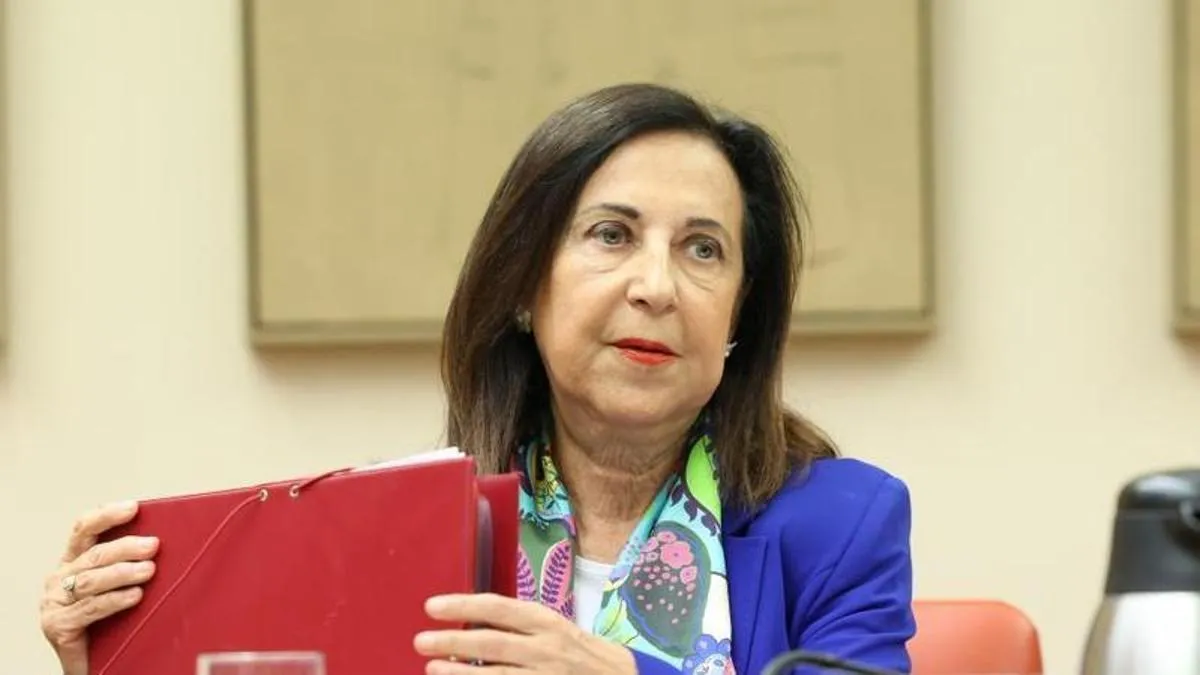

The ongoing dispute between Spain's Ministries of Defense and Interior regarding the Ceuta crisis has become increasingly evident, particularly during recent congressional appearances by key officials from both ministries. Defense Minister **Margarita Robles** emphasized that the **National Intelligence Center (CNI) provided timely warnings about the impending migratory surge** that was described as an 'avalanche' of migrants, which she characterized as 'self-organized.' In stark contrast, Interior Minister **Fernando Grande-Marlaska** asserted that **no report existed predicting the events that unfolded on July 30**.
Robles, who oversees the CNI, did not disclose all pertinent details regarding the alert, citing **the duty of secrecy that hinders public disclosure of their operations**. However, she affirmed that the CNI fulfilled its responsibilities by **sharing and analyzing information with the State Security Forces and the Government Delegation's personnel**. In a subsequent reply, she noted that on July 29, CNI officials **relayed information to the Government Delegation about a planned mass crossing using swimming techniques, which coincided with celebrations in the neighboring country**.
Following Robles’ statements, Grande-Marlaska underscored, after a Cabinet meeting, that **there was no report indicating what would occur on July 30**. He clarified his position, emphasizing that while he did not wish to question the intelligence services' capabilities, he believed they had acted effectively in this instance.
During her appearance before the Defense Commission in the lower house, Robles expressed gratitude to the Armed Forces Intelligence Center (CIFAS) and the CNI for their roles, particularly recognizing **the 25 CNI members stationed in Ceuta who monitor the situation daily from various perspectives**. She cited issues such as the use of social media by smuggling rings, jihadist terrorism, the situation in the African southern flank, and **destabilizing actions through hybrid threats posed by international agents**.
The debate may ultimately hinge on how the alert was communicated, as Robles suggested in one response that it might have been **written or verbal**. If it were verbal, both ministers could technically be telling the truth. Grande-Marlaska queried whether **something resembling the events of July 30, 2026, would not have been escalated to the highest levels for extraordinary measures** if it had indeed been foreseen.
Criticism and Accountability
Robles acknowledged, after facing criticism from **Francesc-Marc Álvaro of ERC**, that **the government had 'arrived late' in managing the situation** and extended apologies to the citizens of Ceuta, referring to them as 'the best of Spain.' She detailed a timeline of the [crisis in Ceuta](https://www.elperiodico.com/es/politica/20260825/consejo-ministros-aborda-martes-crisis-133630541), starting from the Supreme Court's ruling on July 8, which prohibited the immediate return of migrants arriving by sea without breaching borders, through to the return of migrants on August 1, with Ceuta filled with foreigners. While not blaming Morocco, she frequently mentioned social media as a factor, describing a **'mass avalanche that self-organizes' through decentralized and encrypted misinformation systems**.
The **Popular Party (PP)** responded by sending parliamentary spokesperson **Ester Muñoz** to a session deemed crucial. Muñoz accused the government of prioritizing vacations over national interests and confronted Robles with contradictions between the Defense and Interior ministries regarding whether there was sufficient intelligence alerting them to the impending crisis. She pointedly asked, **'Who is lying?'**. Furthermore, she remarked on Robles' discomfort, implying her precarious position within the government, and criticized the government's lack of action regarding Morocco, despite repeated claims from Moroccan officials about Ceuta and Melilla.
'Invasion' and Military Support
In the aftermath of Muñoz's remarks, retired General **Alberto Asarta**, representing **Vox**, accused the government of deceit, stating that **no one believes that intelligence services could overlook the concentration of 80,000 to 100,000 individuals at the border**. He underscored that the government’s assertion of ignorance was implausible, even to the Defense Minister herself. Notably, in this session, Robles employed the term **'invasion'** when referring to the military's support for the border reinforcement in response to calls via social media for yet another swimming 'invasion' of Ceuta.
In response to Robles, **Txema Guijarro**, spokesperson for **Sumar**, challenged her definition of invasion, asking, **'What constitutes an invasion, Minister?'** He aimed to clarify that an invader typically seeks to plunder and seize territory. This left-wing faction within the coalition did mention Morocco's poor conduct but refrained from blaming it for an invasion, attributing the crisis instead to the **'pressing misery' that serves as the only pull factor**.
Robles is the first of nine government members scheduled to appear before the lower house this week to discuss actions taken during the migration crisis. During a visit to Ceuta amidst the peak of the crisis, she defended the CNI and CIFAS, stating, **'They perform their duties under very difficult conditions that cannot always be disclosed.'** Furthermore, she presented a report from the Defense Staff (EMAD) outlining the events in Ceuta as unfolding in three distinct phases. The **first phase**, labeled 'concentrated immigration,' spans from the Supreme Court's ruling on July 8 until the morning of July 30, during which **the planning and execution of a maritime crossing gradually increased**. The report noted the involvement of **pre-existing Facebook groups disseminating instructions for swimming into Ceuta**.
The **second phase**, termed 'mass assault,' began at 11:30 AM on July 30, when **thousands surged across the border**, driven by a sense of urgency while social media platforms like Facebook and TikTok circulated messages and images of people crossing without any obstacles. Robles observed that most of those crossing had not prepared for their entry in advance. The **third phase** involved 'mass return,' which was marked by narratives of disappointment on social media, some of which blamed the local Muslim population for not aiding those who had recently arrived.
Robles estimated that over **3,000 military personnel** had been deployed to reinforce the Armed Forces in Ceuta, with **1,600 patrols conducted in support of the Civil Guard and Police**, including 400 nighttime patrols. Echoing sentiments expressed during her previous visit to Ceuta at the crisis's height, she warned that **any threat to Ceuta and Melilla is a threat to Spain as a whole**. She concluded her address by reiterating to **'ministers from the neighboring country'** that **'Ceuta and Melilla are Spain, and they are not to be touched.'**
As reported by elperiodico.com.