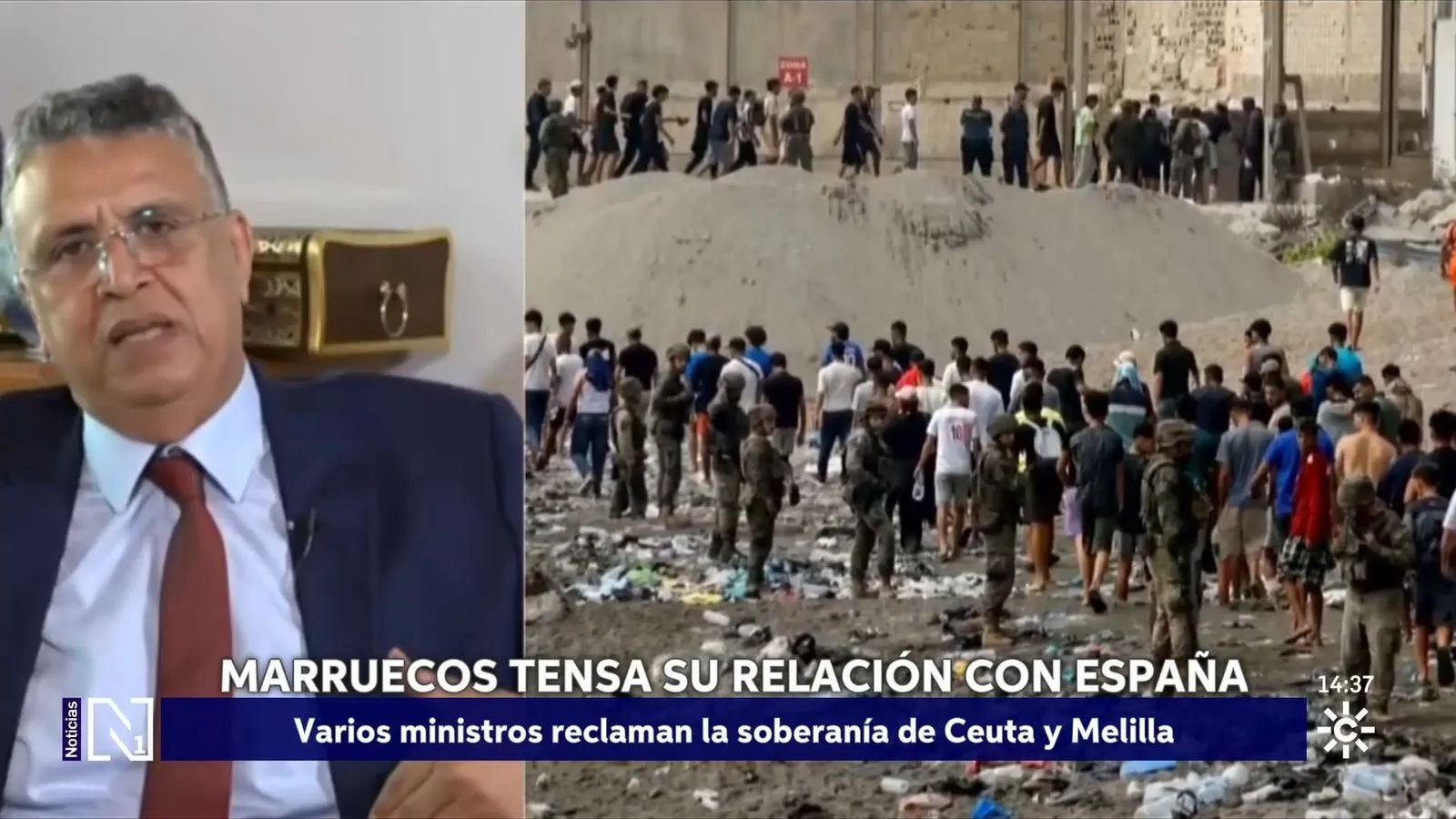

Complexities of the Ceuta Crisis: Humanitarian and Political Dimensions
The crisis surrounding Ceuta is unfolding on two distinct fronts, each presenting its own set of challenges. The first front is characterized by a humanitarian crisis stemming from the unprecedented influx of migrants entering illegally. The second front is the international arena, where Morocco has begun to make strategic moves regarding its claims over the autonomous cities of Ceuta and Melilla. Recently, Moroccan Justice Minister Abdellatif Ouahbi reiterated the country’s ‘historical and geographical rights’ over these territories. During the celebration of the anniversary of the Prophet Muhammad, in the presence of King Mohamed VI, the Minister of Religious Affairs, Ahmed Toufiq, called for the liberation of these ‘occupied territories,’ implying that Ceuta and Melilla are Moroccan cities.
King Mohamed VI made a public appearance on Monday evening at the Royal Palace in Rabat to preside over the religious ceremony celebrating the birth of the Prophet Muhammad, one of the most significant events in the Muslim tradition, alongside Crown Prince Moulay Hassan and Prime Minister Aziz Ajanuch. During this ceremony, the influential minister Ahmed Toufiq spoke of the ‘liberation of the occupied cities in the Atlantic Ocean,’ linking it to Morocco’s spiritual heritage. According to the official Moroccan news agency MAP, he referenced two prominent authors associated with the Prophet Muhammad, mentioning ‘Dalail Al-Khayrat’ by Imam Al-Jazouli as a significant work that inspired Moroccans in their mobilization efforts to reclaim these cities at the dawn of the modern era. Although Toufiq did not explicitly connect this historical reference to the recent events in Ceuta, his remarks coincided with King Mohamed VI’s first public appearance following the recent massive migration towards the Spanish city.
Political Ramifications and Responses
King Mohamed VI, who also holds the title of Commander of the Faithful, last appeared publicly on July 30 during the Throne Day celebration in M'diq, located approximately 30 kilometers from Ceuta. On that very day, thousands of individuals attempted to cross the border into the Spanish city, resulting in an unparalleled migration crisis in the region, with civil organizations reporting that at least 141 people lost their lives during these crossings. In light of the government’s silence, particularly from the Prime Minister and several key ministers following the migration crisis, Justice Minister Abdellatif Ouahbi has taken a prominent role, demanding Spain return unaccompanied Moroccan minors currently on Spanish soil. Ouahbi, a member of the Authenticity and Modernity Party (PAM), the second-largest force in the Moroccan government, is also campaigning for the legislative elections scheduled for September 23, where his party’s candidate, Fouzi Lekjaa, President of the Royal Moroccan Football Federation, is considered a front-runner.
As reported by canalsur.es.