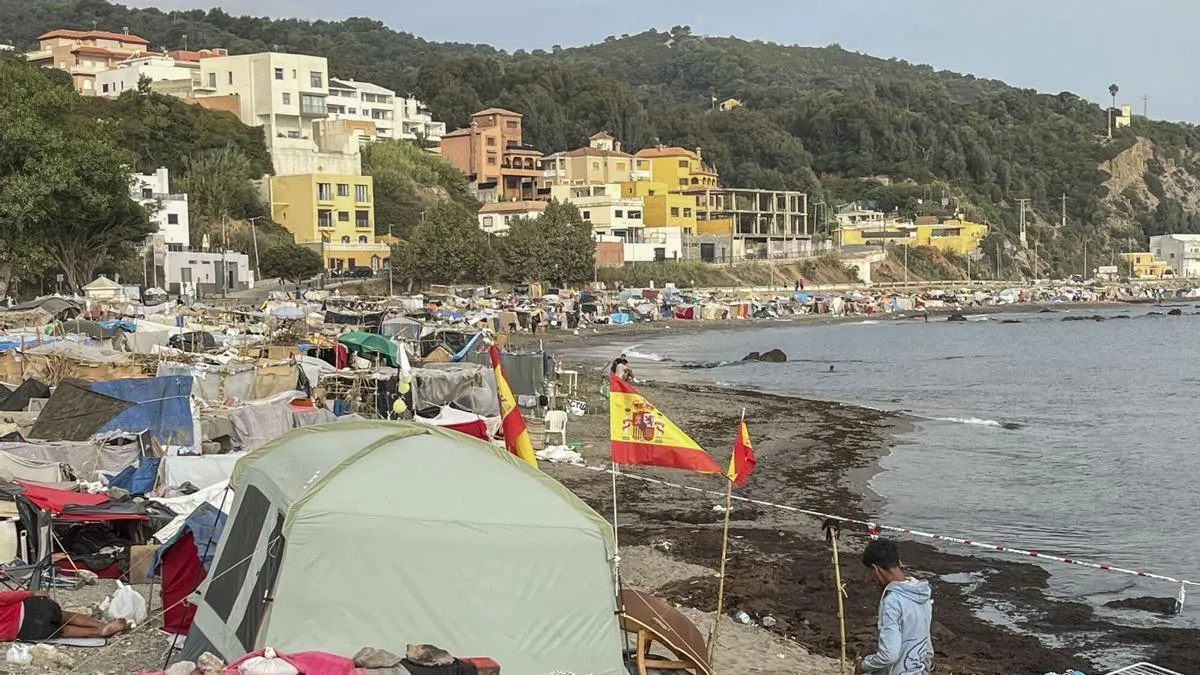

A total of 21 Moroccan citizens have been repatriated to their homeland after throwing stones at members of a military patrol conducting surveillance at El Trampolín beach in Ceuta late Saturday night. According to sources from the Civil Guard, the military regiment number 7 in Ceuta alerted authorities about the situation, prompting the Civil Guard to intervene. Following the incident, the involved individuals were given the option to either voluntarily return to Morocco or face legal proceedings. Since none had prior criminal records, they all chose the former, leading to a peaceful resolution without any material or personal damage reported.
The altercation took place in one of the areas severely impacted by the mass entry of migrants in July, specifically at El Trampolín and Benítez beaches. The migrants took advantage of their elevated position to launch stones at the military patrol, which has raised serious concerns regarding security in the region.
Calls for Increased Authority and Security Measures
The Spanish Troop and Navy Association (ATME) publicly condemned this incident on their social media channels, expressing regret that such occurrences have now happened for the third time in just ten days. They argued that these attacks against the Armed Forces are happening because these personnel lack adequate authority to perform their duties effectively and assertively. The ATME has called for immediate recognition of military personnel as agents of authority and as individuals engaged in a high-risk profession.
In a parallel development, approximately 500 individuals gathered in Ceuta on Sunday to protest against the government’s handling of the ongoing migration crisis that has plagued the autonomous city since July 30. The protesters demanded “real measures, solutions, and expulsions,” as well as assurances for the safety and rights of local children as the new school year approaches. The demonstration featured participants waving Spanish and Ceuta flags, chanting slogans such as “we demand solutions and expulsion” and “for the children of Ceuta.” They also called for the resignation of the local government delegate, Miguel Ángel Pérez Triano, and emphasized the importance of ensuring safety in schools for children returning to educational institutions this week.
Government Response and Future Plans
The protest commenced at noon in front of the Government Delegation’s headquarters, where attendees sang the Spanish national anthem and shouted phrases like “Ceuta is not for sale.” After the initial speeches, a moment of silence was observed in memory of the deceased victims associated with the mass migration incidents. Protesters later marched peacefully towards the Ceuta-Morocco border at El Tarajal, where they conducted a sit-in and reiterated their demands.
In response to the ongoing situation, the Ceuta Local Security Board has established a security plan to reassure families that their children can attend school safely starting Tuesday. The Secretary of State for Education, Abelardo de la Rosa, announced that the Ministry proposed police escorts for various school routes and increased security near educational facilities during afternoons and evenings to prevent unauthorized access. Additionally, a psychological intervention plan is set to be implemented to help students who may be struggling with the current circumstances. Correspondingly, the Minister of Education, Milagros Tolón, is scheduled to visit Ceuta coinciding with the start of classes.
This Sunday also saw a renewed exchange of accusations between the government and the main opposition party. While Minister Óscar Puente claimed that the Ceuta president, Juan Jesús Vivas, has “forgotten his institutional role” to become merely a pawn for Feijóo, the PP’s Deputy Secretary of Health and Social Policy, Carmen Fúnez, criticized the government for “insisting on imposing a camp” in the Ceuta port, creating “uncertainty” and attempting to sidestep a problem that affects and concerns everyone involved.
As reported by elperiodico.com.