
The recent mass exodus of Moroccans seeking refuge in the Spanish enclave of Ceuta has sparked intense reactions across various sectors, with many Moroccan writers deeming it a "deafening cry" against the rampant corruption and authoritarianism of the Moroccan regime, which has exacerbated the ongoing crises in the country. This collective migration, described by Moroccan author Mohamed Majdoubi as one of the "gravest crises" facing Morocco, starkly contrasts the official government narrative promoting security, stability, and growth. Citizens are risking their lives to escape the dire conditions they face, revealing deep-seated contradictions in the state's rhetoric.
Majdoubi links illegal immigration to multiple systemic failures, including health, education, employment, and the struggle for dignified living standards, alongside the drastic decline in purchasing power compounded by widespread corruption and autocratic governance. He criticizes the tendency to attribute the causes of this mass exodus to external forces or to blame the aggrieved citizens who are protesting against their country's deplorable conditions.
In a similar vein, Moroccan writer Tarek Lissawi highlights that the crisis reflects "structural developmental imbalances," notably high unemployment rates, low wages, rising living costs, and a lack of justice and equal opportunities. Writer Mustafa Mounir connects the increasing phenomenon of collective fleeing from Morocco to an economic and social reality that compels citizens to seek liberation from oppressive circumstances. He argues that solely relying on security measures cannot address the underlying motivations for migration, especially given the soaring youth unemployment rates, coupled with rising costs of living, inadequate public services, and a pervasive lack of accountability and transparency.
Furthermore, Moroccan commentator Mohamed Ben Dhiou asserts that the social crisis stems from the entrenchment of privileges where financial interests intertwine with political power, creating conflicts of interest. He warns that if the current situation persists, it will drive skilled individuals and capital out of the country, as the perception that opportunities are not based on merit deepens the erosion of trust and fuels the desire to leave. Similarly, writer Amin Bouchaib emphasizes that the root cause of mass migration lies in the crisis of confidence in institutions and the messages directed at the youth, noting that this collective flight reflects profound suffering amidst a loss of hope.
International Reports Highlight Complicity in Border Control
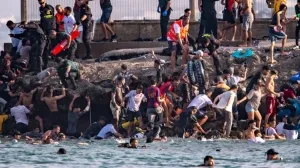
As the situation escalates, international media reports indicate that the Moroccan authorities may have facilitated the mass crossing of illegal migrants into Ceuta, revealing a troubling laxity in border control that allowed tens of thousands to flood into the enclave within a short period, culminating in a humanitarian crisis. In an article titled "Morocco Shows How Migration Became a Weapon" published by the American site "Counter Punch," journalist John P. Ruel asserts that the mass influx to Ceuta on July 30 "would not have occurred without, at the very least, the government of Morocco's tolerance." Spanish authorities estimated that approximately 72,000 people entered Ceuta, a staggering number compared to the enclave's population, indicating that the Moroccan government's lax border enforcement is a crucial factor in understanding these events.
Ruel cites previous instances, noting that Morocco had previously eased border control in 2021, which allowed around 8,000 individuals to enter Ceuta over two days. He suggests that the deliberate gap exposed by this crisis remains exploitable, linking the previous easing of border control to the new wave of migration that followed five years later, with significantly larger numbers. The Guardian's report titled "Border Crossing Chaos Leads to Harrowing Situation for Moroccans in Ceuta" provides a more direct description of how the crossings occurred, revealing that approximately 50,000 Moroccans reached Ceuta after Moroccan border controls were temporarily lifted, resulting in at least 72 casualties from drowning during the crossing attempts. This stark reality underscores the exploitation of illegal migration by Moroccan authorities, often at the expense of young lives.
These testimonies are significant as they directly connect the relaxation of Moroccan border control and the resulting surge in crossings. The report indicates that crossing had been impossible for many until the monitoring procedures changed, leading to an unprecedented influx. The narrative shifts from a mere failure to control the borders to one of complicity, with a tangible alteration in surveillance levels preceding the wave of migration. In another report titled "Ceuta's Government Chief Accuses Morocco of Atrocities in Mass Border Crossing," The Guardian relays comments from Ceuta's Government Chief Juan Jesús Vivas, asserting that the wave of crossings "if not organized, was at least encouraged or allowed by Morocco." The report further states that Moroccan border surveillance had been reduced to a minimum before being completely lifted at the end of July, allowing tens of thousands to surge into Ceuta. A testimony from one of the migrants revealed that Moroccan police were pushing individuals toward the water, urging them to swim, which highlights the difference between an inability to prevent crossings and a deliberate reduction in monitoring that allowed this unprecedented wave of migration to occur.
These events illustrate how the Moroccan authorities did not hesitate to push their youth and children into the sea, facilitating their journey to Ceuta by intentionally relaxing border controls and opening access points. This ruthless employment of illegal migration as a political maneuver has transformed the lives of Moroccans into a bargaining chip for narrow and nefarious political calculations, with little regard for the human tragedies that may ensue from such reckless adventures.
As reported by el-massa.com.