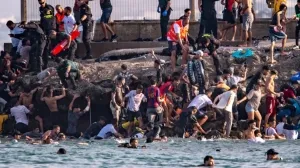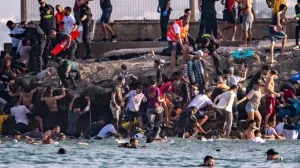

The mass exodus of Moroccans towards the Spanish enclave of Ceuta has sparked significant reactions, with many Moroccan writers describing it as a "resounding cry" against the corruption and oppression of the ruling regime, which has exacerbated the accumulated crises within the country. Moroccan author Mohamed Majdoub remarked in an article that this phenomenon represents one of the "most dangerous crises" facing Morocco, highlighting a stark contradiction between the official rhetoric surrounding security, stability, and growth, and the reality faced by citizens who are willing to risk their lives in search of a better existence outside their homeland. He linked the wave of illegal immigration to various crises concerning health, education, employment, and the quest for a dignified life, in addition to the alarming decline in purchasing power alongside rampant corruption and authoritarianism in the kingdom. Majdoub criticized the tendency to blame the mass exodus on external factors or to label the fleeing citizens as mere victims of the dire conditions prevailing in the country.
Furthermore, writer Tarek Lissawi pointed out in his article that this crisis reflects "structural developmental imbalances," notably high unemployment rates, low wages, rising living costs, and the absence of justice and equal opportunities. Similarly, author Mustafa Ming highlighted that the widening phenomenon of mass flight from Morocco is a reflection of the socio-economic realities compelling citizens to seek alternatives to their harsh conditions. He emphasized that a purely security-oriented approach cannot adequately address the motivations behind migration, particularly as youth unemployment rates soar, coupled with rising costs of living, inadequate public services, lack of transparency, and the disconnection between accountability and responsibility. In parallel, writer Mohamed Ben Deios linked the social crisis to the overpowering influence of rent-seeking behavior, the intertwining of money and power, and conflicting interests, warning that the persistence of this situation drives away talent and encourages brain drain and capital flight, as the perception that opportunities are not based on merit deepens the loss of trust and fuels the desire to leave.
Amine Bouchaib also emphasized that the root cause of mass migration stems from a crisis of trust in institutions and the messages directed towards the youth, illustrating that this collective flight reflects profound suffering amidst a loss of hope. The alarming situation has led to the rapid influx of tens of thousands of individuals within a short timeframe, as reported by international media outlets.
Reports Indicate Complicity in Facilitating Mass Migration to Ceuta
International media reports have highlighted that the surge of illegal Moroccan migrants heading to Ceuta has exposed a leniency, even complicity, from Moroccan authorities regarding border control. The relaxed monitoring has resulted in the influx of tens of thousands in a brief period, culminating in a humanitarian crisis. In an article titled "Morocco Shows How Migration Has Become a Weapon," published by the American site Counter Punch, writer John P. Ruel stated that the mass influx to Ceuta on July 30 "would not have occurred without at least the tolerance of the Moroccan government." Spanish authorities estimated around 72,000 individuals entered the city, a staggering figure relative to Ceuta's population, suggesting that Morocco's relaxed border control was a crucial element in understanding these events. Ruel referenced previous occurrences, noting that Morocco had eased border monitoring in 2021, allowing approximately 8,000 people to cross into Ceuta within two days.
Ruel posited that the deliberate loophole revealed by this crisis remains exploitable, citing assessments from the Middle East Political and Economic Institute. This perspective connects the previous easing of border controls with the recent surge, which saw significantly larger numbers crossing after five years. The Guardian’s report titled "Border Crossing Chaos Leads to a Dire Situation for Moroccans in Ceuta" provides a more direct description of how this crossing transpired. The report indicated that about 50,000 Moroccans managed to reach Ceuta after Moroccan border controls were temporarily lifted, while the surge resulted in at least 72 drownings during crossing attempts, highlighting the Moroccan authorities' exploitation of illegal migration, even at the expense of young lives.
This account emphasizes the direct link between the lifting of Moroccan surveillance and the sudden spike in the number of crossing attempts, asserting that crossing had been impossible for many before the changes in monitoring procedures allowed people to approach the border in massive numbers. This narrative shifts the focus from a failure to manage borders to a complicity through an actual change in the level of surveillance prior to the mass crossings. In another report titled "Ceuta's Government Chief Accuses Morocco of Committing Atrocities during Mass Border Crossings," The Guardian conveyed assurances from Ceuta's Government Chief Juan Jesus Vivas, that this wave of crossings was "not organized, but at least encouraged or allowed by Morocco." The same report noted that Moroccan border monitoring had dropped to a minimum before being completely lifted in late July, facilitating the flow of tens of thousands into Ceuta. Testimonies from individuals crossing indicated that Moroccan police were pushing people towards the water, urging them to swim, illustrating the difference between an inability to prevent crossings and a reduction in surveillance that allowed this surge.
These incidents reveal that the Moroccan authorities did not hesitate to push their youth and children into treacherous waters, deliberately easing controls and opening borders to exploit illegal migration as a cruel political tool, turning the lives of Moroccans into leverage for narrow and malicious political calculations, indifferent to the human tragedies that this perilous quest may entail.
As reported by el-massa.com.