
On August 18, 1976, a seemingly mundane task of trimming a poplar tree turned into one of the most dangerous crises on the Korean Peninsula since the signing of the armistice in 1953. This incident, known as the "Ax Incident," involved a joint American-South Korean team entering the Korean Demilitarized Zone to remove a tree that obstructed the line of sight between two observation points. Within minutes, the team was attacked by North Korean forces armed with axes, resulting in the deaths of two U.S. officers, Captain Arthur Bonifas and Lieutenant Mark Barrett. Washington did not regard this as a mere border skirmish; the U.S. heightened its readiness, deployed air reinforcements, and considered military options, which included a possible strike on a North Korean barracks. Three days later, the Americans returned to the location, this time under a massive military operation named "Operation Paul Bunyan." This incident illustrates the ongoing dilemma that defines the Korean Peninsula: how to respond to an armed adversary without triggering a full-scale war.
A Routine Task in an Unroutine Environment
The Joint Security Area at Panmunjom was established following the Korean War armistice in 1953, serving as a small space where representatives of both sides could meet while soldiers faced each other across the nearly non-existent border. Over the years, this area evolved into a constant gauge of intentions, provocations, and signals. In August 1976, the challenge was a large poplar tree that blocked the line of sight between United Nations observation points. A team of 15, including Bonifas and Barrett, was sent in to trim the tree. According to U.S. records, North Korean forces launched a surprise attack on the team, leading to the tragic deaths of the two officers. Timing played a crucial role in the incident, as declassified American intelligence documents indicated that the surrounding environment was already tense, with a likelihood of provocation from the North.
Thus, the question in Washington was not merely about punishing the responsible parties, but rather about how a weak response could be interpreted by Pyongyang, and conversely, what could happen if the response was excessively forceful. This led to a serious deliberation among U.S. officials, including Henry Kissinger, who discussed the crisis in terms of deterrence. The concern was that inaction might embolden North Korea to continue its provocations. Subsequently, the readiness of U.S. forces in Korea was elevated, with additional F-4 aircraft and plans for deploying naval power and B-52 bomber sorties being considered. Ultimately, the operation to cut down the tree transformed from a maintenance task into a political message, emphasizing the delicate balance of demonstrating strength while leaving a path for de-escalation.
Operation Paul Bunyan: A Show of Force
On August 21, just three days after the initial incident, a new team returned to the site to complete the mission. Named after the legendary American lumberjack, Operation Paul Bunyan was marked not just by the chainsaw used to fell the tree, but by the overwhelming military presence that accompanied it. U.S. forces were on high alert, with fighter planes and bombers circling overhead while the aircraft carrier Midway was positioned nearby. This operation was deemed by the United Nations Command as the largest show of force since the Korean armistice was signed in 1953. Surprisingly, North Korean troops did not intervene to stop the felling of the tree, and following the crisis, Kim Il Sung sent a message of apology, leading to negotiations regarding the reorganization of the Joint Security Area.
The repercussions of this incident extended far beyond the tree itself. In the weeks that followed, both sides reached a significant modification in the arrangements for the Joint Security Area, which restricted the security forces of each side to their respective sides of the military demarcation line. Thus, what began as a simple issue of obstructed sightlines resulted in a fundamental change in the management of one of the world's most sensitive military zones. The avoidance of direct confrontation became a crucial part of the solution, highlighting that sometimes preventing war requires not just an escalation of arms but a reduction in opportunities for minor incidents to escalate uncontrollably.
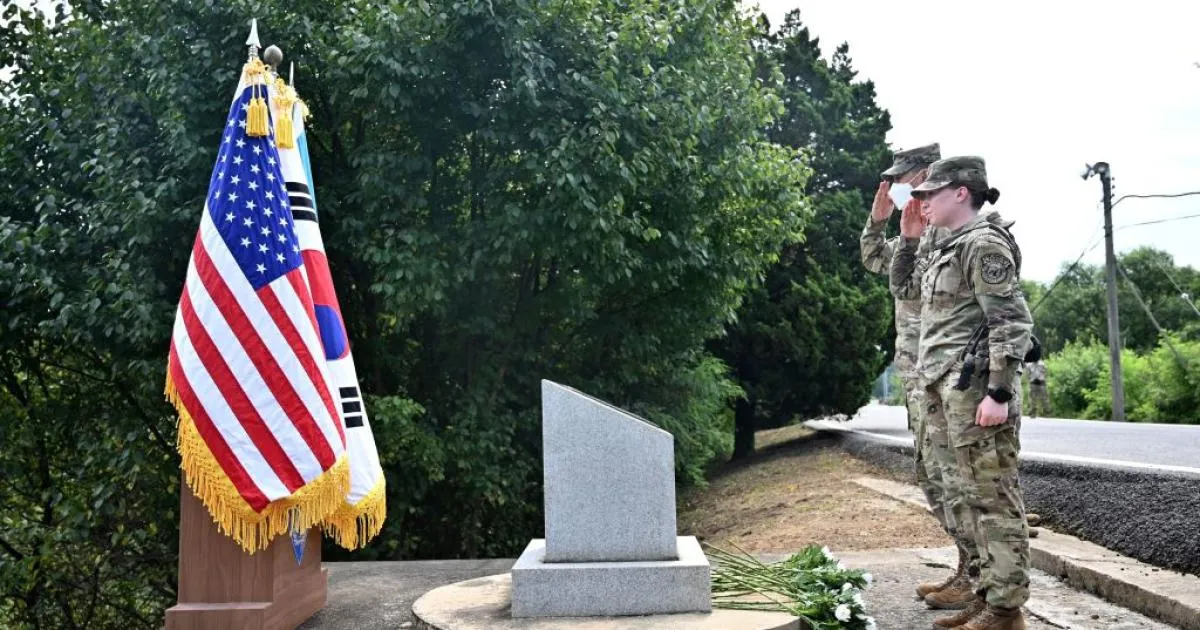
As we reflect on the 50th anniversary of the Ax Incident, the underlying questions remain pertinent. The U.S. and South Korea are currently conducting the "Ulchi Freedom Guardian" exercises, which North Korea has labeled provocative, pledging to enhance its nuclear deterrent. Although the weaponry has evolved significantly since 1976, the logic established under the poplar tree endures: every military drill, missile test, or troop movement can simultaneously serve as a deterrent message to its initiators while being perceived as a provocation by adversaries. Consequently, the memory of that poplar tree persists in the military and political consciousness of Korea, symbolizing the thin line that separates a minor tactical incident from a major strategic decision in a region that has remained under an armistice for over seven decades, which has not eliminated the fundamental causes of conflict.
As reported by alaraby.com.