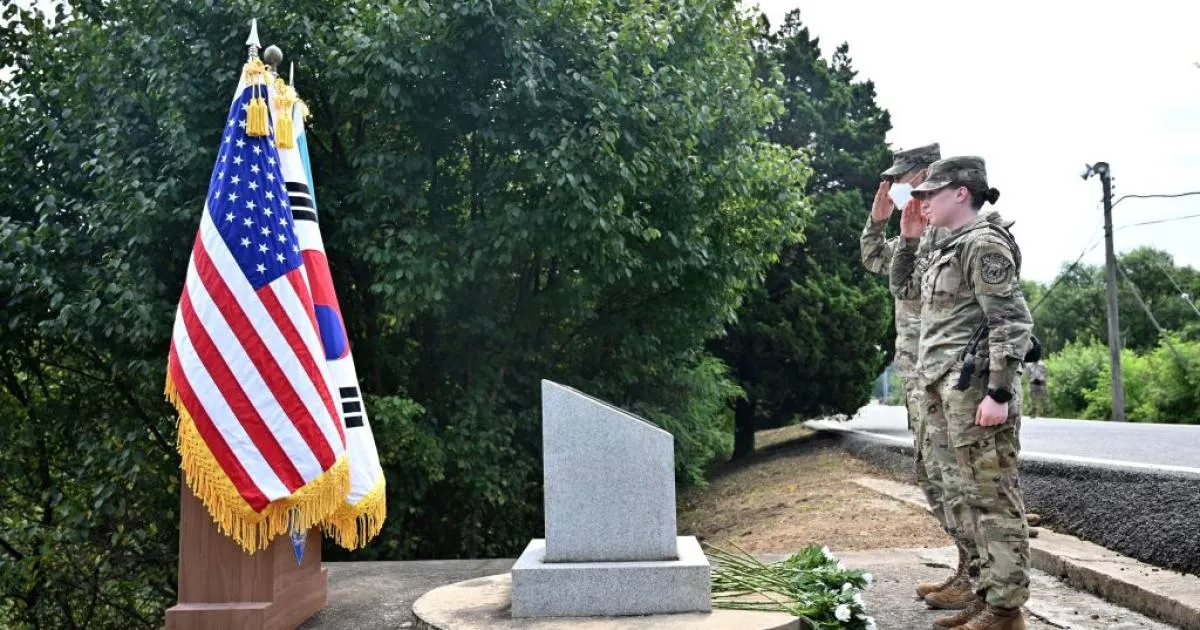

On August 18, 1976, a seemingly minor task—pruning a poplar tree that obstructed the view between two observation points in the Korean Demilitarized Zone (DMZ) at Panmunjom—escalated into one of the most dangerous crises on the Korean Peninsula since the cessation of hostilities in 1953. An American-South Korean team was sent to execute this routine maintenance task, but minutes into the operation, the tree became the epicenter of a violent confrontation. North Korean forces attacked the team, resulting in the deaths of two American officers, Captain Arthur Bonifas and First Lieutenant Mark Barrett, who were brutally killed with axes by the attackers. The U.S. government did not treat this as a mere border skirmish; instead, it heightened its military readiness, dispatched aerial reinforcements, and initiated discussions on potential military responses, including the possibility of striking a North Korean base.
Three days later, the U.S. returned to the site, but this time it was under the banner of a massive military operation dubbed "Operation Paul Bunyan." The incident, now referred to as the “Axe Murder Incident,” serves not only as a peculiar story about a tree but also as a profound illustration of a dilemma that continues to define the Korean Peninsula: how to respond to an armed adversary without triggering a full-scale war.
Routine Task in an Unpredictable Environment
The Joint Security Area at Panmunjom was established following the 1953 armistice that ended the Korean War. It became a small space where representatives from both sides could meet, with North Korean troops facing United Nations Command forces in a setting that blurred the lines of traditional borders. Over the years, this area evolved into a perpetual laboratory for gauging intentions, signals, and provocations. In August 1976, the issue at hand was a large poplar tree that blocked the line of sight between United Nations observation points. A team of 15, including Bonifas and Barrett, was dispatched to trim the tree. However, upon their arrival, they were attacked by North Korean forces, leading to the tragic deaths of the two officers.
The timing of the incident was particularly fraught with tension, as declassified American documents suggest that the intelligence community was already viewing the area as charged and was wary of a potential confrontation, although it could not confirm that the killings of the officers were premeditated. Consequently, the prevailing question in Washington was not how to punish those responsible, but rather what message North Korea would interpret from a weak response and what might occur if the reaction was overly aggressive.
A Tree Becomes a Symbol of Prestige
Minutes from meetings of the “Washington Task Force” reveal that Henry Kissinger and military officials deliberated the crisis in terms of deterrence. Kissinger argued that inaction could lead North Korea to conclude that the United States would not respond to further provocations. Military leaders discussed a wide array of military options. The readiness level of U.S. forces in Korea was elevated to DEFCON 3, additional F-4 aircraft were deployed, and plans were made to mobilize 18 F-111 jets, alongside a naval task force and B-52 bomber sorties. Among the options considered was a plan to strike North Korean barracks near the Joint Security Area, although President Gerald Ford ultimately rejected a more aggressive proposal to execute such strikes.
Thus, the meaning of the tree transformed. What had initially been a maintenance task morphed into a political message: if the U.S. was thwarted in its mission, it could be perceived as a retreat under duress, while an excessive show of force could ignite a broader military confrontation. The challenge lay in crafting a response that was strong enough to restore deterrence yet calibrated to allow an exit strategy for the other side.
On August 21, a team returned to the site to complete the task that had been suspended three days earlier. Named “Operation Paul Bunyan” after the legendary lumberjack of American folklore, the operation involved not just trimming branches but completely cutting down the tree, leaving only the stump. What made this operation extraordinary was not the chainsaw itself but the overwhelming military presence surrounding it, with U.S. forces on high alert, aircraft soaring overhead, and the aircraft carrier USS Midway positioned in the vicinity. The United Nations Command described it as the largest show of force since the Korean armistice.
North Korean forces did not intervene to stop the tree’s removal. Following the crisis, Kim Il-sung reportedly sent a letter of apology, according to historical records from the United Nations Command, and negotiations began regarding the reorganization of the Joint Security Area.
The ramifications of the confrontation extended beyond the mere felling of the tree. In the weeks that followed, both parties reached significant modifications to the arrangements governing the Joint Security Area, restricting the movements of security forces on either side of the military demarcation line and removing North Korean points that had existed on the United Nations Command-controlled side. Thus, an incident that began with an obstructed line of sight resulted in a tangible change in the management of one of the world's most sensitive military zones.
Preventing direct soldier-to-soldier contact was part of the resolution; sometimes, averting war does not simply involve an armament increase but reducing the chances for small incidents to escalate faster than leaders can contain them. Herein lies the significance of the “Axe Murder Incident” in the history of deterrence. Deterrence is not merely about inflicting maximum damage on the adversary but also convincing them that you are prepared to respond while keeping open the path for them to retreat without feeling compelled to escalate to the extreme.
As we mark the fiftieth anniversary of this incident, the United States and South Korea are once again engaged in the “Ulchi Freedom Guardian” exercises. North Korea has labeled this year’s drills as provocative and pledged to enhance its nuclear deterrence, while U.S. President Donald Trump ordered a reduction in the scope of the exercises, which began on August 17 and will continue until August 27. The weapons landscape has changed significantly since 1976, with North Korea now possessing a nuclear arsenal and more sophisticated missiles, rendering regional calculations far more complex. Yet the logic that emerged under the poplar tree has not vanished: every military drill or missile test or troop movement can simultaneously serve as a deterrent message in the eyes of the initiator and a provocation in the eyes of the opponent.
Consequently, the tree remains etched in the military and political memory of Korea. Its significance lies not only in the fact that it nearly ignited a war on its own but also in highlighting how minuscule the gap can be between a minor tactical incident and a major strategic decision in a region that has lived under a ceasefire for over seven decades without eliminating the underlying causes of conflict.
As reported by alaraby.com.