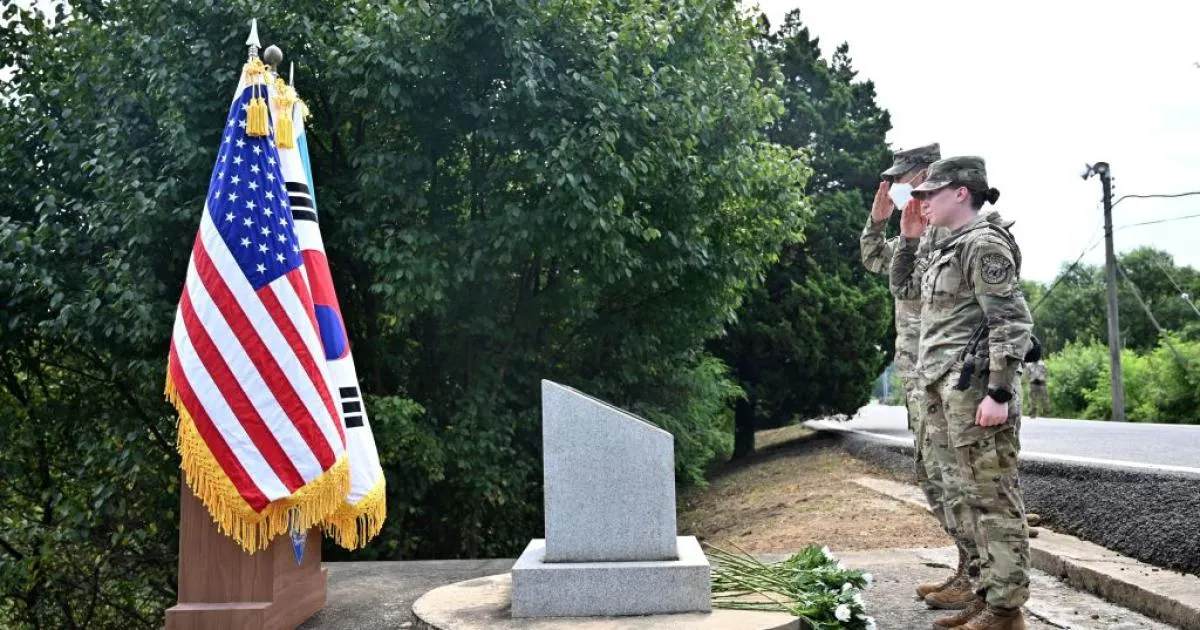

On August 18, 1976, a seemingly mundane task of trimming a poplar tree in the Joint Security Area at Panmunjom escalated into one of the most perilous crises on the Korean Peninsula since the 1953 armistice. This routine maintenance was meant to clear the line of sight between observation posts, but it inadvertently triggered a violent confrontation that would highlight the fragility of peace in the area. An American-South Korean team entered the site to carry out the trimming, but within minutes, they were attacked by North Korean forces wielding axes, resulting in the death of two American officers: Captain Arthur Bonifas and Lieutenant Mark Barrett. The incident did not merely represent a limited border skirmish; it raised alarms in Washington, prompting a heightened state of alert, aerial reinforcements, and discussions at the White House about potential military responses, including strikes on North Korean bases.
In the aftermath of the axe incident, the stakes were raised significantly. Only three days later, U.S. forces returned to the site, but this time with overwhelming military display under 'Operation Paul Bunyan.' This operation was not just about removing a tree; it symbolized a show of strength and a message of deterrence to North Korea. The complexities of responding to such provocations without escalating into full-blown conflict were vividly illustrated in this encounter. The need for a response that was both strong enough to restore deterrence and measured enough to avoid a military escalation was paramount.
The Implications of the Incident
The Joint Security Area at Panmunjom had been established following the armistice that ended the Korean War. This unique area saw representatives from both sides meet while soldiers faced each other from a distance that often rendered traditional borders meaningless. By August 1976, the presence of a large poplar tree obstructing the view between United Nations observation posts became a contentious issue. U.S. intelligence assessments indicated that the environment surrounding the incident was already charged with tension, suggesting that North Korea might be seeking to provoke a confrontation. This prompted U.S. leaders to deliberate not merely on how to punish the aggressors but also on how their response would be interpreted by Pyongyang.
The discussions led by U.S. Secretary of State Henry Kissinger and military officials revolved around the principles of deterrence. They recognized that failing to respond could give North Korea the impression that the U.S. would not retaliate against future provocations. Hence, military readiness was significantly elevated, with the deployment of additional aircraft and naval forces to the region. A range of military options was considered, showcasing the delicate balance between assertiveness and restraint that characterized U.S. military strategy in the region.
Lasting Effects and Lessons Learned
When the team returned to Panmunjom on August 21, they executed their mission with the symbolic weight of Operation Paul Bunyan, not merely trimming the tree but removing it entirely. The operation was a show of force, with U.S. forces on high alert, and it ultimately went unchallenged by North Korean troops. The aftermath of this incident brought about significant changes in the operational protocols within the Joint Security Area, illustrating how a seemingly trivial incident could lead to substantial adjustments in military engagement rules. The key lesson from this crisis was the importance of managing perceptions in military responses—how small tactical incidents can escalate into larger strategic decisions, particularly in a region that has remained in a state of tension for over seven decades.
As we reflect on the fiftieth anniversary of the axe incident, the complexities remain. The recent military exercises by the U.S. and South Korea reiterate the ongoing strategic calculations in the region, especially considering North Korea's advanced nuclear capabilities. The underlying logic that emerged from the poplar tree incident continues to resonate: every military exercise or missile test carries the dual weight of deterrence and provocation. This incident serves as a reminder of the thin line between peace and conflict in a region that has long been characterized by unresolved tensions.
As reported by alaraby.com.