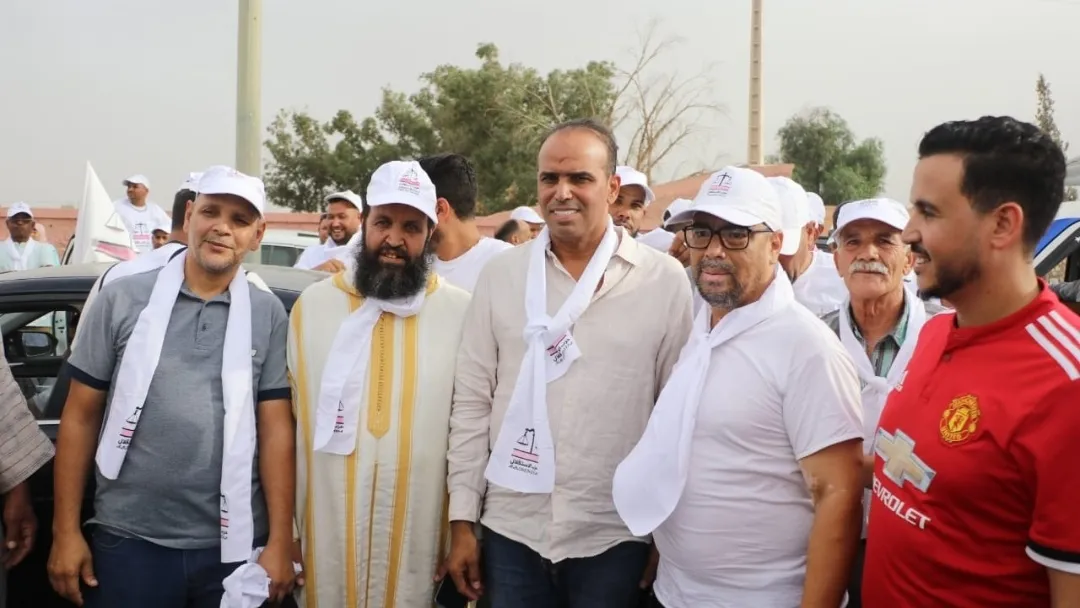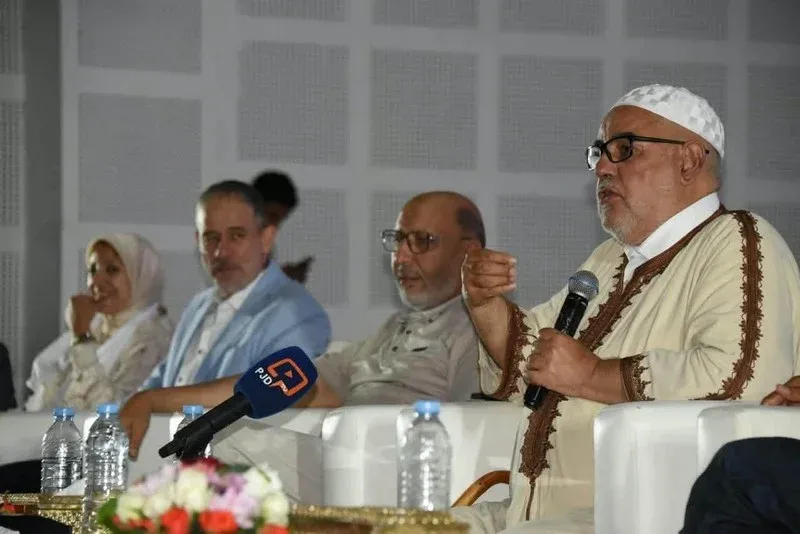

When Abdelilah Benkirane, the Secretary-General of the Justice and Development Party (PJD), stands at an election rally to announce that King Mohammed VI would terminate relations with Israel if it becomes evident that Moroccans oppose them, he does not merely present a political stance open to discussion; rather, he speaks in a manner that suggests he embodies a broad popular will. This approach simplifies a highly complex issue into an electoral confrontation with his adversaries, explicitly urging his supporters to push for the cancellation of relations and linking his political competition to what he terms "Israeli infiltration" into society and institutions.
Benkirane has every right to oppose relations with Israel, and his party has the prerogative to incorporate this stance into its platform. However, political opposition is one thing, while monopolizing the expression of popular will is quite another. The Moroccan populace is not an organization subordinate to the PJD, nor is it merely an audience gathered at a rally in Marrakech. It comprises over forty million citizens, each with differing assessments of national interests. Among these, some reject Israeli policies and advocate for Palestinian rights, yet simultaneously believe that the management of Morocco's foreign relations is the prerogative of the state and its institutions, governed by delicate balances that transcend emotional reactions and slogans.
Who Truly Represents Moroccans?
If Benkirane genuinely believes that his position reflects the will of the majority of Moroccans, he should defer to the ballot boxes, securing a clear majority for his party before presenting his program to constitutional institutions. The notion that the masses have granted him a comprehensive mandate to speak on their behalf necessitates a clear electoral foundation. Leading a political party and representing a segment of voters do not bestow upon him the right to voice the sentiments of an entire nation, nor do they justify the division of citizens into nationalists on one side and "normalizers" or agents of foreign interests on the other.
A paradox emerges within the trajectory of the Justice and Development Party, particularly considering that Moroccan-Israeli relations were resumed in December 2020, while the party was in power, with Saad Eddine El Othmani, then Secretary-General of the party, signing the tripartite announcement on behalf of the Moroccan government. At that time, party ministers did not resign, nor did the PJD withdraw from the majority; their continued presence in government was not viewed as a betrayal of Palestine. Yet today, after transitioning to the opposition and as elections loom, the very same issue has resurfaced to dominate their political discourse and become a focal point of confrontation with their opponents.
Has the party's principles changed, or has its position shifted away from power?
Benkirane, who previously served as Prime Minister, understands better than anyone that foreign policy is not merely a passionate speech or a moral auction. He knows that sovereign decisions are not made amidst the clamor of platforms but are instead based on a careful assessment of the country’s interests, security, territorial integrity, and international relations. He is also aware that Morocco has not abandoned its publicly declared stance supporting Palestinian rights, as evidenced by the King’s presidency of the Al-Quds Committee, which is part of a sustained institutional commitment. Thus, serious debate should not be about raising the bar of slogans but rather discussing the outcomes of these relations, their costs, their returns, and their limits, as well as what they have achieved or failed to achieve for Moroccan interests.
Foreign Relations Are Not an Electoral Slogan
It is politically permissible to critique the outcomes of these relations, demand guarantees and transparency, and reject any influence that undermines Moroccan sovereignty. However, turning the Palestinian cause into a tool for attacking political rivals is an entirely different matter. Benkirane has even gone so far as to urge Fatima Zahra Mansouri, a leader in the Authenticity and Modernity Party, to declare her "innocence" from the statements of Moroccan publisher Ahmed Cherkaoui, linking her stance on those comments to a political description concerning Israel. This shift in discourse moves the debate from discussing policies and positions to judging intentions, intertwining party rivalry with a measure of nationalism.
The contradiction intensifies as Benkirane warns against "Israeli infiltration," while not addressing the influence of transnational political Islamist currents with the same severity in his rhetoric. This inconsistency raises questions about the principle of sovereignty, which should not allow for double standards. If foreign influence is rejected because it undermines national decision-making, then it must be repudiated regardless of its source, whether linked to Israel, political Islamist organizations, or regional axes seeking to expand their political and ideological influence within the region.
Sovereignty is indivisible, and those who oppose Moroccan institutions becoming a sphere of Israeli influence should equally reject their subjection to any external reference, whether from a transnational organization or a regional axis, or from a group that prioritizes ideological allegiance over national belonging. It is inconsistent to regard "infiltration" as a danger when emanating from an adversary but to diminish its threat when arising from an ideologically or intellectually close entity.
The Palestinian issue transcends any single Palestinian organization; Palestine is older than Hamas and persists beyond various factions. Criticizing Hamas’s choices or attributing partial responsibility for decisions that civilians bear the costs of does not absolve Israel from its responsibility for civilian casualties, nor does it negate the rights of Palestinians. Rather, it signifies a refusal to reduce an entire people to a single organization and a rejection of transforming the blood and suffering of victims into a tool for partisan leverage in Rabat or Marrakech.
Ideological posturing has harmed the Palestinian cause whenever it has been tied to conflicts between factions and organizations, turning the Palestinian into an element of a broader regional dispute involving Iran, its proxies, Israel, the United States, and other powers. It would be more prudent for any party advocating for the cancellation of relations to propose a practical vision for the aftermath of such a decision: how Morocco will protect Palestinian rights, what diplomatic alternatives are suggested, and how it will safeguard the kingdom's security and strategic interests, along with an assessment of the implications of this step on Morocco’s external files, particularly concerning territorial unity.
The phrase "the people reject" is insufficient; politics requires alternatives and an assessment of consequences, costs, and outcomes. Those calling for a strategic change of this magnitude must elucidate to the public what Morocco stands to gain and what it may lose, and how it will address the repercussions of the decision. Simply launching slogans while leaving the state to bear the costs is not a substitute for genuine political engagement.
It would have been more appropriate for Benkirane, as he positions himself as a defender of national causes, to prioritize the defense of Morocco's territorial integrity whenever separatist propositions or stances that undermine the kingdom's sovereignty arise. Defending Palestine does not contradict prioritizing immediate national issues; nationalism is tested not only when it concerns distant lands but must first be grounded in a clear stance regarding the sovereignty of the country in which the politician operates and seeks the votes of its citizens.
Moreover, the political landscape in Morocco permits Benkirane and other actors to express their rejection of state strategic choices, organize gatherings, criticize competitors, and critique public policies. The same space is available for Islamists, leftists, and those opposed to relations with Israel to defend their positions. However, this freedom should not morph into a tool for distributing certificates of nationalism and treason or serve as a means to exclude opponents from the national belonging due to political disagreements.
We do not need someone to delineate who is a good Moroccan and who is a questionable one. We do not require party guardianship over our sentiments regarding Palestine. Moroccans are fully capable of expressing solidarity with the Palestinian people, condemning civilian casualties, and criticizing Israeli government policies, while simultaneously advocating for their nation’s decision-making independence and national interests. These positions are not contradictory unless the discussion is reduced to stark binaries such as "for normalization or against Palestine."
Abdelilah Benkirane is a political party leader and not the exclusive spokesperson for the Moroccan people. He has the right to oppose relations with Israel, propose a program for their cancellation, and ask voters to support it. His opponents also have the right to discuss this program, its costs, and its implications. However, using the name of the king to predict sovereign decisions or branding dissenters as "Israeli candidates" for not aligning with his rhetoric shifts the debate from legitimate political competition to a struggle for monopolizing national legitimacy.
The Moroccan public is weary of exploiting just causes and collective sentiments for settling political scores. Morocco's interests are not an electoral game, and Palestine is not a ballot box. The nation is greater than Benkirane, his party, and all his adversaries. Anyone wishing to speak on behalf of Moroccans must first respect the diversity of their opinions, their intelligence, and their right to disagree, and cease acting as if forty million citizens have granted him a mandate to speak on their behalf.
As reported by hespress.com.