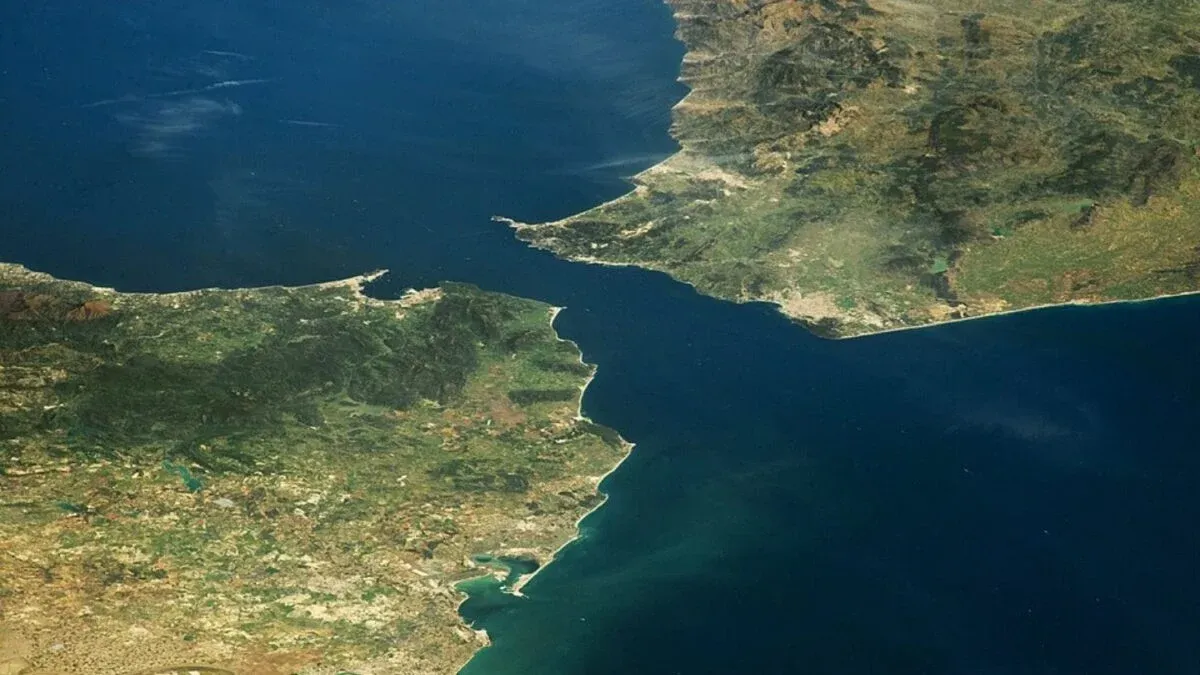

The idea of constructing a tunnel between Spain and Morocco has lingered in discussions for decades, evolving from a mere infrastructure proposal to what some might call a geographical obsession. This ambitious project has been repeatedly proposed, shelved, revived, and once again suspended in a limbo that characterizes grand ideas; they seem too logical to abandon, yet too complex to execute. On paper, the concept is undeniably appealing. Standing in Tarifa and gazing south, one might ponder how Europe and Africa can be so close, separated only by water. The straightforward answer, however, is that beneath this water lies a significant problem that has thwarted progress for years.
The primary adversary of the tunnel project has not simply been financial constraints or political will; rather, it is the unpredictability of the geological conditions beneath the Strait of Gibraltar. This issue has persisted as a more profound challenge than anticipated. It is crucial to clarify that the tunnel has not been definitively canceled, but it is far from being in the actual execution phase. In 2026, a noteworthy development arose when the Spanish government commissioned a new study from the CSIC to investigate the seabed at the Camarinal Sill, a critical area for the proposed route. This revelation does not bring the project closer to reality; instead, it underscores the lingering fundamental questions that remain unanswered.
When a project of this magnitude requires revisiting the seabed after 45 years of studies, reports, and promises, the message becomes clear: we still lack precise knowledge regarding whether the terrain can accommodate such a substantial construction without transforming it into a technical nightmare. At first glance, one might assume that the primary obstacle for an underwater tunnel between Spain and Morocco is its depth, and while this factor is indeed significant, it is not the most pressing issue. Historically, the proposed route avoids the most extreme points of the Strait and relies on the Camarinal Sill, where the seabed is relatively shallower, making it theoretically a more viable option for fixed connectivity. However, "shallower" does not equate to "easier".
Beneath the surface, engineers do not encounter a uniform, predictable, and accommodating rocky base. Instead, they face a delicate mixture of materials including Flysch complex, sandstone and clay layers, recent sediments, and areas where the geological behavior can change over remarkably short distances. This unpredictability poses a significant challenge for a subterranean project that spans dozens of kilometers. Constructing a tunnel involves more than just drilling; it requires maintaining a stable environment for decades, capable of withstanding pressure, moisture, deformations, leaks, and, in this case, seismic activity. The geological history of the Strait of Gibraltar does not invite relaxation, as this region is situated within a complex zone of tectonic interaction, part of a fracture system that connects the Azores, Gibraltar, and the western Mediterranean. This context serves as a constant reminder that the subsurface is not entirely dormant.
The devastating Lisbon earthquake of 1755 haunts discussions of significant infrastructure projects in this area, serving as a geological ghost that lingers in the background. While this does not render the tunnel impossible, it highlights a more critical point: if constructed, it will need to coexist with a region that is continually shifting. What makes this new phase of the project particularly intriguing is that it emerges at a time when the logic of the tunnel appears more attractive than ever. An electrified rail connection between Europe and Africa would offer immense benefits in terms of mobility, logistics, and emissions reduction. It could enhance trade exchanges, decrease reliance on ferries, and, theoretically, create a geopolitically and environmentally sensible infrastructure.
However, all of this hinges on a crucial prerequisite: the seabed must not turn the idea into a costly, delayed, and structurally risky endeavor. As it stands, we are not yet contemplating "what the tunnel will look like"; instead, we are still grappling with the question of "if the seabed will ever allow for its construction without incurring disproportionate costs." There is something almost symbolic in this narrative. The tunnel between Spain and Morocco has always seemed inevitable when viewed on a map. It is one of those ideas that appear so obvious that it is challenging to understand why it does not already exist. Yet, the Strait of Gibraltar has reminded us for decades that visual proximity does not always correlate with physical ease.
Europe and Africa are within sight of one another, yet beneath this seemingly brief passage lies one of the most challenging environments imaginable for a project of this scale. Therefore, while the project remains alive, it is ensnared in the same paradox that has persisted for decades: it is captivating enough to refuse to die, yet daunting enough to prevent it from ever being born. Perhaps one day, a train will traverse the depths of the Strait in just half an hour, and this idea will cease to seem like a geopolitical science fiction. However, if that day comes, it will not be merely because someone has conquered the distance; it will be because, at last, someone has managed to persuade the seabed of Gibraltar to allow passage.
As reported by es.gizmodo.com.