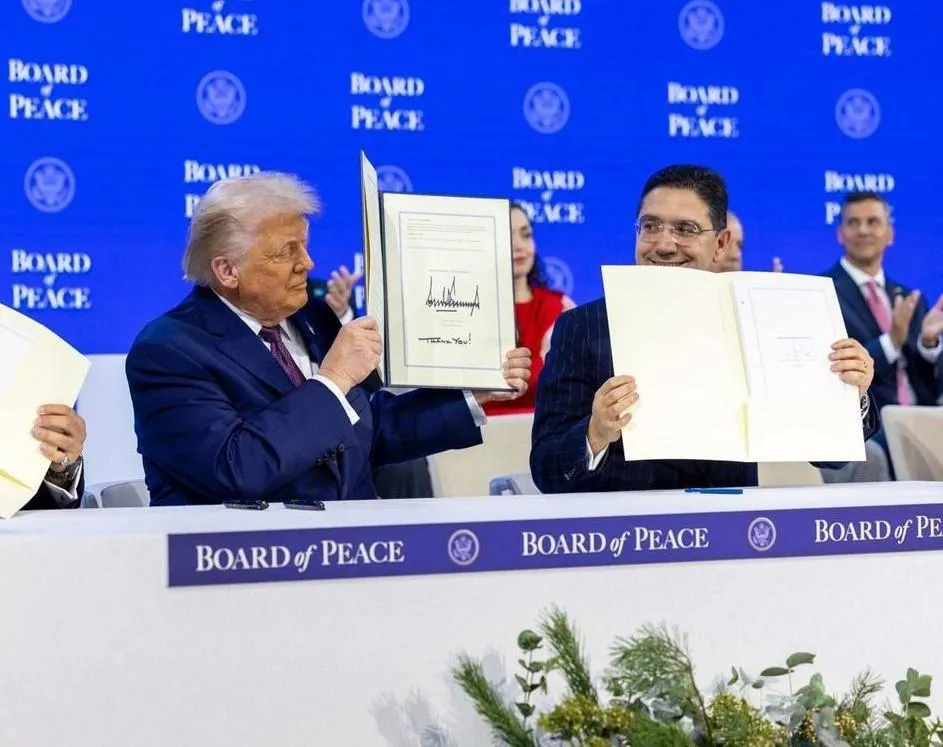
The ongoing discourse surrounding peace in the contemporary international system goes beyond merely addressing the cessation of conflicts; it now encompasses the entities that possess the authority to define, manage, and set the conditions for peace. In a moment marked by stagnation within the United Nations Security Council and a diminishing capability of the UN to enforce binding resolutions for conflict resolution, former President Donald Trump announced the establishment of a "Peace Council" during the World Economic Forum in Davos. This initiative introduces a new framework comprising select countries, including Morocco, signaling a shift in Washington's approach from managing conflicts through multilateral international legitimacy to crafting a selective political architecture driven by power and influence.
Morocco's inclusion in this arrangement is not merely a ceremonial detail; it serves as a powerful political signal regarding the redefinition of Morocco's role within American strategy as a regional player deemed capable of reshaping the power dynamics from the Middle East to the African Sahel. This development emerges against an international backdrop characterized by the declining efficacy of international institutions to produce actionable settlements, amid stark divisions between major powers and repeated failures to halt wars or impose political solutions, from Palestine to Ukraine, and Libya to the Sahel. In contrast, the United States is pivoting towards establishing parallel spheres of influence based on political and security alliances that operate outside conventional legal frameworks, enabling it to manage crises according to its strategic priorities, free from the constraints of international consensus.
The Implications of Morocco's Inclusion in the Peace Council
For Morocco, this membership opens a complex political landscape that transcends mere symbolic participation, leading to a genuine repositioning within the international power equation. Since the United States recognized Morocco's sovereignty over Western Sahara in December 2020, the Moroccan-American relationship has evolved from a traditional partnership to one with clear strategic implications. Morocco is no longer merely a regional ally; it has become a vital player in a broader American vision to reorganize the geopolitical landscape stretching from North to West Africa.
In this context, Morocco's integration into the "Peace Council" carries a dual significance. On one hand, it solidifies its status as a reliable political and security partner; on the other hand, it ties its participation in the new peace architecture to Washington's calculations regarding highly sensitive issues, chiefly the Palestinian cause, where Morocco maintains a unique status through its chairmanship of the Al-Quds Committee, alongside the Western Sahara issue, which remains officially under UN sponsorship. However, this step also raises questions that extend beyond Morocco itself, touching upon the nature of the international system that is unfolding before our eyes. Does the "Peace Council" signify the beginning of a tangible transition from a legal legitimacy-based international system to one founded on networks of influence? Does Morocco's inclusion reflect an acknowledgment of its role as an emerging regional power, or is it a reconfiguration of its role within an American strategy for conflict management that operates outside the frameworks that Washington can no longer fully control?
The Redefinition of International Roles and Morocco's Strategic Diplomacy
Historically, Morocco has relied on its position as an actor capable of navigating multiple levels: a strategic ally of the West, a partner within the Arab and African spheres, and a committed player adhering to UN references in conflicts. Nevertheless, participation in security and developmental arrangements crafted outside the UN poses the risk of redefining this position, potentially rendering Morocco, in the eyes of both partners and adversaries, a component of a US-led network of influence. The United States appears to be crafting parallel spheres of influence based on political and security alliances that allow it to manage crises according to its strategic priorities, unshackled from the constraints of international consensus. Morocco's inclusion is emblematic of deeper transformations, as the roles and functions of states are redrawn within a new international architecture that increasingly blurs the lines between peace as a legal value and peace as a tool in the balance of power.
U.S. Secretary of State Marco Rubio candidly articulated this approach, suggesting that the creation of the council was a response to the "impasses of traditional frameworks," asserting that the reconstruction of Gaza is not a negotiable political option but a necessity to prevent a resurgence of violence. In this framing, peace has shifted from being the outcome of a political settlement to an operational management of the material results of the conflict, essentially establishing a new reality on the ground upon which future development can be built. Furthermore, the U.S. representative to the UN, Mike Waltz, emphasized the operational aspect, mentioning the engagement of over seventy countries in the civilian-military command center and improved humanitarian supply indicators, indicating that this new legitimacy is built on the ability to implement rather than through decisions made by international institutions that are grappling with paralysis.
In this framework, Morocco's participation is not merely a symbolic gesture of an Arab nation in the reconstruction effort; it is part of a broader American vision to reorganize the network of reliable allies capable of managing conflicts outside UN channels. Over the past two decades, Morocco has cultivated a progressively strategic relationship with Washington, transforming from a traditional regional ally into a functional partner in regional security arrangements, leveraging its geographical position at the intersection of Europe and Africa, its internal stability compared to its regional context, and its ability to maintain balanced relations with competing parties in the Middle East and Africa.
Ultimately, Morocco's inclusion in the "Peace Council" represents an implicit recognition of its capacity as a partner capable of playing roles beyond its borders, whether through participation in reconstruction efforts or contributing to regional stability arrangements. This shift takes on special significance, particularly when viewed in light of the Western Sahara issue, which has long been a file under UN auspices but has seen a qualitative transformation with the U.S. recognition of Moroccan sovereignty over the territory in 2020. The transition of the U.S. to establish parallel frameworks for conflict management theoretically opens the possibility of transferring the handling of certain issues from the UN space, where power balances are distributed among multiple parties, to arenas led by political alliances more amenable to American influence.
In a world moving towards transcending UN centrality in favor of multi-level influence networks, peace itself becomes a domain for redistributing power. Within this transformation, Morocco's accession to the "Peace Council" appears less about Gaza's reconstruction alone and more about redefining its position within an international system that is taking shape against the backdrop of classical multipolarity.
As reported by assafirarabi.com.