
The United Arab Emirates (UAE) has reaffirmed its unwavering support for Morocco's autonomy initiative under its sovereignty, which they regard as the only realistic solution to the artificial conflict surrounding the Sahara. This assertion confirms a political stance that has remained steadfast over the years, as Rabat continues to rally international support for its proposal, which it presents as a pathway toward resolution. The significance of the Emirati position transcends the context in which it was announced, given the nature of the relations between Abu Dhabi and Rabat, characterized by political alignment, economic cooperation, and coordination on various regional and international issues.
The UAE's backing of Morocco regarding the Sahara issue is not a reaction to recent developments but rather a cornerstone of bilateral relations. This was concretely demonstrated when Abu Dhabi opened a general consulate in Laayoune in 2020, a move that clearly reflected the depth of Emirati support for Morocco’s position. The ties between the two nations showcase a remarkable degree of alignment on matters that pertain to their respective strategic interests. Over the years, Morocco and the UAE have maintained open political channels and increasing economic and investment cooperation, alongside close ties between their leaders.
Beyond a Simple Diplomatic Stance
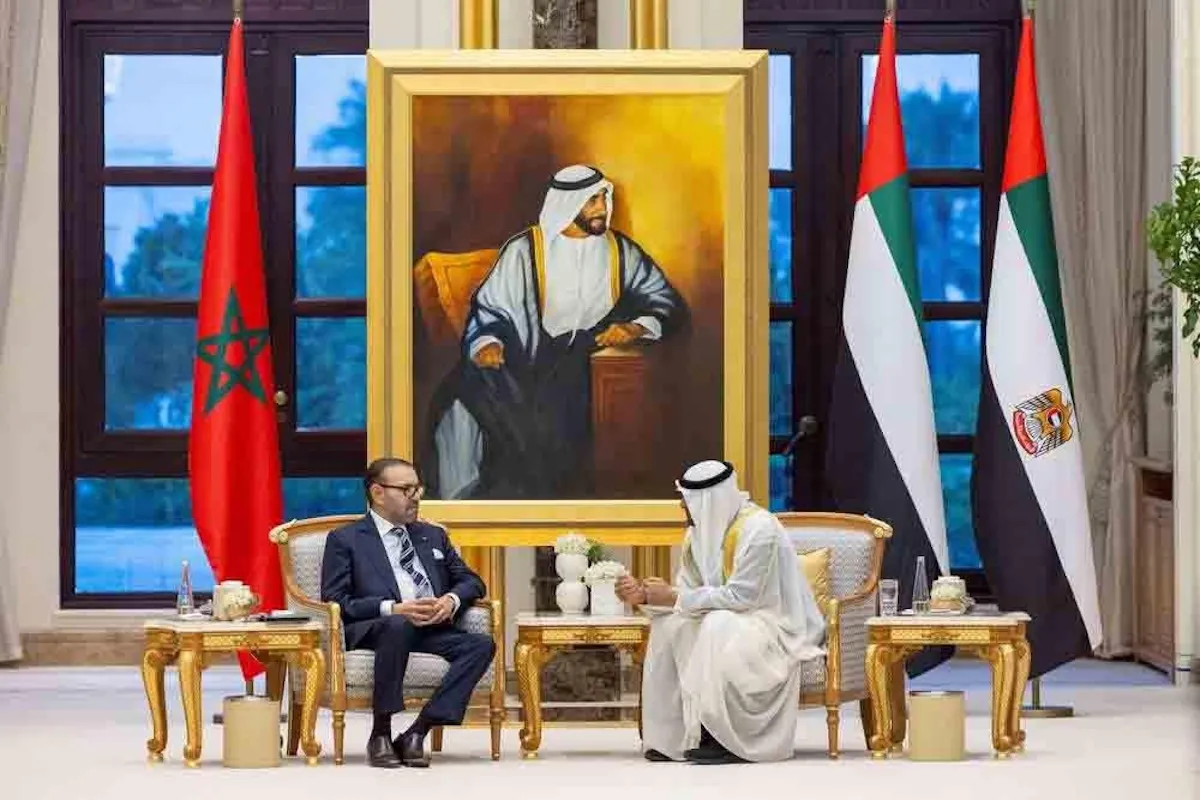
This rapprochement gained new momentum in December 2023 with the launch of a new partnership during King Mohammed VI's visit to the UAE, where he met with Sheikh Mohamed bin Zayed Al Nahyan. This meeting opened avenues for larger-scale projects and cooperation in strategic sectors. Consequently, the Sahara question fits within a broader relational framework rather than being an isolated issue. The Moroccan-Emirati rapprochement has progressively evolved from traditional political ties to a network of common interests encompassing investment, energy, infrastructure, and trade, alongside coordinated regional policies. This intersection endows the bilateral relations with greater sustainability, as they are increasingly grounded in concrete interests and projects linking both economies and expanding the scope of collaboration.
A Growing Circle of Support
The renewal of the UAE's position comes at a time marked by a notable expansion in the number of countries supporting the Moroccan autonomy initiative, although the diplomatic phrasing and stances vary from one capital to another. The United States recognizes Morocco's sovereignty over the Sahara and supports the autonomy proposal, while France has adopted a proactive stance asserting that the present and future of the territory fall under Moroccan sovereignty, with autonomy constituting the viable framework for the resolution process. In 2025, the United Kingdom also shifted towards a more favorable position on the initiative, viewing the Moroccan proposal as a credible and viable basis for arriving at a sustainable solution, while continuing to support the UN-led process.
Other countries from Europe, Africa, the Arab world, Latin America, and the Caribbean have rallied to these positions, making autonomy significantly more prominent in the international diplomatic discourse surrounding this artificial dispute compared to when Morocco first presented this initiative under its sovereignty in 2007.
However, the international support is not uniform, as there is a distinction between countries that recognize Moroccan sovereignty over the Sahara and those that view autonomy as a serious and realistic proposal or as an appropriate basis for negotiations. This nuance is essential for understanding the international context of the issue without conflating divergent positions under a single political label.
For years, Moroccan diplomacy has focused on broadening the support base for the autonomy initiative while strengthening its political and economic footprint in Africa and developing partnerships with Western powers, Gulf states, and several Latin American countries. This strategy has contributed to gradually evolving the debate on the Sahara: it is no longer about managing a prolonged conflict but about seeking the political formula capable of resolving it, with the Moroccan initiative becoming a central element of statements from an increasing number of capitals.
This does not imply that the disagreement over the future of the Sahara is resolved. The Polisario Front maintains its claim for self-determination and its separatist path with the support of Algeria, while the United Nations continues its efforts to achieve a political resolution based on UN Security Council Resolution 2797, adopted in late October 2025, which established the autonomy initiative as a realistic basis for building a political resolution to this artificial dispute. The persistent divergences among the parties make international positioning a decisive factor in steering the course of discussions, especially as Rabat seeks to solidify autonomy as a concrete basis for resolution, while its adversaries adhere to divergent approaches regarding the territory's future.
The position of the UAE once again reflects the unique bond that unites Abu Dhabi and Rabat. Support on strategic issues is no longer an exception in diplomatic relations but has become an integral part of a shared political and economic trajectory between the two countries. For Morocco, the sustained support from the UAE adds to a diplomatic capital that it seeks to develop around a national priority and a steadfast sovereignty. Meanwhile, the UAE maintains a strategic relationship with the Kingdom that extends to political, investment, and economic cooperation.
The growing support for autonomy places this issue in a distinct diplomatic phase compared to previous years. After decades of diplomatic impasse, the Moroccan initiative occupies a more significant place in the calculations of several international powers, while Rabat continues to bet on transforming this dynamic into momentum towards a political resolution. At the heart of this landscape, Moroccan-Emirati relations serve as a model for an alliance that has maintained great continuity, transforming mutual support on strategic issues into an extension of a partnership with growing interests, even as a definitive resolution to this artificial dispute remains tied to the UN-sponsored political process.
As reported by atalayar.com.